





HVAC marketing has one job: Produce profitable booked work at a cost your business can sustain.
That sounds obvious, but it’s easy to evaluate your marketing one step too early. You count website visits, clicks, impressions, form fills, and leads without connecting those numbers to the jobs that actually make it onto your schedule. A lead is only useful if the customer is in your service area, needs work you want, can be reached, books the appointment, and produces enough revenue to justify what you spent to acquire it.
That’s why effective HVAC marketing hinges on deciding which channels fit your business now, what each one is supposed to accomplish, what comes next, and how you’ll know whether any of it is working. The channels below aren’t ranked by popularity. Each one is broken down by what it costs, what it’s good at, what to measure, and where it fits depending on your stage, with the specifics on how that shifts as you grow covered further down.
What HVAC Marketing Actually Has to Do
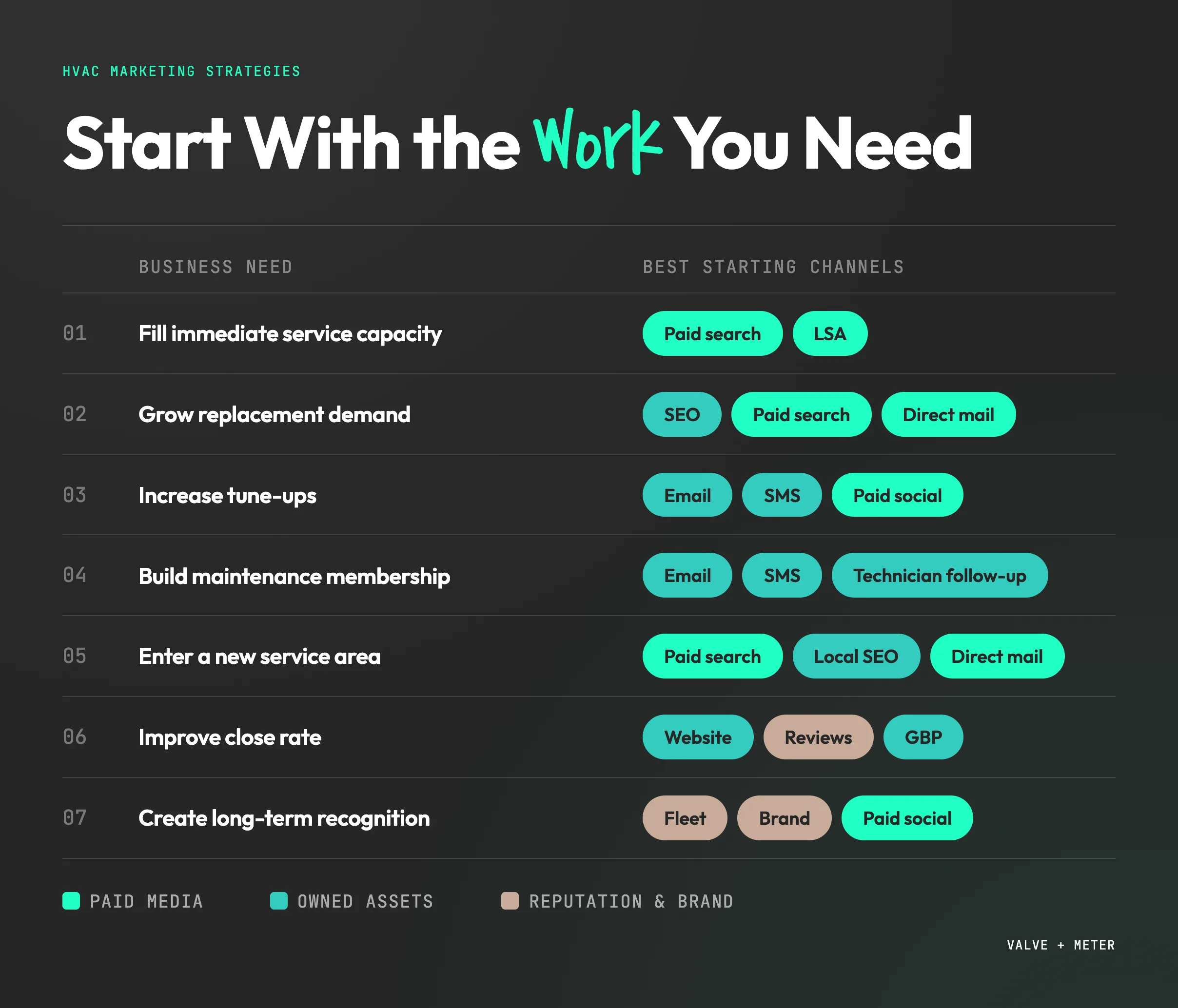
Your marketing can’t be separated from the operation it’s feeding. A business with 10 open installation slots has a different problem than one whose install crews are booked for three weeks but whose service board is thin. Growing replacement revenue calls for a different channel mix than building maintenance agreements or keeping technicians productive during shoulder season.
Before you choose channels, define what work you actually need. That starts with a few practical questions:
- Do you need more service calls, replacements, tune-ups, or maintenance-plan enrollments?
- Which service lines produce your strongest margins?
- Which geographic areas can your team serve efficiently?
- How many additional jobs can your operations absorb?
- What does seasonality do to that capacity?
- What percentage of qualified calls does your team actually book?
- What can you afford to pay for a booked job?
A channel that produces 100 calls isn’t necessarily better than one that produces 50. If the first produces low-value, out-of-area, or poorly qualified calls while the second fills installation slots with profitable work, the smaller number is worth more to your business. That’s the standard the rest of this article is built around: Connecting marketing activity to calls, booked jobs, and revenue, not treating traffic or lead counts as the final measure.
The Marketing Channels That Book HVAC Jobs
A strong HVAC marketing program does a few different things: Catches demand that’s already searching for you, stays visible before the need shows up, converts people once they reach you, and brings past customers back. To accomplish all that, not every channel needs to run at once. You just need the right ones in the right order.
Local SEO
Local SEO is what puts your business in the map pack and organic results when someone searches “AC repair near me.” The goal is to gain more visibility for your brand in the searches that turn into calls from homeowners your technicians can serve. That takes more than city names inserted into web pages; your site, service pages, local content, Google Business Profile, reviews, and technical foundation all need to reinforce what you do and where you do it. A full breakdown of what that build looks like is in local SEO strategies for HVAC companies.
What to Measure: Rankings for priority service-and-location searches, qualified organic calls and forms, booked jobs attributed to organic traffic, and cost per booked job once SEO costs are allocated to the channel.
What a Good Number Looks Like: There’s no universal ranking or traffic target that proves this is working. A good result is growing visibility for the services and markets you want while cost per booked job stays viable. Don’t count it a win because traffic rose 40% if that traffic isn’t producing the work you need.
Website and Conversion
Your HVAC website doesn’t create much value by simply existing. It needs to convert the attention generated by search, paid ads, referrals, direct mail, fleet visibility, and social media into a call or a form. That means a homeowner should quickly understand:
- What you do
- Where you work
- Why your company is credible
- How to reach you
- What the next step is
Mobile usability, load speed, service-page structure, and clear calls to action all decide whether that traffic becomes a phone call or gets lost. What separates a site that converts from one that doesn’t is covered in HVAC website examples.
What to Measure: Calls and forms by landing page, traffic-to-lead conversion, qualified lead rate, booking rate, and booked jobs by page or source where attribution allows.
What a Good Number Looks Like: Improvement should show up downstream. A higher conversion rate is valuable when it produces more qualified calls and booked work from comparable traffic. Your website is also one of the first places to check before adding more paid spend; sending more traffic to a site that consistently loses ready-to-book homeowners compounds the problem instead of fixing it.
Paid Search
Paid search lets you compete immediately for high-intent searches instead of waiting for organic visibility to build. Someone searching “AC repair near me” at 4 p.m. on a 95-degree day is close to a decision. HVAC advertising through paid search works best when aimed narrowly at:
- High-value services
- Specific zip codes
- Dayparting around when calls actually convert, rather than running broad across every service in every zip code around the clock
It’s especially useful when you need demand faster than SEO can build it, a priority service line has open capacity, you’re entering a new service area, or a seasonal window is worth capturing quickly.
What to Measure: Search terms, qualified calls and forms, lead cost, booking rate, cost per booked job, and average booked-job value by campaign and service line.
What a Good Number Looks Like: Cost per booked job should stay below what you can economically afford for that work, a number that depends on job value, margin, and close rate. A cheap lead isn’t a win if nobody books it.
Google Local Services Ads
Local Services Ads (LSA) run on a pay-per-lead model instead of a pay-per-click one. You bid on specific terms and only pay for qualified leads, not for clicks that never turn into a call. HVAC LSAs currently average $45 to $85 per lead with a 31% conversion rate, which makes cost per booked job easier to calculate up front than most other paid channels. The simplicity of paying per lead can make LSA look easy to evaluate. It isn’t; you still need to separate calls that match your service area and the services you actually offer from duplicate contacts and calls that never turned into an appointment.
Getting a strong result from this channel takes:
- Balancing LSA spend against broader paid search, rather than replacing it
- Keeping reviews consistent since they directly influence LSA ranking
- Budgeting around the lead volume your team can realistically handle
- Targeting specific high-profit services and areas instead of casting a wide net
What to Measure: Charged leads, valid leads, contact rate, booking rate, disputed-lead recovery, and cost per booked job.
What a Good Number Looks Like: The channel is working when booked jobs, not just charged leads, come in at a cost that meets your unit economics. If LSA looks cheap at the lead level but the calls routinely fail to book, that apparent efficiency disappears.
Google Business Profile
For many HVAC searches, your Google Business Profile is where the homeowner decides which company to call. Categories, services, photos, reviews, and profile activity all shape how you appear and whether someone chooses you. GBP and local SEO are closely connected but shouldn’t be treated as identical. Your website helps Google understand your services and markets, while your profile gives Google and homeowners another local signal and another path to reach you.
Left unclaimed or half-filled out, a weak profile undercuts every dollar you spend on paid channels sending traffic toward a results page where your listing looks incomplete next to a competitor’s.
What to Measure: Map visibility for priority searches, GBP calls, review velocity, and booked jobs tied to GBP calls.
What a Good Number Looks Like: Better map visibility should translate into more qualified calls from the areas you want. If profile interactions rise but booked work doesn’t, look at call quality, reviews, and what happens after contact.
Paid Social
Paid social generally reaches customers at a different point than paid search. A homeowner may not be actively searching for HVAC service when your ad appears. That makes it useful for building local awareness, promoting seasonal services, retargeting past website visitors, and staying visible before demand becomes urgent, rather than driving a same-day call the way paid search or LSAs do.
Judging paid social only by last-click leads can undervalue a channel that influences demand earlier in the decision. At the same time, awareness can’t become an excuse for spending you can’t measure.
What to Measure: Qualified inquiries, retargeting performance, booked jobs attributable to campaigns where possible, and cost per booked job for direct-response campaigns.
What a Good Number Looks Like: For direct-response social, the same economic test applies: Can the channel produce booked work at an acceptable cost? For awareness campaigns, define the market, frequency, and business outcome you’re watching for before you spend, not after.
Email and SMS
A past customer already knows your company, which makes your customer database one of the most valuable audiences you can neglect. Email and SMS can support seasonal tune-up reminders, maintenance-plan promotion, unsold-estimate follow-up, customer reactivation, and review requests, all at a cost far below any paid channel because you’re not paying to reach someone cold.
This channel gets more valuable the larger your customer base grows. A company with 20,000 past customers has an asset a newer competitor simply doesn’t have.
What to Measure: Booked appointments, reactivated customers, maintenance-plan enrollments, revenue by campaign, and unsubscribes.
What a Good Number Looks Like: Revenue and booked work should justify the relatively low cost of reaching your existing list without damaging engagement through excessive or irrelevant messages. Open rates and click-through rates help diagnose a campaign; they aren’t the final result.
Direct Mail
Direct mail gives you control over geography and audience in a way many digital channels don’t. You can target neighborhoods around existing jobs, homes that fit replacement criteria, or an audience tied to a seasonal offer. A cost breakdown by format and volume is in how much HVAC marketing costs. It’s particularly useful when your geographic strategy is precise. Building density in a profitable neighborhood often returns more than spreading impressions across an entire service area.
What to Measure: Response by list and creative, calls, booked jobs, cost per booked job, average ticket, and geographic performance.
What a Good Number Looks Like: A campaign should generate enough gross profit from booked work to justify creative, printing, postage, and list costs. Response rate alone isn’t enough. One campaign can have a lower response rate and still be more profitable because it generates higher-value jobs.
Reviews and Referrals
Reviews affect two separate parts of your marketing: They strengthen local visibility, and they influence whether a homeowner chooses you after finding you. That makes reputation both a search and a conversion issue. Referrals work differently but depend on a customer willing to put their name behind yours. Neither should be treated as passive. Build a process for asking every completed job for a review, responding to reviews, and requesting referrals at the right moment rather than hoping both happen on their own.
What to Measure: Review volume and velocity, average rating, referral lead volume, referral booking rate, and booked jobs from each source.
What a Good Number Looks Like: Your review profile should stay competitive within your local market and keep generating new, legitimate feedback. Referral leads should convert strongly enough to justify whatever program supports them. The review count that actually matters depends on the competitors around each of your locations.
Brand and Fleet
Not every channel is built to capture someone who needs service right now. Your brand creates recognition that makes every other channel work harder later. A homeowner may see your trucks, direct mail, and digital ads repeatedly before their system fails, and when the need finally arrives, your company isn’t a complete unknown.
Fleet graphics carry extra weight here because your vehicles already spend their days in the neighborhoods you want to serve. What a rebrand does and doesn’t change for a company already running other channels is covered in does HVAC branding actually book jobs.
What to Measure: Branded search volume, direct traffic, calls mentioning your trucks or other brand exposure, and changes in conversion or acquisition efficiency across channels after a rebrand or brand push.
What a Good Number Looks Like: Brand investment should make customer acquisition easier over time. Because attribution here is less direct, decide what you’ll watch for before the campaign launches rather than building the success story afterward. Branding isn’t a substitute for demand generation; it makes existing demand easier to convert, and it’s the channel most companies cut first under budget pressure, then wonder why every other channel’s numbers softened without an obvious cause.
Which Channels to Run First
The right marketing channels for HVAC businesses aren’t fixed; they change as your revenue does. The best next investment for a $1 million company isn’t the best next investment for a $15 million one.
Sequencing matters because every new channel adds demands on budget, tracking, call handling, and management. Running the wrong mix for your stage is the difference between a plan that compounds and one that just adds cost.
The stages below are a framework, not a rigid formula. Your geography, margins, service mix, and growth goals can move individual channels earlier or later than the ranges suggest. The order itself is the one lever most companies get wrong, and it’s not something to cut for the sake of a shorter plan.
Around $1 Million: Build the Demand-Capture Foundation
At this stage, you usually don’t need ten active channels running. You need a few that reliably put qualified opportunities in front of your business: A website that converts, a complete and actively managed Google Business Profile, local SEO targeting your core services and area, paid search or LSA when you need faster lead flow, and a deliberate review-request process.
The key is concentration. It’s easy to spread a smaller marketing budget so thin across social media, direct mail, SEO, paid search, and other experiments that no single channel has enough resources to work. Build the core demand-capture system first, and get basic attribution in place. You want to know which calls came from paid search, organic search, GBP, and referrals, before adding more channels on top of a system you can’t yet measure.
Around $5 Million: Diversify and Build Leverage
At $5 million, you likely have a larger customer database, more branded search demand, more reviews, and more fleet exposure than you did at stage one, enough marketing volume to see real patterns in what’s working.
This is where diversification starts paying off. Keep strengthening the core SEO, GBP, website, paid search, and LSA programs, and start layering in email and SMS for retention, direct mail targeted at high-value neighborhoods, paid social and retargeting, and more systematic reputation and referral programs.
Optimization starts mattering as much as volume here. If paid search produces plenty of leads but your booking rate is poor, fixing call handling may generate more revenue than raising the ad budget. If a service area produces expensive jobs with thin margins, more leads there isn’t growth.
Around $15 Million and Multi-Location: Manage a Portfolio
At $15 million, or across multiple branches, your marketing has to support a more complex system. A channel that performs well in one location can underperform in another because competition, brand recognition, technician capacity, and service mix differ market to market. The focus shifts toward market-by-market budget allocation, capacity-based media management, brand consistency across locations, and centralized measurement.
You’re no longer asking whether paid search works. You’re asking where the next $25,000 of paid search produces the highest incremental value without overwhelming your technicians. That level of decision-making depends on integrated data. The larger your business gets, the less useful channel reports in isolation become.
The One Exception to the Sequence
Local SEO is the one channel that doesn’t move with revenue stage. Start it in stage one regardless of budget, because it takes months to build and no later budget increase closes that gap faster than starting earlier would have. If you’re waiting until you’re bigger to begin, you’re already behind on a channel with a multi-month lead time.
Review your channel mix against your stage at least once a year rather than assuming it still fits. A channel you added 18 months ago and never revisited is a channel that may no longer earn its place in the budget, and the two rarely stay aligned as cleanly as a set-it-and-forget-it plan assumes.
How to Tell Whether Your HVAC Marketing is Working
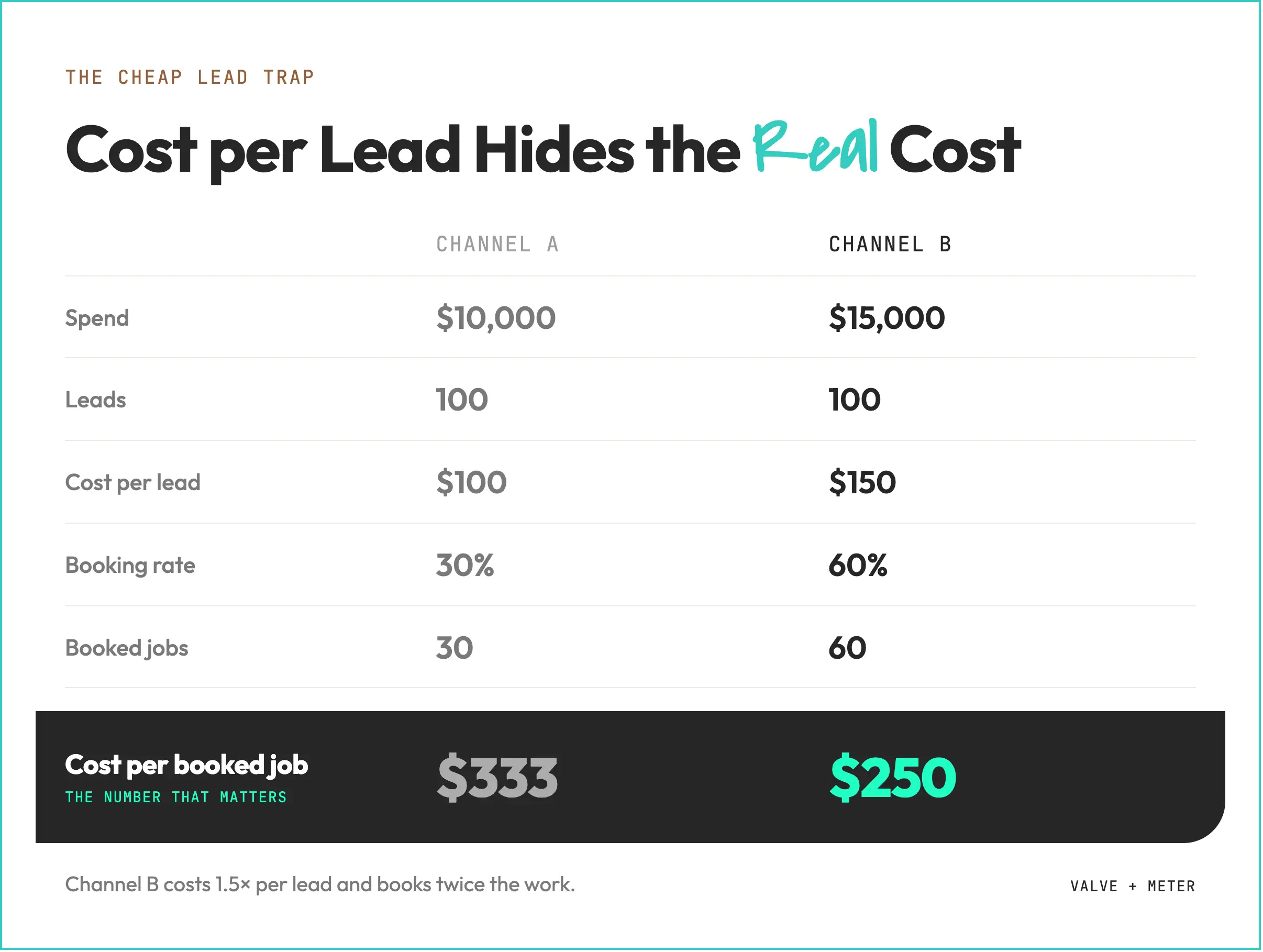
The measurement problem usually starts with the wrong denominator. You’re often shown cost per lead because it’s the easiest number to calculate. Spend $10,000, generate 100 leads, and the cost per lead is $100.
Now compare two channels. Channel A costs $100 per lead, generates 100 leads, and books 30 jobs. Channel B costs $150 per lead, generates 100 leads, and books 60 jobs. Channel B looks worse if the report stops at lead cost. It looks much better once you calculate booked work, since it produced twice the jobs for one and a half times the spend per lead. The point of measurement is to understand what’s actually creating business for you, not make a channel look efficient.
Measure Cost Per Booked Job
At minimum, connect each important channel through spend, inquiry, qualified opportunity, booked appointment, completed job, and revenue. That’s the only way to compare the cost of your marketing channels against the outcome your business actually needs: booked jobs.
An acceptable cost per booked job depends on the economics of the service. A $250 maintenance visit, a $900 repair, and a $12,000 replacement can’t support the same acquisition cost, which is also why blended reports can hide what matters. If one campaign generates cheap service calls and another generates expensive replacement opportunities, comparing them only on aggregate lead cost can lead you to cut the more valuable one.
Call Tracking Matters Here
Phone calls remain a major conversion path for HVAC, and without source-level tracking, a real portion of your marketing attribution disappears. But don’t stop at the call itself; a 90-second conversation could be a booked replacement estimate or a vendor solicitation, and the difference only shows up once the call is classified.
Connecting that data into your CRM or field-service platform closes the loop, so the marketing source follows the customer through to the appointment, the job, and the revenue it produced.
Give Channels Enough Time to Produce a Real Read Before Judging Them
Paid search generates data quickly. SEO develops more gradually. Direct mail may need repeated drops before a pattern shows up. Brand investment can influence performance across every other channel without ever producing a clean last-click conversion. None of that means every decision should wait four months. You should react quickly to obvious waste, but you should also set an evaluation window for each channel before deciding whether it worked, rather than judging a long-term investment by a three-week read.
Compare Revenue, Not Just Volume
Two campaigns can produce the same number of booked jobs and very different value to your business. Track service type, average ticket, revenue, location, and whether the customer is new or returning alongside the raw booked-job count. That’s where your marketing data turns into something you can actually run the business on.
When to Bring in Outside Help
You don’t need an outside agency simply because your marketing spans multiple channels. Plenty of HVAC companies manage a meaningful share of it internally. The need for outside help usually gets clear once complexity outpaces your ability to manage, measure, or improve the system. A few signs worth paying attention to:
- Nobody on your team can explain which channels are actually producing booked jobs.
- Different vendors report different versions of the same performance.
- Marketing decisions get made on lead counts instead of booked jobs.
- Paid campaigns run with no connection to technician capacity.
- SEO, paid media, your website, and your CRM operate independently of each other.
- You’re still personally making routine channel decisions that should be running on their own by now.
- Growth has stalled despite spending more.
None of that means the person or vendor currently handling it is doing bad work. It usually means the system has grown too complex to manage in pieces.
That’s the point worth bringing in help, whether that’s a plan built around where your business actually is or ongoing management from a team that works with HVAC companies specifically and can connect channel strategy to your operations, attribution, and revenue rather than just adding more activity. Valve+Meter’s work with HVAC companies covers both.
Frequently Asked Questions
What is HVAC digital marketing?
HVAC digital marketing uses online platforms and digital tools, search, paid ads, social media, and email to promote your heating and cooling services and generate leads you can trace back to a campaign, as opposed to traditional channels like print or radio that are harder to measure against actual booked jobs.
How do I market my HVAC business?
Start with a well-designed, mobile-friendly website and a complete Google Business Profile; both are foundational to every other channel. Then layer in channels in the order that matches your current revenue stage, near-term lead channels first, longer-payoff brand work once those are covered. Trying to run the full list from day one usually means every channel is underfunded and none of them produce a clear result.
How do I get more customers for my HVAC business?
Combine channels that work at different speeds rather than relying on one: local SEO and social media build visibility over time, targeted paid ads and Local Services Ads produce near-term calls, and direct mail lets you target specific neighborhoods digital channels can’t reach as precisely. Add reviews and referrals on top, and your existing customers become a lead source that costs less than any paid channel. The combination matters more than any single channel, since each one covers a gap the others leave.
How do trade shows and local events fit into HVAC marketing?
Local home expos, trade shows, and community events put your business in front of homeowners face-to-face, which builds credibility that digital channels can’t replicate on their own. They also open the door to partnerships with complementary local businesses, electricians, plumbers, roofers, and a read on industry trends worth watching by talking directly with other attendees. They’re a smaller, slower channel, better suited to a business with its near-term lead channels already covered.
How much should I spend on HVAC marketing?
There’s no universal percentage that fits every HVAC business. Your investment should reflect your growth goals, competitive intensity, service-area size, margins, and the economics of acquiring different types of work. The more useful question isn’t what percentage you should spend; it’s what you can afford to spend to acquire profitable work, and where the next dollar produces the strongest return.
Do I need social media for my HVAC business?
Social media can support local recognition, seasonal messaging, and brand reinforcement, but it doesn’t automatically belong ahead of high-intent demand channels. If you’re hard to find on Google, your website is weak, and calls aren’t being tracked or answered well, posting more often on Facebook probably isn’t your first constraint to fix. Channel priority should follow what your business actually needs next.
Build the Channels in the Order Your Business Needs Them
HVAC digital marketing becomes complicated when channels are added faster than the business can evaluate them.
More tactics do not automatically produce more growth. Start with the work you need to book. Make sure homeowners can find you. Make sure the website and phone process convert them. Use paid channels where you need faster demand. Build retention as the customer base grows. Add awareness and brand channels as the business develops enough scale to benefit from repeated exposure. Then measure the entire system back to the job.
That is what turns HVAC marketing from a collection of activities into a growth engine.
If you can’t clearly see which channels are creating booked work and where the next marketing dollar should go, request a free marketing assessment. Valve+Meter can identify where demand, conversion, attribution, or channel sequencing is limiting growth.