




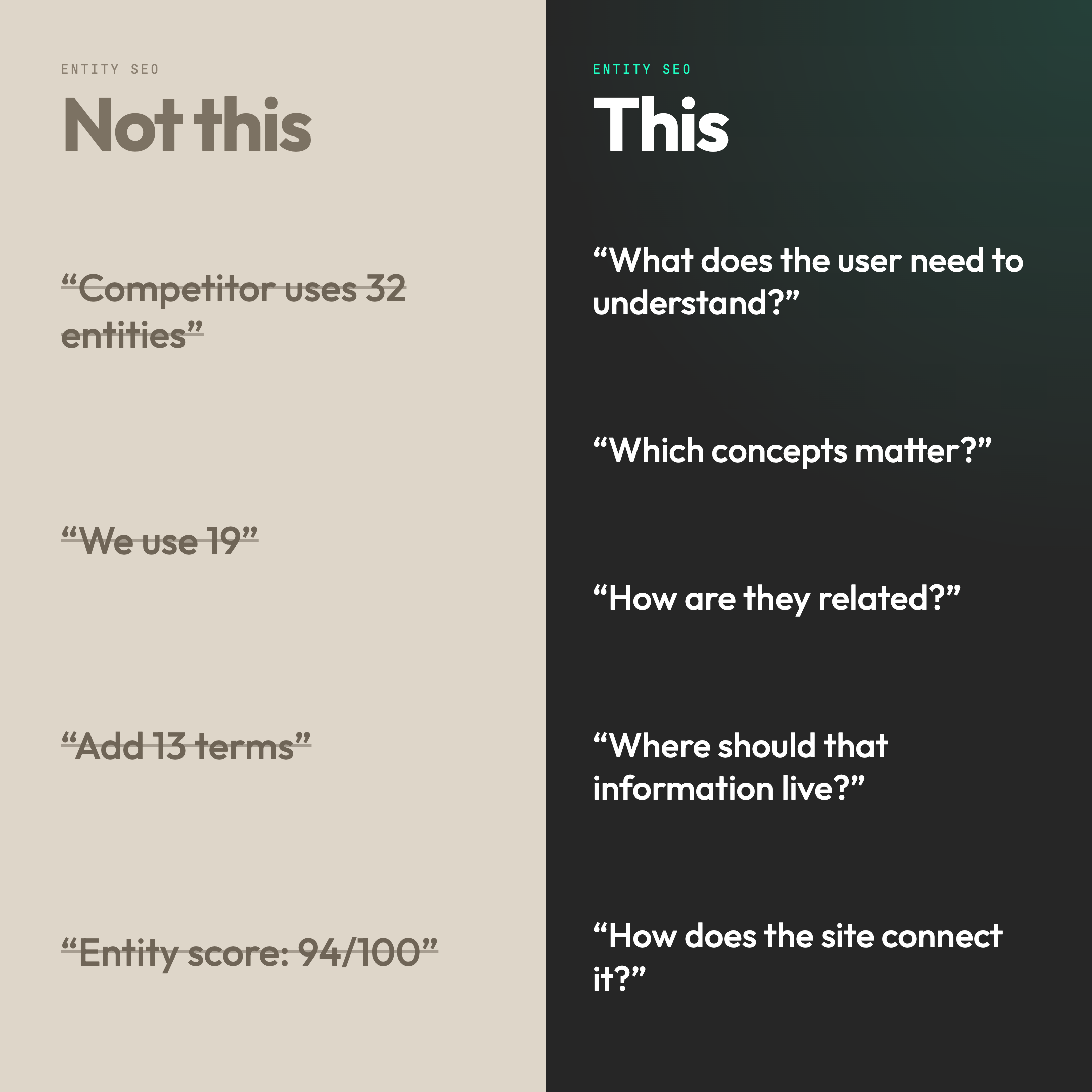
Keywords still matter in SEO. But keywords alone are no longer a very good model for understanding how search engines interpret the web.
Modern search engines increasingly try to understand things, concepts, people, places, organizations, products, services, and the relationships between them. In SEO, we generally refer to these recognizable concepts as entities.
That distinction changes how we should think about optimization.
Entity SEO is not about finding another list of terms to sprinkle into a page. It is about making the subject of your content unmistakably clear, establishing how important concepts relate to one another, and helping search engines understand why your website or business is a credible source on the topic.
In this guide, we’ll explain what SEO entities are, how they differ from keywords, how search engines use entity relationships, and how marketers can apply entity thinking to content, site architecture, structured data, and broader search strategy.
Key Takeaways
- Entities do not replace keywords. Keywords reveal how people search; entities help search engines understand what those searches and the resulting content actually mean.
- Entity SEO is primarily about relationships, not entity density. Mentioning more related concepts does not automatically make a page better.
- Context matters. Search engines need to understand not only which entities appear on a page, but how those entities relate to one another.
- Site architecture and internal linking can reinforce entity relationships across an entire website, not just within individual pages.
- Structured data can clarify meaning, but it does not create authority on its own.
- Your business itself is an entity. Consistent signals about your organization, people, services, locations, and expertise can matter just as much as the entities discussed within your content.
- Good entity optimization should make content more useful to people first. If adding an entity does not improve the explanation or reduce ambiguity, it probably does not belong there.
What Are SEO Entities?
An SEO entity is a distinct concept or thing that a search engine can recognize independently of the words used to describe it.
Entities can include:
- People
- Businesses
- Places
- Products
- Services
- Events
- Organizations
- Topics
- Objects
- Ideas
Consider a phrase like “apple.”
Without context, it could refer to a fruit or Apple Inc. Those are two different entities that happen to share the same word.
If the surrounding content discusses iPhones, Tim Cook, macOS, and Cupertino, the intended entity becomes clear. If it discusses orchards, nutrition, varieties, and recipes, it means something entirely different.
This is one reason entities matter.
Search engines are not merely trying to match the words in a query with the same words on a webpage. They are trying to determine what the searcher means and which information best satisfies that intent.
Entities vs. Keywords: What’s the Difference?
Keywords are the words and phrases people use when searching.
Entities are the concepts those words represent.
The distinction is important, but it would be a mistake to conclude that entity SEO has replaced keyword research.
It hasn’t.
Keyword research remains one of the best ways to understand:
- What people search for
- How they describe their problems
- Which topics have meaningful demand
- How search behavior differs across stages of the customer journey
- Which variations of a concept matter to an audience
What keywords cannot always tell us is how all those concepts fit together.
For example, someone researching heat pump repair might also encounter concepts such as:
- Compressor
- Refrigerant
- Reversing valve
- Air handler
- Auxiliary heat
- Defrost cycle
- Outdoor temperature
- HVAC technician
Simply adding those terms to a page does not make the content authoritative.
What matters is whether the content accurately explains their relationships.
A useful way to think about the distinction is:
Keywords tell us how people ask. Entities help describe what they are asking about.
The strongest SEO strategies use both.
Why Entities Matter in Modern Search
Search engines have steadily become better at understanding language, context, and the relationships between concepts.
Google’s Knowledge Graph is one visible example of this approach. Rather than treating information as an enormous collection of disconnected strings, the Knowledge Graph connects recognizable entities with attributes and relationships.
For example, a search engine might understand that:
- A person works for a company.
- A company operates at a particular location.
- A product belongs to a particular category.
- A city is located within a particular state.
- A service is offered by a particular business.
That network of relationships gives search engines context.
Consider a branded search for Valve+Meter.
The phrase itself contains common English words. But when the search engine recognizes Valve+Meter Performance Marketing as a business entity, it can associate that name with information about the organization rather than interpreting the query literally as a valve and a measuring device.
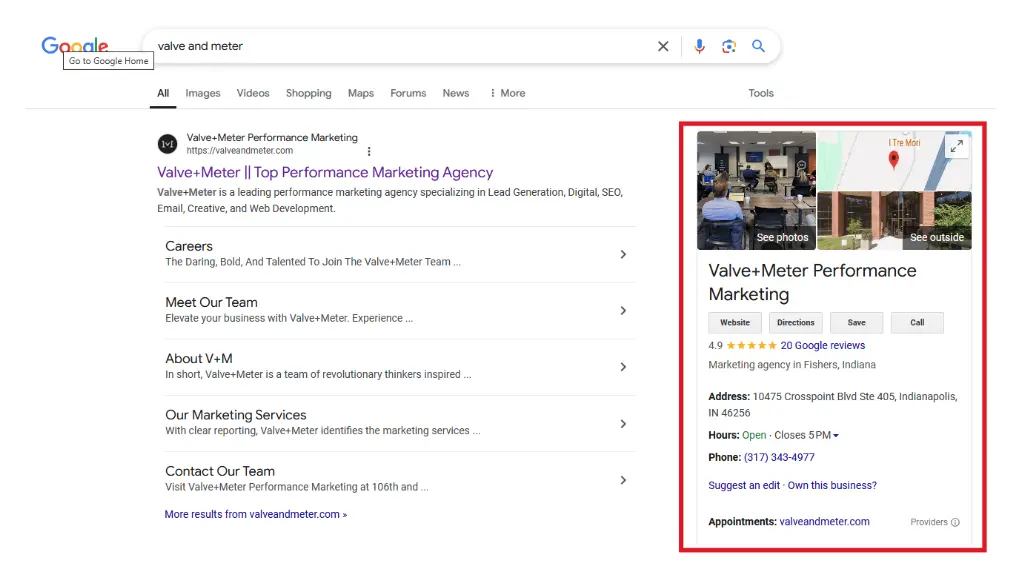
That is entity understanding in practice.
For marketers, the important lesson is not simply that “entities matter.”
It is that search engines increasingly evaluate information in context.
Entity SEO Is About Relationships, Not Entity Density
One of the easiest ways to misunderstand entity SEO is to turn it into another form of keyword optimization.
A tool identifies 35 related entities. A competitor mentions 29 of them. Your page mentions 17.
Therefore, the recommendation becomes: add the missing entities.
That may occasionally improve a page, but it is not much of a strategy.
A page can mention dozens of relevant nouns while saying almost nothing useful about them.
The more important question is:
What relationships must a reader understand in order to fully understand this subject?
For example:
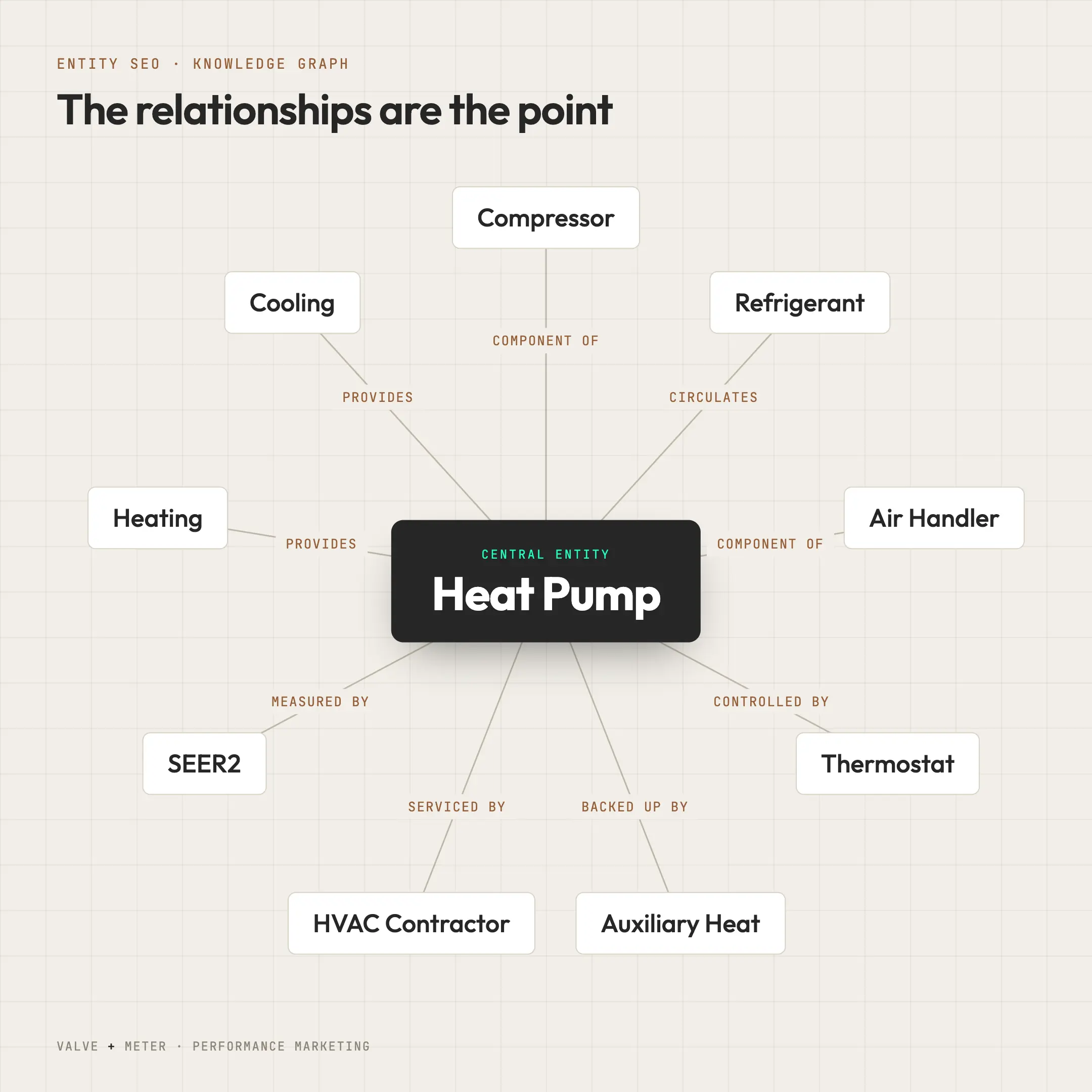
- A compressor is a component of an air conditioning system.
- Low refrigerant can cause an evaporator coil to freeze.
- A heat pump can provide both heating and cooling.
- A heat pump may be an alternative to a gas furnace, depending on the home and climate.
Those relationships communicate meaning. This leads to a principle we use when evaluating entity opportunities:
Don’t optimize for entity count. Optimize for clarity and completeness.
If an entity helps explain the subject, answer the user’s question, distinguish between similar concepts, or provide necessary context, include it. If it does none of those things, its presence is unlikely to make the content better.
How Search Engines Identify Entities
Search engines can use many different signals to understand entities. Natural language processing, machine learning, structured databases, structured markup, links, surrounding text, and other contextual information can all contribute to entity recognition.
Natural Language Processing
Natural language processing, or NLP, allows computers to analyze human language and identify meaningful components within text.
NLP systems can recognize things such as:
- People
- Organizations
- Locations
- Products
- Dates
- Events
- Categories
- Relationships
More importantly, modern language processing can use surrounding context to help determine which entity a word or phrase refers to.
For SEO professionals, NLP tools can be useful for examining how concepts appear within content and identifying topics or relationships that may be underdeveloped.
They should be treated as research tools, however—not as instructions for writing.
Google’s Knowledge Graph
Google’s Knowledge Graph organizes information about recognizable entities and their relationships.
It helps Google connect information such as a business with its founders, a person with an occupation, a landmark with a city, or a product with its manufacturer.
SEO professionals can use Knowledge Graph results as one source of insight when researching how Google appears to understand a subject.
But the Knowledge Graph should not be mistaken for a complete inventory of every concept Google understands.
Wikipedia and Wikidata
Wikipedia and Wikidata can be useful resources for entity research because they organize information around distinct subjects and relationships.
Wikidata, in particular, stores structured information about entities, their attributes, and their relationships to other entities.
For topics well represented in these databases, they can help researchers:
- Clarify terminology
- Identify related concepts
- Understand parent-child relationships
- Distinguish between ambiguous entities
- Discover important attributes associated with a subject
Their usefulness depends heavily on the subject. A nationally known company or scientific concept is more likely to have extensive structured information than a local HVAC contractor or niche commercial service.
Specialized Entity Databases
Other databases can provide useful entity information within particular industries.
For example, business-focused resources may help establish relationships between companies, executives, industries, acquisitions, locations, and brands.
The specific database matters less than the goal:
Use reliable sources to understand the subject and its relationships—not simply to create a longer list of terms.
How to Conduct Entity Research for SEO
Entity research should begin with the subject and the searcher’s needs, not with a tool.
A practical research process can include several layers.
1. Start With the Primary Entity
Identify the central subject of the page. For example:
- “Heat pump”
- “Chapter 7 bankruptcy”
- “Copper repiping”
- “Roof replacement”
- “Water softener”
Then ask what someone needs to understand about that primary entity to satisfy the intent behind the search.
2. Identify Important Related Concepts
Next, identify entities that directly contribute to understanding the topic. For a heat pump page, that might include:
- Compressor
- Refrigerant
- Air handler
- Thermostat
- Outdoor unit
- Auxiliary heat
- SEER2
- HSPF2
For another type of page, the entity set will look completely different. The goal is not comprehensiveness for its own sake. It is to identify the concepts necessary to explain the subject well.
3. Define the Relationships
This is the step many entity SEO exercises skip. Ask how the entities relate.
Is one:
- A component of another?
- A cause of another?
- A symptom?
- An alternative?
- A prerequisite?
- A location?
- A person associated with an organization?
- A service provided by a business?
- A broader or narrower category?
Relationships often reveal what the content actually needs to explain.
4. Analyze Search Results and Competitor Content
Competitor analysis can uncover concepts that strong-ranking pages consistently address. Look beyond whether a competitor simply mentions a word. Evaluate:
- What questions are they answering?
- Which concepts receive significant explanation?
- What relationships are they describing?
- Which subtopics appear repeatedly across strong results?
- Where does the existing search result set leave questions unanswered?
The final question is especially important. Entity research should not merely help you imitate what already ranks. It should help you identify where you can produce a more useful answer.
5. Use NLP and Entity Tools as a Check
Once you understand the topic conceptually, NLP and entity extraction tools can help identify omissions. They may reveal a related concept you overlooked or show that competing pages consistently discuss a particular subtopic. Treat this as a diagnostic step.
A tool saying an entity is “missing” does not mean the entity automatically belongs in the article. Editorial judgment still matters.
Creating Content Around Entities
Good entity-focused content usually does not look radically different from good content. It is accurate. It is well organized. It covers the concepts necessary to understand the subject. And it explains how those concepts fit together.
The difference is largely in how you plan the content. Instead of beginning with “How many times should this keyword appear?” you begin asking “What does someone need to understand about this subject?”
That can lead to better headings, more logical explanations, stronger internal links, and fewer thin pages created around slight keyword variations.
Don’t Turn Entity Optimization Into Semantic Keyword Stuffing
Entity optimization can go wrong in a familiar way. SEO tools surface lists of “related terms,” “recommended concepts,” or “semantic entities.” Writers then force those terms into existing copy. The result may be technically more comprehensive while becoming noticeably worse for a human reader. Relevance beats entity count.
Before adding an entity, ask:
- Does this help answer the searcher’s question?
- Does it help explain another important concept?
- Does it remove ambiguity?
- Does it add useful context?
- Does this page have a legitimate reason to discuss it?
If the answer is no, leave it out.
Entity SEO Extends Beyond a Single Page
One of the most important implications of entity-based thinking is that optimization should not stop at the page level. Websites themselves communicate relationships. Consider an HVAC site’s architecture:
Air Conditioning
→ AC Repair
→ Refrigerant Leaks
→ Frozen Evaporator Coils
→ Compressor Problems
That structure helps communicate relationships among concepts. Internal links can reinforce them further. A page about frozen evaporator coils might naturally link to information about refrigerant leaks because the subjects are related. An AC repair page may link to both because they represent common repair scenarios.
This is very different from adding internal links simply because an SEO tool recommends a particular anchor.
Internal Linking as a Relationship Signal
Internal linking helps users and search engines discover content, but it can also express the conceptual structure of a website. Useful internal links answer questions like:
- What broader topic does this page belong to?
- Which related subject should someone understand next?
- Is this page a component of a larger service or topic?
- Which page is the primary authority on this concept?
Breadcrumbs, navigation, contextual links, anchor text, and hierarchical page structures can all contribute to that understanding. In many cases, the best “entity optimization” is not adding another paragraph to a page. It is improving the structure connecting the site’s existing information.
Structured Data and Entity SEO
Structured data gives website owners a standardized vocabulary for describing page content in ways machines can interpret more easily. Schema markup can help clarify that something on a page represents:
- An Organization
- A Person
- A LocalBusiness
- A Product
- A Service
- An Event
- An Article
- A FAQ
- And many other defined types
This can reduce ambiguity and make explicit relationships that are already present in the content. But structured data is frequently overstated in SEO discussions.
Schema is a clarification mechanism, not magic SEO dust.
Adding Organization markup does not automatically make a company authoritative. Adding Person markup does not turn an unknown author into a recognized subject-matter expert. Adding Service markup cannot compensate for a weak service page.
Structured data works best when it reinforces accurate information already supported by the page, the website, and other signals across the web. It can also make pages eligible for certain search features when Google supports an applicable structured data type.
The distinction matters: Structured data can help a search engine interpret information. It does not manufacture credibility.
Your Brand Is an Entity Too
Entity SEO discussions often focus entirely on the topics contained within content. For businesses, that overlooks an important part of the equation: The company publishing the information is also an entity. Search engines may encounter information about a business across many sources:
- The company’s website
- Google Business Profiles
- Business directories
- Social profiles
- Professional profiles
- News coverage
- Industry associations
- Review platforms
- Author pages
- Third-party websites
- Structured data
Consistency across those sources can make it easier to understand fundamental facts about an organization. For example:
- What is the company’s name?
- Where does it operate?
- What services does it provide?
- Who works there?
- Which locations belong to the same organization?
- Which people are associated with particular areas of expertise?
- How does the company relate to other recognized organizations or brands?
This is one reason entity SEO should not be treated exclusively as a content-writing exercise. It intersects with local SEO, digital PR, technical SEO, content strategy, reputation, site architecture, and brand building.
Entity SEO and Topical Authority
Entity thinking can also improve the way marketers approach topical authority. A website does not establish meaningful topical depth by publishing hundreds of pages containing variations of the same keyword.
Instead, strong topical coverage usually requires a coherent collection of information addressing the important concepts within a subject and the relationships among them. That might mean:
- A primary service page
- Supporting problem or symptom pages
- Educational resources
- Product or solution comparisons
- Location-specific information where appropriate
- Supporting expert content
- Logical internal links connecting the material
The result is less about “covering every keyword” and more about building a useful body of knowledge around a subject. That is a healthier way to think about topical authority.
Common Entity SEO Mistakes
Entity SEO becomes much less useful when it is reduced to a tactical checklist.
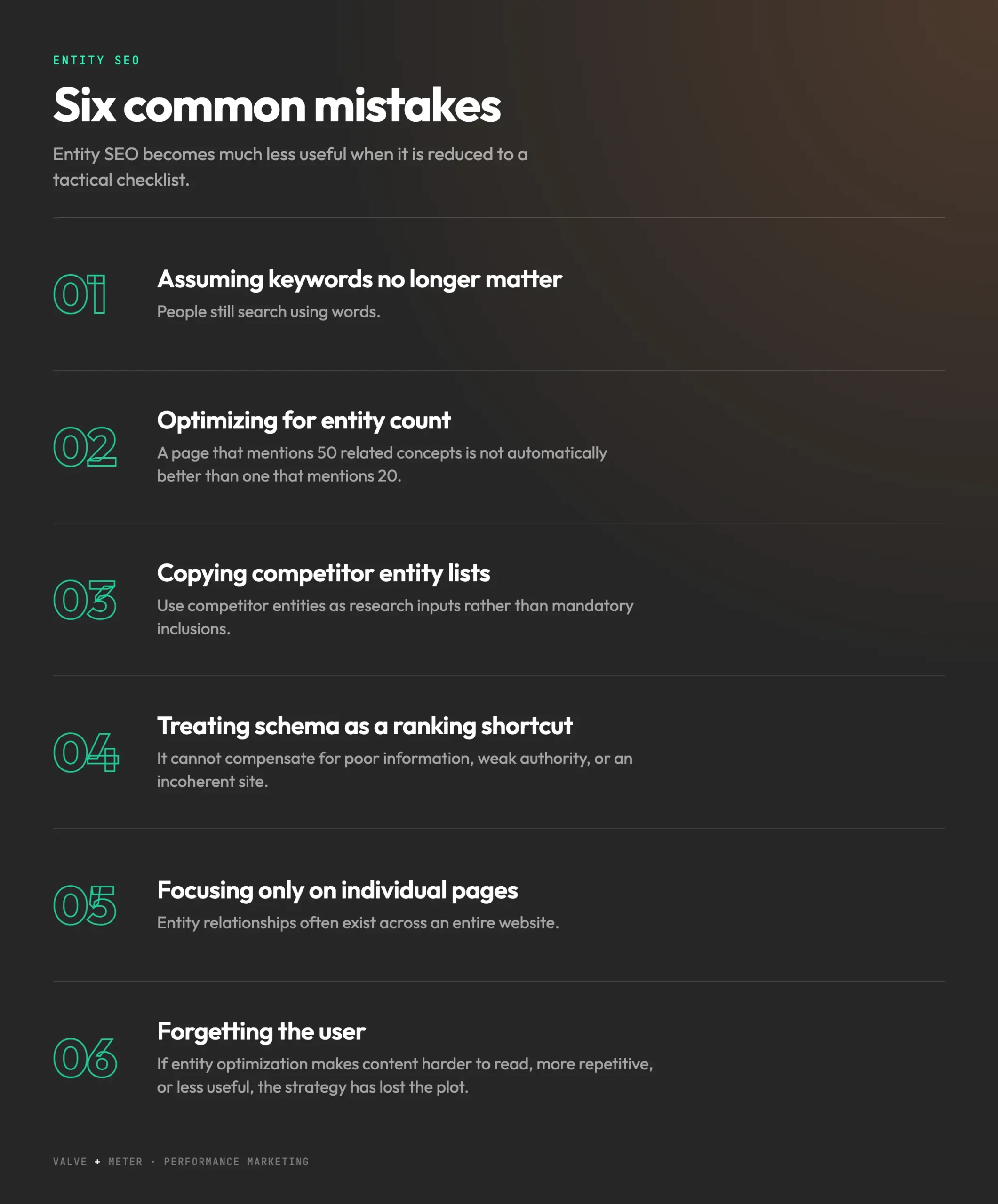
Mistake 1: Assuming Keywords No Longer Matter
People still search using words. Keyword data remains essential for understanding demand, phrasing, and intent. Entities complement keyword research. They do not eliminate the need for it.
Mistake 2: Optimizing for Entity Count
A page that mentions 50 related concepts is not automatically better than one that mentions 20. Completeness should be judged by whether the content adequately explains the subject—not by the number of recognized entities present.
Mistake 3: Copying Competitor Entity Lists
Competitor content can show you what a search result set considers important. It can also show you what everyone else is doing badly.
Use competitor entities as research inputs rather than mandatory inclusions.
Mistake 4: Treating Schema as a Ranking Shortcut
Schema can clarify information and enable certain search features. It cannot compensate for poor information, weak authority, or an incoherent site.
Mistake 5: Focusing Only on Individual Pages
Entity relationships often exist across an entire website. Ignoring site architecture and internal links means ignoring one of the clearest ways a website can communicate how its subjects fit together.
Mistake 6: Forgetting the User
If entity optimization makes content harder to read, more repetitive, or less useful, the strategy has lost the plot. The purpose of understanding entities is to communicate meaning more clearly—not to write for an entity extraction tool.
How to Monitor an Entity SEO Strategy
There is no single “entity SEO score” that determines whether a strategy is working. Evaluation should focus on the larger search and business outcomes the work is meant to support. Depending on the strategy, that can include:
- Organic visibility across relevant topic groups
- Rankings for important searches
- Search Console impressions and clicks
- Organic conversions
- Visibility of important service or product pages
- Internal linking coverage
- Indexation
- Branded search behavior
- Rich-result eligibility and appearance
- Local visibility where applicable
Revisit the content itself as well.
Industries change. Products change. terminology changes. Competitors publish better information. Search behavior evolves.
Entity research should therefore be part of an ongoing content strategy rather than a one-time optimization exercise.
A Practical Entity SEO Framework
You do not need an elaborate entity database to begin applying these ideas.
For any important page or topic, ask:
1. What is the primary entity?
Clearly define the subject the page is about.
2. What does the searcher want to accomplish or understand?
Entity coverage should follow intent.
3. Which related entities are necessary to explain the subject?
Identify concepts that genuinely contribute to the answer.
4. How do those entities relate to one another?
Components, causes, alternatives, categories, locations, people, organizations, services, and other relationships all provide context.
5. Does the page explain those relationships clearly?
Mentioning the concept is not enough.
6. Does this information belong on this page?
Some entities deserve supporting pages of their own.
7. How should the pages connect?
Use site architecture and internal links to reinforce meaningful relationships.
8. Can structured data clarify anything that is already true?
Use schema to describe—not invent.
9. What evidence supports the publisher’s authority on the subject?
Consider the business, authors, experts, locations, experience, and third-party signals surrounding the content.
That is a much more useful entity SEO process than simply comparing how many related terms appear on competing pages.
Summary
Entity SEO reflects a broader evolution in search. Search engines are increasingly capable of interpreting concepts rather than merely matching strings of text. That makes context and relationships more important to how marketers should think about content.
But entity SEO should not become another exercise in mechanical optimization.
Keywords still matter.
Schema is useful but not magical.
Entity extraction tools can uncover opportunities, but they cannot determine what makes an answer useful.
The real opportunity is to build websites that communicate subjects clearly: what things are, how they relate, where information belongs, and why the source should be trusted.
If your entity strategy improves those things, it is probably improving your SEO strategy too.
Frequently Asked Questions
What is an SEO entity?
An SEO entity is a distinct concept or thing that a search engine can recognize and understand independently of the exact words used to describe it. Entities can include people, companies, places, products, services, events, topics, and other clearly identifiable concepts.
What is the difference between entities and keywords?
Keywords are the words and phrases people use when searching. Entities are the underlying things or concepts those words refer to. Keyword research helps marketers understand search demand and language, while entity research helps establish meaning, context, and relationships.
Do entities replace keywords in SEO?
No. Keywords remain important because they reveal how people search and which topics have demand. Entity SEO adds another layer by helping marketers think about what those searches mean and how the concepts involved relate to one another.
How do NLP tools help with entity SEO?
Natural language processing tools can identify people, organizations, places, products, concepts, and other entities within text. SEO professionals can use these tools to analyze content and identify potentially important concepts, but tool recommendations still require editorial judgment.
What is the role of Google’s Knowledge Graph in entity SEO?
Google’s Knowledge Graph organizes information about recognized entities and their relationships. It demonstrates how Google can connect information about people, businesses, places, products, and other concepts rather than treating every search as a simple keyword-matching exercise.
Does structured data improve entity SEO?
Structured data can help search engines interpret information more clearly by explicitly describing entities and their properties. It can also make pages eligible for certain rich results. However, schema markup does not create authority or guarantee better rankings on its own.
How do internal links support entity SEO?
Internal links help establish relationships between pages and concepts. Thoughtful links, anchor text, breadcrumbs, and site hierarchy can communicate how individual topics fit within a broader subject area while also helping users discover related information.
How do you identify relevant entities for a page?
Begin with the page’s primary subject and the intent behind the search. Then identify the people, places, products, services, components, problems, attributes, and other concepts necessary to explain that subject. Competitor analysis, search results, Wikidata, NLP tools, and other databases can help validate or expand the research.
How many entities should a page include?
There is no correct number. A page should include the entities necessary to explain the subject thoroughly and accurately. Adding entities solely because a tool recommends them can result in semantic keyword stuffing rather than better content.
Why should businesses care about becoming recognized entities themselves?
A business is part of the information search engines attempt to understand. Consistent information about the organization’s name, locations, services, people, expertise, and relationships can help reduce ambiguity and strengthen the broader set of signals surrounding the brand.