




HVAC branding is a conversion multiplier, not a demand generator. It doesn’t directly drive more visibility or calls. What it does is make your contracting business more recognizable, credible, and easier to choose once someone’s already looking.
When one HVAC contractor came to Valve+Meter, it had been operating as two brands under one roof since acquiring a local competitor a few years earlier. Maintaining that split diluted both brands’ authority, confused customers, and split search equity. Neither brand was performing the way it should have.
We helped merge two fragmented, competing signals into one strong, familiar brand with a conversion-focused website. Within months, the company saw a 26% increase in website leads with a higher conversion rate than before.
Did the new logo and color palette we built drive those results? No. The impact the branding had on how homeowners viewed, valued, and trusted the brand converted more of the calls it was already earning. And that’s exactly what HVAC branding is built to do.
What HVAC Branding Changes and What It Doesn’t
Your HVAC brand can’t fix a lead problem. If the phone isn’t ringing enough, your business needs more people finding it, not a better first impression once they do. Branding also can’t fix a close rate problem, a slow dispatch process, or technicians who show up late. A new logo on a truck that still arrives an hour past the time it was scheduled doesn’t change the review that gets left afterward.
A strong HVAC brand does three specific things:
- Makes the truck in someone’s driveway more recognizable
- Shortens the gap between finding a company and trusting it
- Gives referrals something specific to repeat
You can see the impact of your brand in the same places those other problems show up: click-through rate on search results, time on site, form completion rate, and the percentage of calls that convert to booked jobs. A company with a strong, cohesive look and messaging is easier to find, easier to trust, and easier to choose over a competitor with three different names or logos in Google reviews.
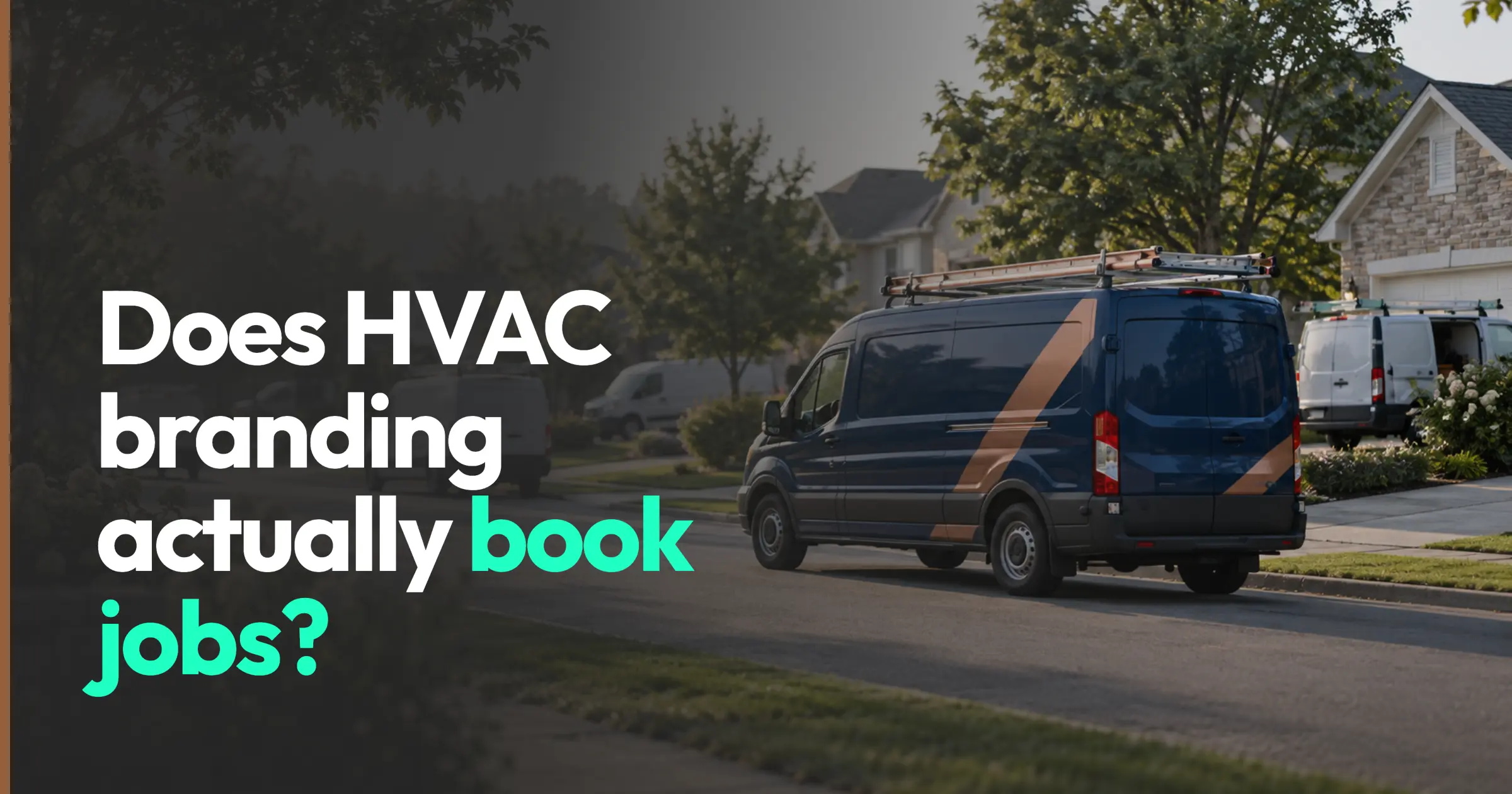
A rebrand also changes what a referral repeats. “Call the guys with the blue trucks” spreads faster and more accurately than a name a neighbor half-remembers. That consistency compounds over years of job sites, review requests, and repeat customers who might not recall the company name but remember what its trucks look like.
None of this shows up as more searches next month. But it does show up as a better ratio between searches and booked jobs, which is a different number, and the one that actually pays the bills.
What Changed for Two HVAC Contractors After a Rebrand
Two HVAC companies came to Valve+Meter carrying two different kinds of branding problems. Sheets Heating & Cooling in Fort Wayne had grown by acquiring a local competitor in 2019, then kept running the acquired business as its own separate company for years afterward: separate website, separate Google listing, separate reviews. A homeowner searching either name found a smaller, older-looking version of a company that no longer existed on its own.
Grove Heating and Cooling, a father-and-two-sons operation in Maryland, had the opposite kind of issue. There was only one Grove, but the marketing behind it was patched together from manufacturer co-op campaigns and whatever ideas their previous agency had pitched that year, with no way to tell what any of it earned back. Valve+Meter treated both as the same kind of job: figure out what each business actually was all about, then build one identity that is easy to remember and recommend.
For Sheets, that meant a new mark pulling recognizable pieces from both companies rather than starting from scratch, alongside an updated color palette and a set of brand guidelines to keep it consistent going forward. From there came the physical pieces: business cards, folders, vehicle wraps built to read clearly even from a moving car, and signage on the building itself.
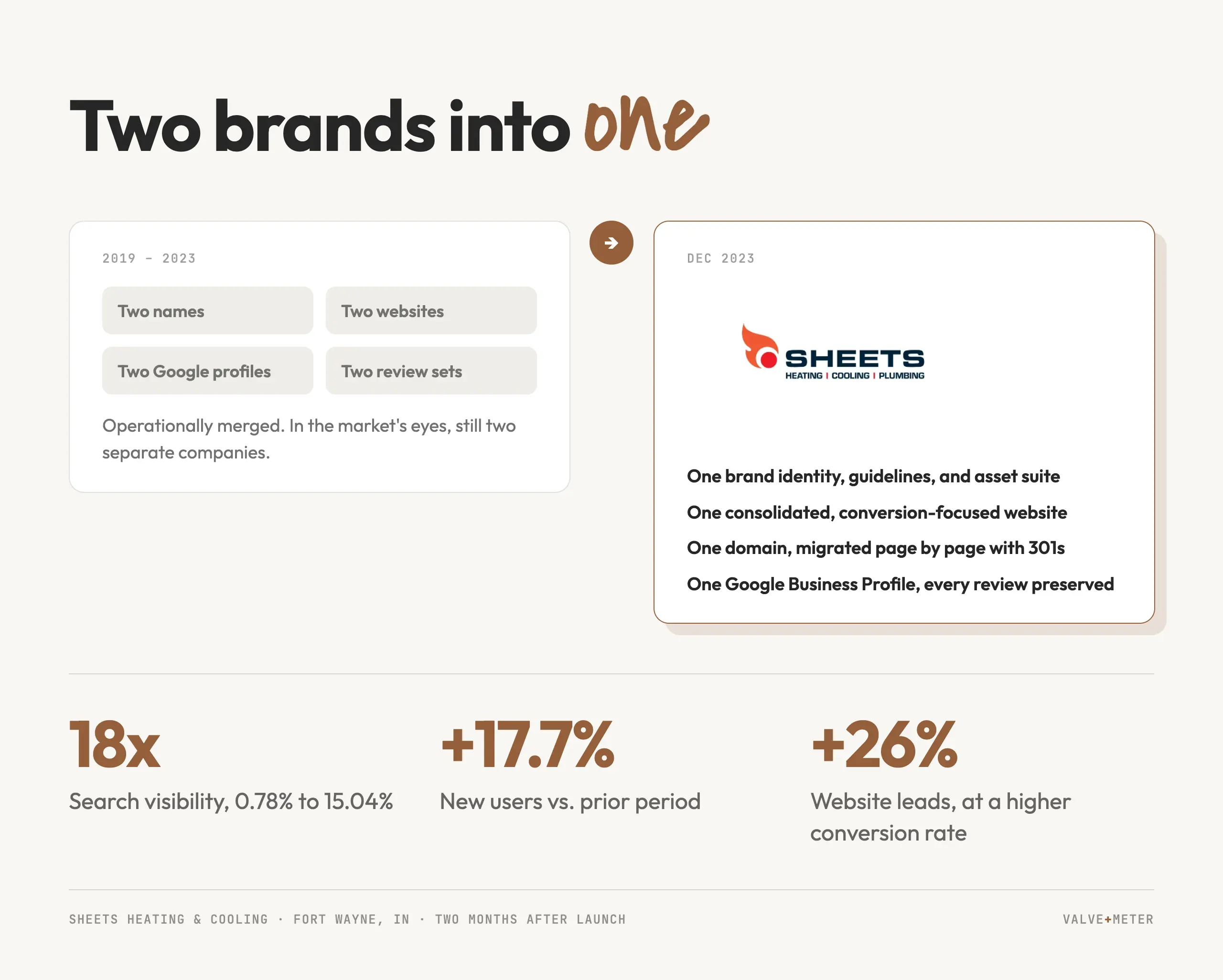
Every surface a customer might see got redesigned around the same identity, carried across trucks, uniforms, and a rebuilt website. The goal was reassuring customers that nothing about the service had changed, just the name and visuals. These changes, along with a careful domain migration, a Google Business Profile merge, and a new consolidated, conversion-focused website, added up to an 18x increase in search visibility, a 17.7% increase in new users, and a 26% increase in web leads converting at a higher rate than either of the original sites.
For Grove, the diagnostic came first: a look at the company, its market, and the competitors already circling its territory. What came out of it was a plan built around SEO, since Grove’s real gap wasn’t creative, it was getting found. The rebrand rolled out alongside that plan instead of after it. The same mark and color system went on the website, the truck wraps, and the direct mail Grove already sent to past customers, so a homeowner who saw a wrap on Tuesday and a mailer on Friday recognized both as the same company.
Grove is the qualitative case for branding. Google reviews doubled, revenue doubled, and ownership has referred Valve+Meter to six other HVAC companies since. Different kind of evidence, same pattern underneath it: a business that had been quietly working against itself stopped doing that, and the numbers moved.
When an HVAC Rebrand Is Worth the Money
A rebrand makes the most sense when something fundamental about the business has changed, or the current identity is actively creating friction. It should solve a defined problem or support a defined growth strategy. It shouldn’t happen just because the existing brand feels old. Several situations can justify the investment:
An Acquisition or Merger
The Sheets example is the clearest case. When two businesses combine but keep presenting different names and identities, customers can stay confused long after the operational merger is done. A unified brand establishes one company, one reputation, and one identity to grow from.
Service Area Expansion
A brand built around one small market can become restrictive once an HVAC contractor expands into additional cities, regions, or states. That doesn’t automatically mean a new name. It does mean evaluating whether the current name and positioning still fit the company you’re becoming.
Name Confusion
If your company name gets confused with another contractor in the market, some of your marketing may be strengthening someone else’s recognition instead of yours. A distinctive name and identity matter more as paid advertising, local search, direct mail, and fleet visibility increase.
Fleet Replacement
Vehicle wraps are one of the largest physical expressions of an HVAC brand. If a substantial part of your fleet is already getting replaced, that’s an efficient point to introduce an updated identity rather than rewrapping newer trucks again a short time later.
Generational Handoff
A transition from one generation of ownership to the next can also trigger a brand evaluation. The goal doesn’t have to be abandoning the company’s history. Often the better move is keeping the recognition and reputation that already have value while updating the identity and messaging for the company’s next stage.
When It Is Not
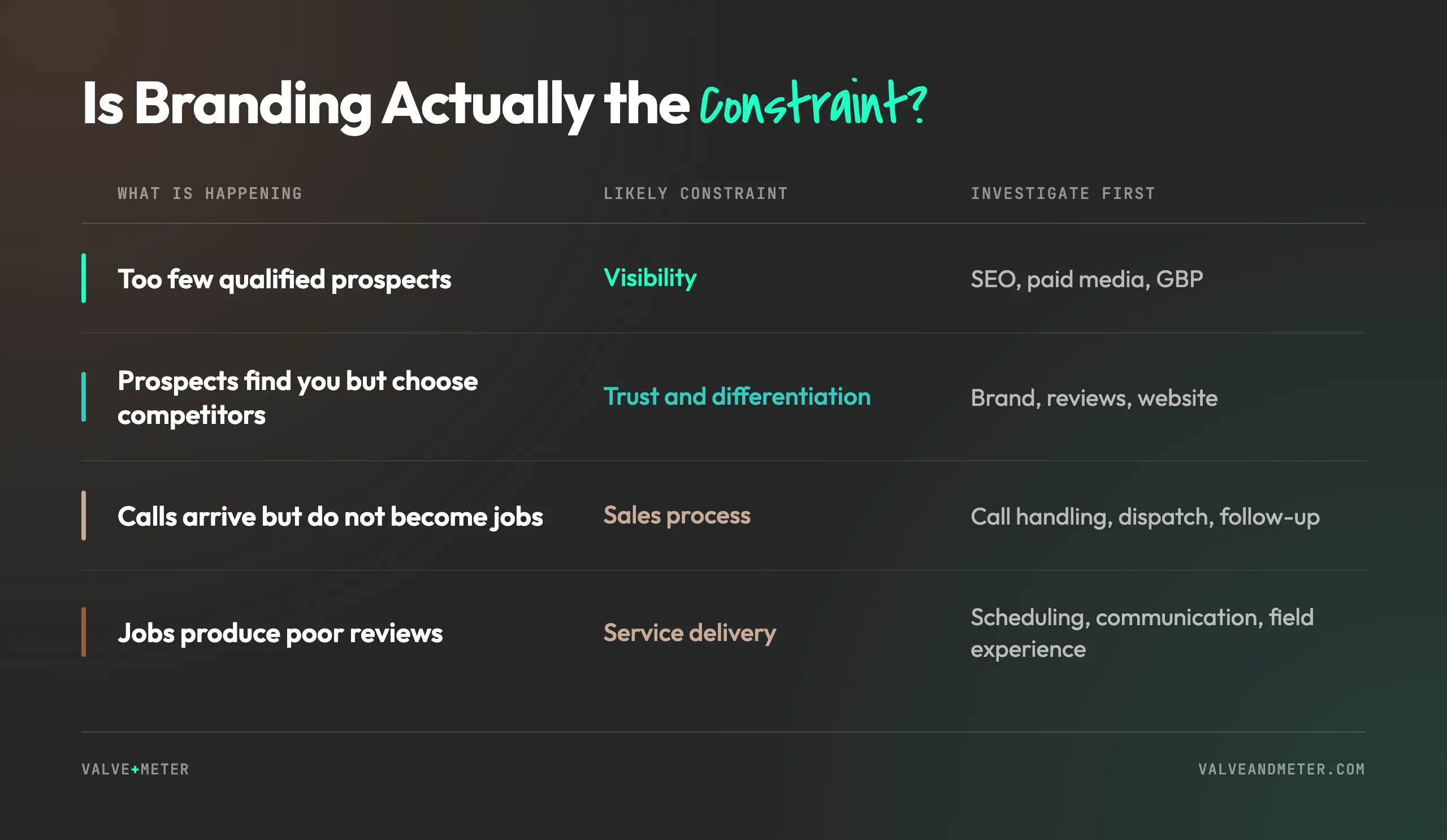
If the phone isn’t ringing, start there. A contractor generating too few qualified opportunities has a lead-generation problem before it has a branding problem. Changing the name, redesigning the logo, wrapping the fleet, and rebuilding every branded asset gets expensive. None of that creates search demand or guarantees more homeowners will find the company.
Figure out why lead volume is weak first. Are you visible when homeowners search for your services? Are paid campaigns reaching the right market? Does your Google Business Profile compete effectively? Are you generating enough reviews? Are visitors reaching the website but not converting? If so, check out our guide to generating more HVAC leads, which covers the channels and tactics behind lead flow.
Next, fix the constraint that’s actually limiting growth. If qualified prospects are already finding you but choosing competitors, branding may deserve a closer look. If qualified prospects aren’t finding you at all, a new identity just gives you a better-looking company that’s still hard to find.
What an HVAC Rebrand Includes
A true rebrand isn’t a logo swap. The exact scope depends on the business, but a contractor rebrand may address:
- Brand strategy: Who the company serves, how it should be positioned, what differentiates it, and what customers should associate with the name.
- Company name: Not every project requires a new name. When the existing name creates confusion, geographic limitations, or problems after an acquisition, renaming may be part of the strategy.
- Visual identity: Logo systems, colors, typography, iconography, photography guidance, and the standards governing how those elements get used.
- Messaging: Taglines, key value propositions, service messaging, website language, and the other language that communicates why customers should choose the company.
- Fleet graphics: HVAC trucks and vans have to communicate quickly. A design that looks good on a screen but becomes unreadable in traffic isn’t doing its job.
- Uniforms and field materials: The company that arrives at the homeowner’s door should look like the company the homeowner researched online.
- Website and digital profiles: The new identity has to extend into the website, Google Business Profile, social channels, digital ads, email, and other online touchpoints.
- Sales and marketing collateral: Direct mail, maintenance-plan materials, estimates, presentation folders, leave-behinds, signage, and other assets may need updating.
Valve+Meter handles brand strategy, identity, messaging, brand audits, standards, website and creative applications, and vehicle wrap design, alongside the broader work we do with HVAC companies on marketing overall. Some physical production and installation, like printing, sign fabrication, uniforms, or applying vehicle wraps, goes through outside vendors.
When you’re planning a full rebrand, sequencing matters. A new website and Google Business Profile can reflect the new identity within days. Physical assets move on their own schedule, replaced in batches as uniforms wear out, trucks come up for wrapping, or collateral runs low. A rebrand doesn’t require swapping every physical asset on day one, but it requires a plan for what changes immediately and what changes as the old pieces cycle out.
The next two articles in this series go further into two of these pieces: What an HVAC fleet-graphics rollout costs and how it’s sequenced, and how a new identity carries through the physical presence customers see every day.
HVAC Slogans and Taglines That Work
An HVAC slogan has one job: Survive being read at 40 miles an hour off the side of a truck, or spoken in a fifteen-second radio spot, and still mean something. That rules out most of what sounds good in a meeting.
The slogans that hold up tend to be short, five words or fewer, specific to what the company does or promises, and readable without a run-up. “Comfort you can count on” is generic enough to belong to any HVAC company in the country. “We fix it right the first time” says something a competitor’s slogan usually doesn’t.
Good HVAC branding ideas for a slogan start with what the company actually does differently, like same-day service, flat-rate pricing, or a specific guarantee, rather than a feeling the brand wants to evoke. A promise that can be checked, like “same-day service or it’s free,” outperforms a mood word like “comfort” or “quality,” because it gives the reader something to hold the company to.
Test it the way it’ll actually be seen: on a truck door, moving, from 30 feet away. If it doesn’t read in two seconds, it won’t work as a slogan, even if it reads well in a brand deck.
FAQ
How much does an HVAC rebrand cost?
There’s no set price because scope varies so much. A brand audit or messaging engagement is a different project than one that includes strategy, identity, messaging, a new website, fleet graphics, signage, and uniforms. Valve+Meter scopes each engagement to what the business actually needs rather than publishing a flat rate. The branding service page covers the process and deliverables in more detail.
How long does an HVAC rebrand take?
A full brand strategy, identity, and messaging engagement typically runs six to ten weeks, depending on scope and how quickly the client’s team moves through discovery. A brand audit alone usually takes two to three weeks. Add time on top of that when the project includes a new website, vehicles, signage, or other physical assets to produce and install.
Do I need to change my company name to rebrand?
No. A rebrand can keep an established name while changing the positioning, messaging, visual identity, or how the brand gets applied. A name change matters more when the existing name creates a specific problem: confusion after an acquisition, overlap with another local contractor, or a service area the name no longer fits. Don’t give up brand recognition that already has value without a real reason to.
Can I just update the logo?
Sometimes. If your company’s positioning is clear, customers recognize the name, and the brand still reflects the business, a visual refresh alone can solve the problem. If the problem goes deeper than appearance, a new logo won’t fix it.
Find Out If Branding Is What’s Limiting Your Growth
HVAC branding matters because homeowners rarely make a decision from a single interaction. They search, see a truck, read a review, ask a neighbor, visit a website, get a piece of mail, and compare companies against each other before they call. A strong brand helps all of those exposures add up to recognition and trust instead of staying disconnected from each other.
Even so, branding is a business investment, not a cosmetic exercise. If people are already finding your company but too few are choosing it, your brand may be holding back the marketing you’re already paying for. If people aren’t finding you in the first place, there’s a more urgent constraint to fix first.
Valve+Meter works with HVAC contractors to sort out which of those is actually happening before recommending where to invest. Request a free marketing assessment to see what’s limiting growth and whether brand is one of the problems worth solving.