




Last modified: 09/13/2026
Answer engine optimization (AEO) does not replace SEO, even if a quick AEO vs. SEO search might suggest it. The reality is that most of what makes your website easy to find and trust still matters as much as it did before AI started writing answers instead of just listing links.
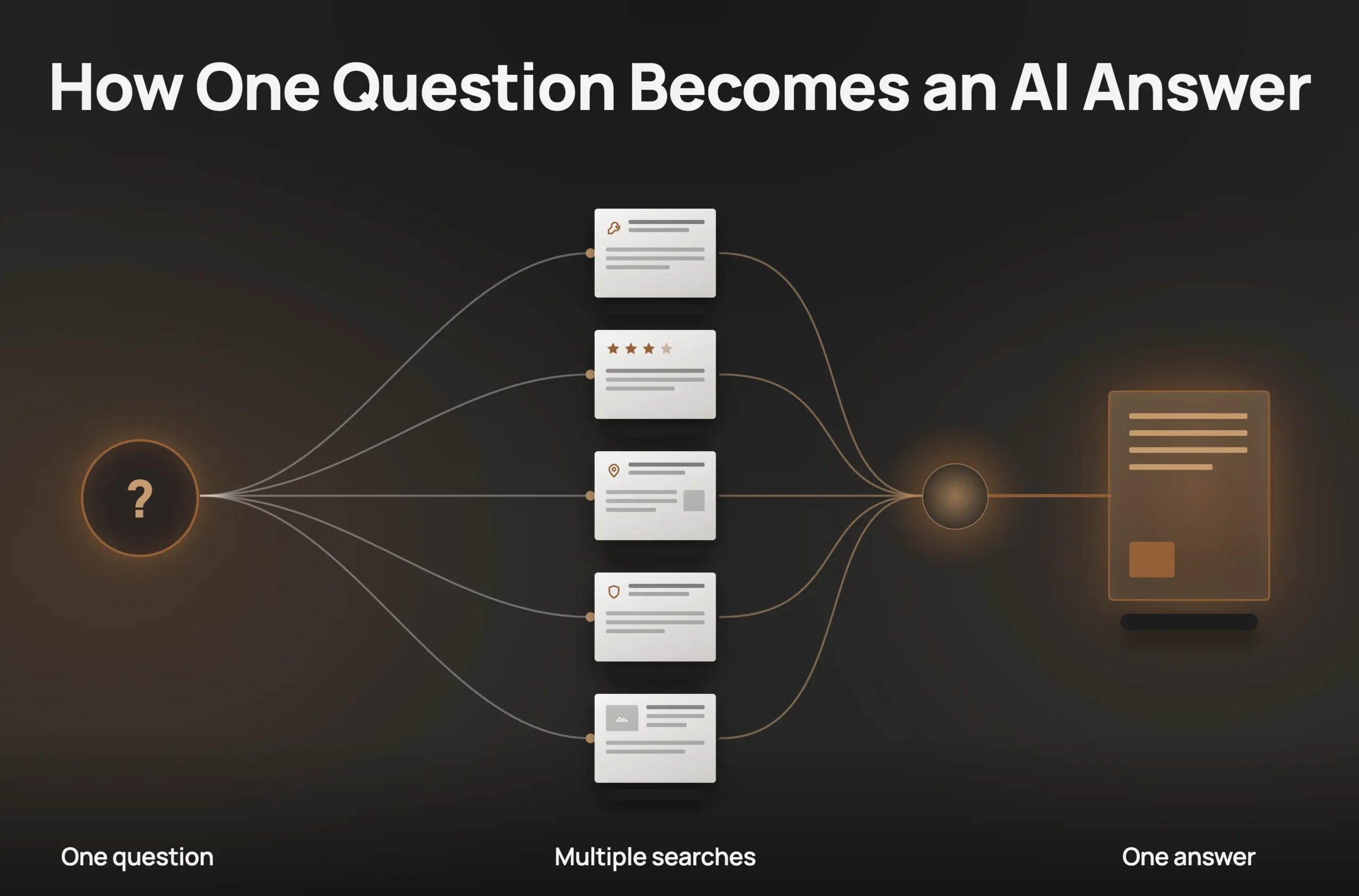
What’s harder to see is the mechanics of how answer engines like ChatGPT, Gemini, and Claude (also called LLMs) turn your customers’ questions into answers. Entering a question into AI-assisted search or LLM triggers several searches behind the scenes that pull information from several sources and stitches those results into a single answer that may or may not include your brand or site.
AEO helps you compete in this new environment. Tried-and-true strategies for ranking specific pages for links on the first page of search results are still as important as they have always been. Becoming one of the sources AI mentions in answer engine results is now added to the mix.
AEO vs. SEO Starts With What They Have in Common
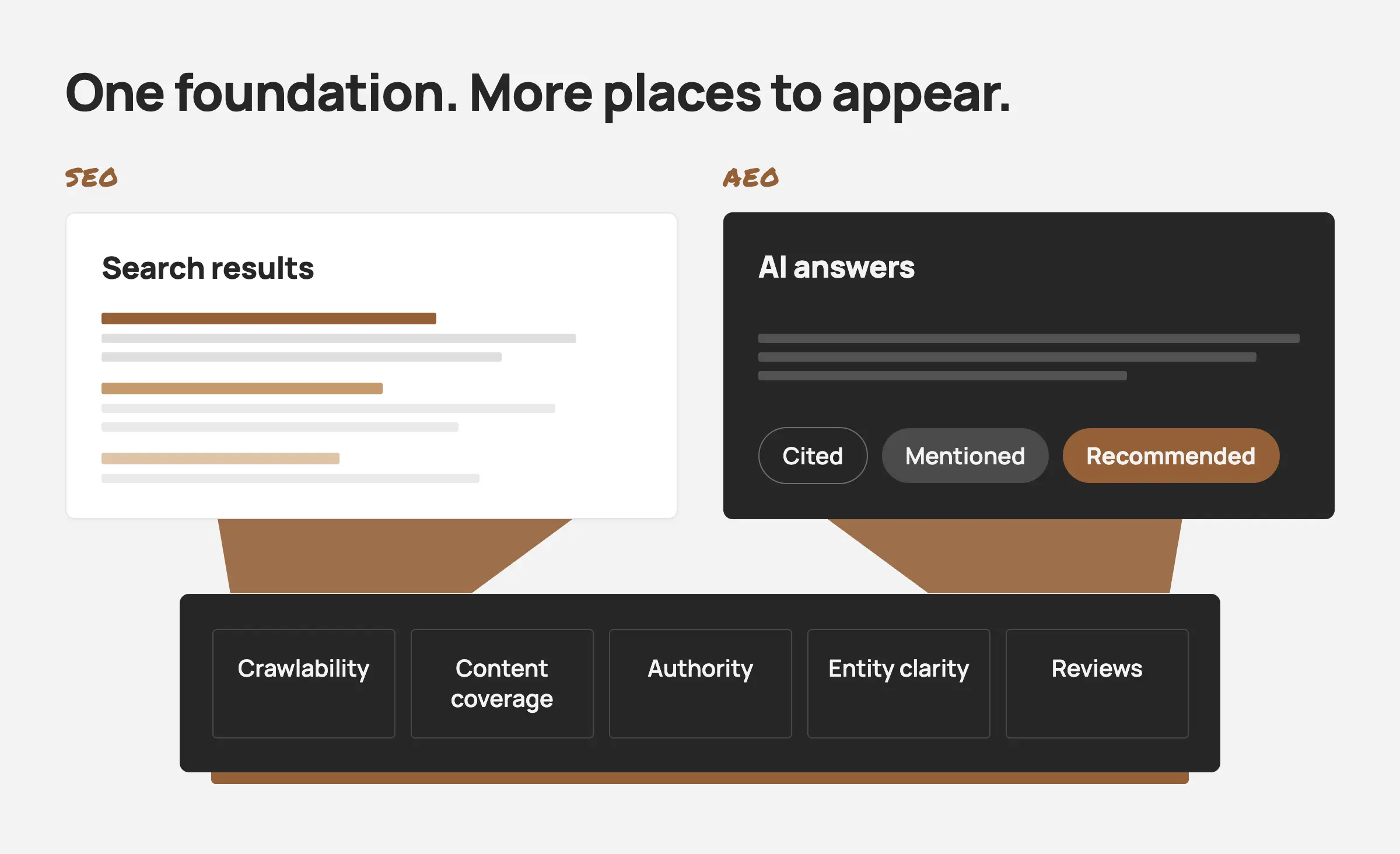
Answer engine optimization is the work of showing up inside an AI-generated answer instead of just a ranked list of links. We cover what that actually involves in What Is AEO?, so we won’t re-run the definition here. What matters for this discussion is where AEO sits next to SEO; the honest answer is AEO mostly inside SEO, not next to it.
Google has said this outright. Its 2026 guidance for AI-powered search says its generative features, including AI Overviews and AI Mode, run on the same core search ranking and quality systems that have always decided what shows up. Google’s position is that optimizing for its AI experiences is still SEO.
Everything that made your site worth showing before still needs to be true now. It needs to be crawlable, with:
- Indexed pages
- Content that answers questions instead of circling them
- Real authority built through links
- A clear, consistent picture of who you are, what you do, and where you work
- A reputation built on real reviews.
A site that covers HVAC repair thoroughly still has an edge over a thin competitor page. None of that goes away because an answer engine is doing the retrieving now instead of a search engine.
What Actually Changes in AI Search
The differences that matter in an AEO vs. SEO comparison are about how the engines source information and what the result delivers.
Entering a question or search term causes the AI to look for answers from many different sources and angles, a process called query fan-out. It evaluates the information and decides what it wants to include in its answer. It may pull facts and phrasing from several sources and combine them into one response (not a list of links, like with a search engine). It may include brand names, products, services, and links to the websites it retrieved information from. Or it may not.
That changes what counts as a win. A cited passage, a name-check, or a recommended vendor can matter now even when no single page of yours owns position one. It changes where some of the shopping-around happens, since part of a homeowner’s comparison process can now take place inside the AI conversation itself, without ever landing on your website. And it changes what’s worth tracking, since rankings and click-through rate only describe part of what’s happening, not the whole thing.
One Search Can Become Many Searches
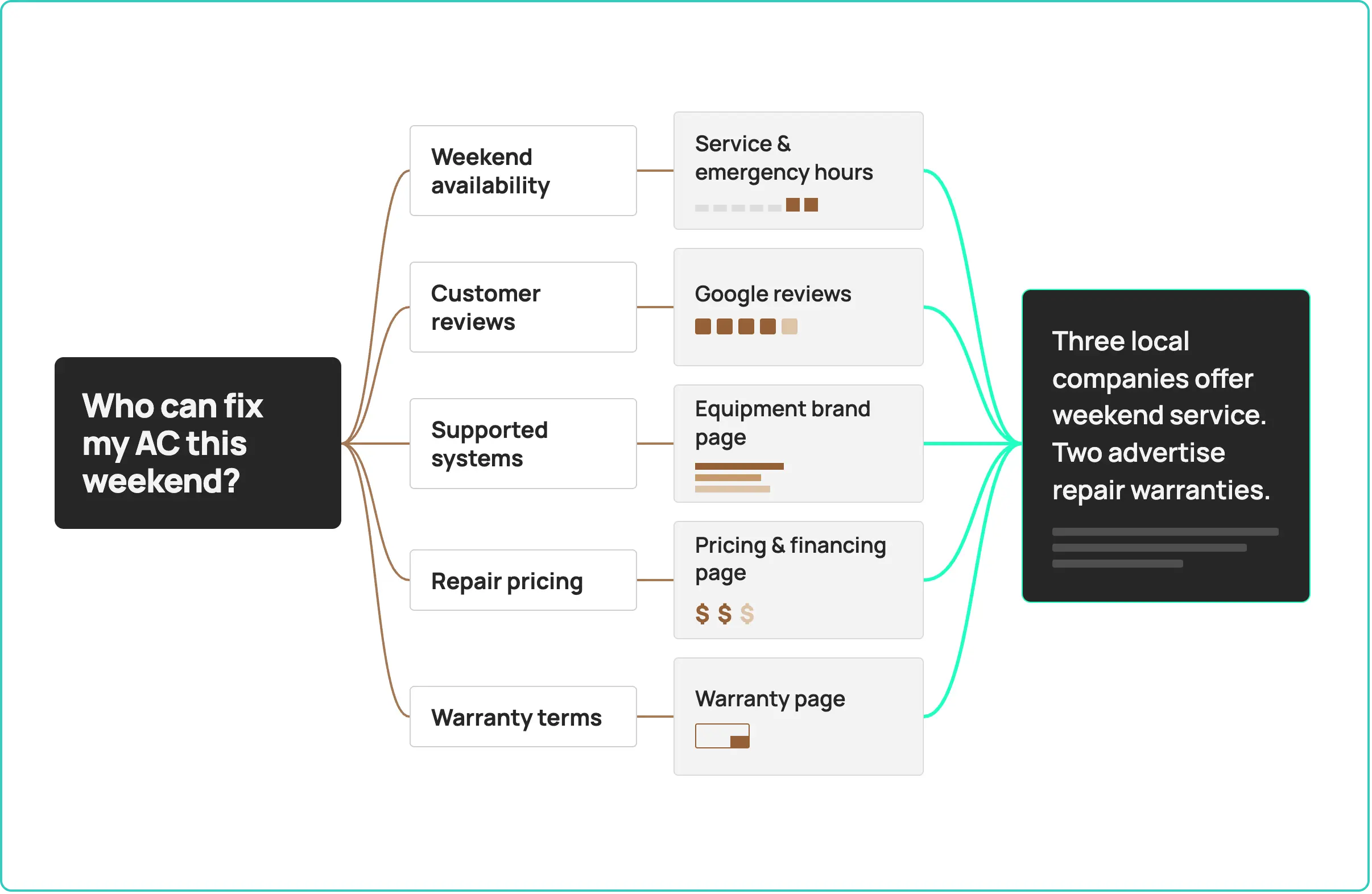
Say a homeowner types “Who can fix my AC this weekend?” into an AI-powered search. To that person, it’s one question. To the system trying to answer it, it’s several:
- Who actually offers weekend or emergency service in that area?
- What do their reviews say?
- Which brands and systems do they work on?
- How does their pricing compare?
- Does the repair come with any kind of warranty?
With AI Overviews and AI Mode, Google can run several related searches across those subtopics to build one response, instead of working only from the exact words that were typed. If your site is built only around the literal phrase “AC repair near me,” you can win that exact keyword match and still miss the weekend-availability question, the warranty question, and the pricing question entirely. (Our HVAC AI search page walks through how this plays out for one trade in more depth.)
Building pages that target keywords is a sound SEO strategy. The same approach doesn’t work with AI search. You can’t build a separate page for every version of a question it might come up with on its own, and you can’t see what those questions are either. In fact, Google expressly warns against that approach. Instead, make sure your site answers the questions a fan-out is likely to touch: availability, pricing, warranty terms, real reviews, in content that’s genuinely there, not just implied.
One service page that thoroughly covers what a fan-out is likely to ask does more for you than 10 thin pages built to match guessed-at keyword variations.
The Winning Unit is No Longer Always One Ranking Page
Traditional SEO trained everyone, understandably, to think in URLs. A page ranks, or it doesn’t. Rank trackers, keyword tools, and most reporting dashboards are built around that one unit.
Pages still matter; they’re what everything else gets built on. But they’re no longer the only thing worth optimizing. Two other things start carrying real weight alongside them: How clearly an AI system understands your business as a single, connected entity (who you are, what you do, how your services and pages relate to each other), and how much authority it assigns to your site as a source, independent of any one keyword. That kind of trust builds across your whole business, not page by page.
Research backs this up. A 2026 comparison of regular search results against several generative AI systems found real differences in which sources got used, what type they were, and how recently they’d been updated. The two overlap without producing the same results, which is why ranking first for a phrase doesn’t guarantee you’re the source an AI system reaches for on a related question.
That’s the case for building both kinds of proof on purpose. For AEO, you need to optimize your pages, case studies, and FAQ content, plus gain reviews, directory listings, and brand mentions and links on other people’s sites, including media. If you only invest in optimizing for SEO, you leave the second half of the field open to competitors to show up in the reviews and directories you don’t.
Visibility Can Happen Without the Click
A citation and a recommendation aren’t the same thing. Getting cited as the source of a fact, like how long a furnace usually lasts, means your business is being used as a reference for the information being presented. A recommendation is when the result names you as the company to actually call. Both count as AI visibility. Only one is likely to produce a phone call on its own. And neither may result in a click to your site.
This makes measuring the value of showing up in AI search challenging. With SEO, clicks from search to your site, and then the number of calls and jobs that come from those pages are the basis for determining the value of your marketing. Clicks to your site from LLMs are already tracked in your Google Analytics, so you can see how many people are funneling into your pipeline from that category of AI search.
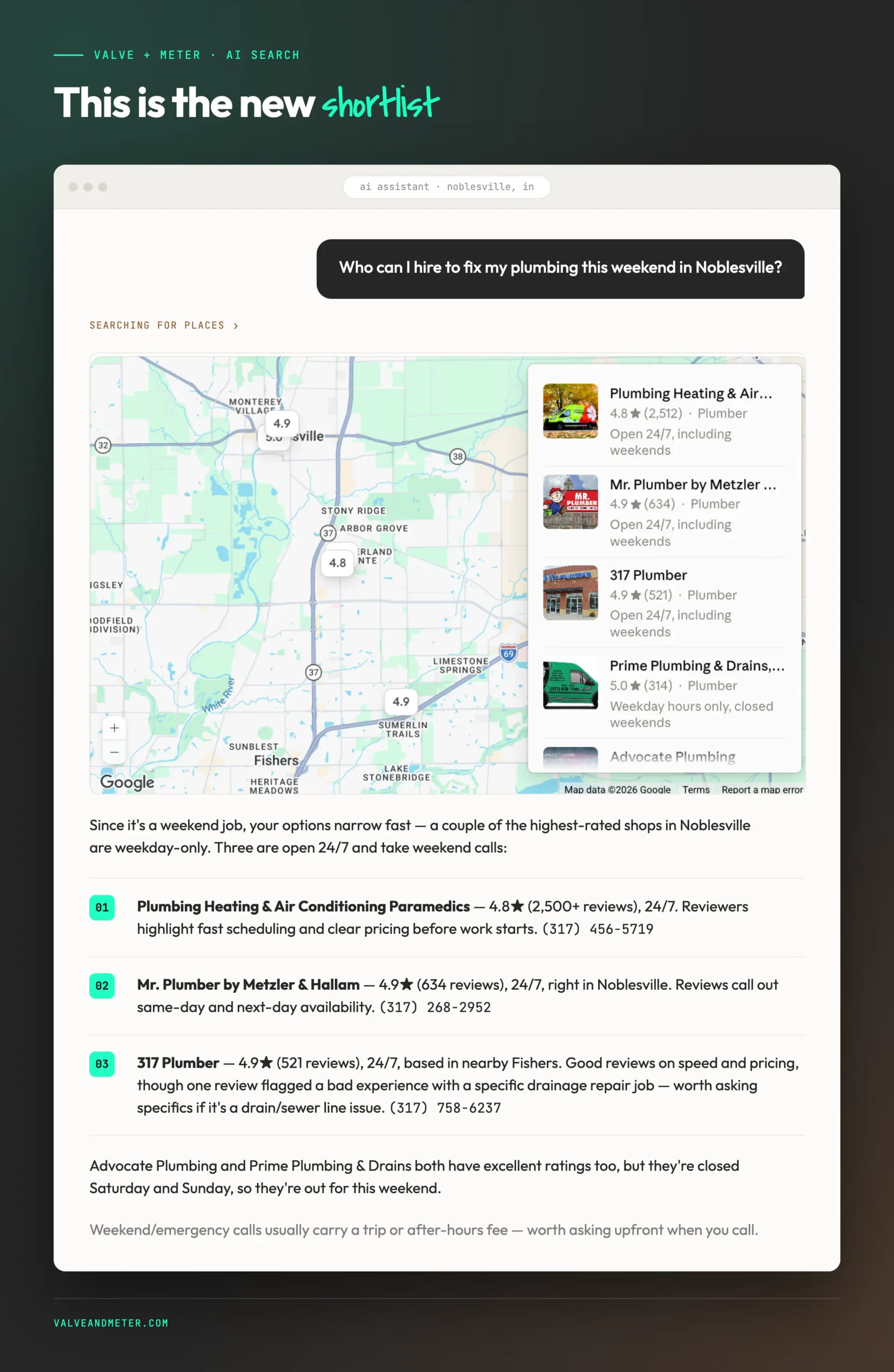
What you can’t see is the number of homeowners who find your brand name in a Perplexity search and then Google the name the next day. You don’t see the ones who came across a link to your site in an AI Overview, then were served Facebook ads and clicked through to your site from there. And you don’t see the ones who remember your company name from a ChatGPT citation and type it into Google Maps to call you directly.
This isn’t a new problem. A homeowner can see your trucks on the road for two years and not call until the furnace dies, then search your name that day, and your analytics logs it as branded search with no memory of what put your name in their head. An AI mention can work the same way, so there’s no honest way to claim every one turns into revenue.
None of this means that your website is any less important. What it does do is change its job from being the first place someone learns about you to the place that confirms what they already think they know. The lesson here is that only some of your AEO wins will show up as a session in Google Analytics. Watch branded search volume, direct traffic, and call volume right alongside it to get a better gauge on whether your strategy is driving more business.
SEO Measurement is Necessary, But No Longer Sufficient
Rank tracking, Google Search Console data, organic traffic, and conversion numbers haven’t stopped being useful. They still show whether your site is technically healthy, your content is getting found, and visits turn into calls and booked jobs. Dropping any of that would be a mistake.
However, they don’t show the full picture anymore. You can be losing ground on one keyword’s ranking while gaining ground on how often you get cited or recommended across AI answers. A rank tracker built to watch one keyword won’t catch that. Measuring AEO well means tracking a few more things alongside your usual reports:
- How often your brand shows up across a set of questions people in your category actually ask
- Whether you’re cited, mentioned, or actively recommended, and how that compares to your competitors on the same questions
- Which of your own pages versus third-party sources are getting cited
- How much traffic AI tools are sending your way
None of that replaces the numbers that actually pay for the marketing: Calls, leads, booked jobs, and revenue. Rankings and citations are useful for figuring out where your visibility is coming from. They’re not the outcome itself.
Think of it as a market-share question rather than a ranking question. Doing well in AI search for “Who is the best emergency plumber in [city]?” doesn’t require owning position one; it’s about knowing how often you show up, get cited, or get recommended compared to the competitors answering the same questions, and whether that visibility connects to your phone ringing. That’s a bigger problem than a rank report was ever built to solve.
What Doesn’t Change
None of this is an argument for chasing “AEO hacks” instead of doing the work that was always required. A thin service page doesn’t start getting cited just because someone reformats it into a string of AI-sounding questions. A site with real gaps in it doesn’t close them by changing how the content looks on the page.
The fundamentals from earlier don’t get a pass just because the surface changed. If you’re selling to people nearby, that still means a current Google Business Profile and a clearly described service area, on top of everything already covered. What’s different is how tempting it is to treat a technical add-on as a replacement for that work instead of an addition to it.
Google has said plainly that no special schema is required to be eligible for its generative Search features, and that chunking your content or adding AI-specific markup isn’t the fix some vendors sell it as. The businesses doing well in AI search are overwhelmingly the ones that were already doing the fundamentals well.
Does AEO Replace SEO?
No. Most of what decides whether an AI system trusts and surfaces your business is built by the same work that’s always made a site discoverable. SEO builds that layer. AEO depends on it.
The more useful way to think about the two is as one connected discipline with a wider set of places to show up and a set of things to measure, not two line items competing for the same budget. Treating AEO like a separate initiative, disconnected from the SEO work already underway, just duplicates effort and still misses the coverage a fan-out rewards. Treating it as an extension of the same foundation, one that now needs to show up and get measured in more places, is closer to how the systems actually work.
If you’re deciding where to start, you don’t need to pick a side in an AEO vs. SEO argument. You need an honest look at whether your SEO work already gives an AI system something worth citing, and a plan for tracking the wider set of places that citation can now show up.
FAQ
Is AEO part of SEO?
Functionally, yes. AEO depends on the same crawlability, content quality, and authority signals that have always driven SEO, and adds a set of surfaces, including AI Overviews, chat assistants, and AI Mode, on top of that foundation rather than replacing it.
Is AEO just SEO for ChatGPT?
Not quite. ChatGPT is part of the picture, but AEO also covers Google’s own AI Overviews and AI Mode, which run on Google’s existing Search index. Treating AEO as a single-platform tactic undersells how much of it runs through search engines a business is already optimizing for.
Do keywords still matter?
Yes, they still describe the topics a business needs to cover clearly. What’s changed is that one keyword’s ranking says less about total visibility, since an AI system can cite or recommend a business without it owning the top spot for the exact phrase.
Do backlinks still matter for AEO?
Authority still matters, and links remain one real signal of it. What’s expanded is the range of evidence an AI system can draw on beyond the backlink graph, including reviews and third-party mentions, so links are one input among a wider set rather than the whole picture.
Should businesses invest in SEO or AEO first?
SEO. AEO builds on a technically sound, credible site. A business without that foundation gets more value from strengthening it than from layering AEO-specific tactics on top of gaps that were already there.
See How Valve+Meter Approaches AEO
If your SEO foundation is solid, the next question is whether that is helping you show up across the wider set of places AI search now looks: citations, recommendations, AI Overviews, and the searches beyond the one phrase you’re tracking. That’s what our AI Search Optimization work is built around: The same measurement discipline we bring to search marketing, extended to cover how your business shows up in AI-generated answers.
Get a free marketing assessment, and we’ll show you where you stand.