



Google’s spam policy defines a doorway page by what it does with a visitor: it ranks for a search and then passes the person along to another page that is more useful. A city page is not a doorway when a customer can see the work you do in their town and call or book from that page, even if it shares a layout and a good deal of wording with your other city pages. The template version many contractors have, with the town name swapped into general service copy and a button to the main contact page, is much closer to what the policy describes.
Large sets of thin, near-identical pages can draw a manual action, and one documented case involved a site whose pages were each written by people. The more common outcome for weak city pages is that Google crawls them and leaves them out of the index, and the business usually finds out from a Search Console report. For each page you have, the practical test is whether a customer who lands on it can get what they came for without clicking somewhere else.
What Google’s doorway policy says
Google’s spam policies for web search define doorway abuse this way:
Doorway abuse is when sites or pages are created to rank for specific, similar search queries. They lead users to intermediate pages that aren’t as useful as the final destination. Examples of doorway abuse include:
- Having multiple websites with slight variations to the URL and home page to maximize their reach for any specific query
- Having multiple domain names or pages targeted at specific regions or cities that funnel users to one page
- Generating pages to funnel visitors into the actual usable or relevant portion of a site
- Creating substantially similar pages that are closer to search results than a clearly defined, browseable hierarchy
The definition has two parts. The first is that the pages are made to rank for specific, similar queries, and city pages meet that part by design. A page for furnace repair in Dublin, Ohio, and another for furnace repair in Westerville exist to rank for searches that differ only by the town name. If that alone made a page a doorway, every contractor with a page per town would be in violation, and the definition would not need its second sentence, which says the pages “lead users to intermediate pages that aren’t as useful as the final destination.”
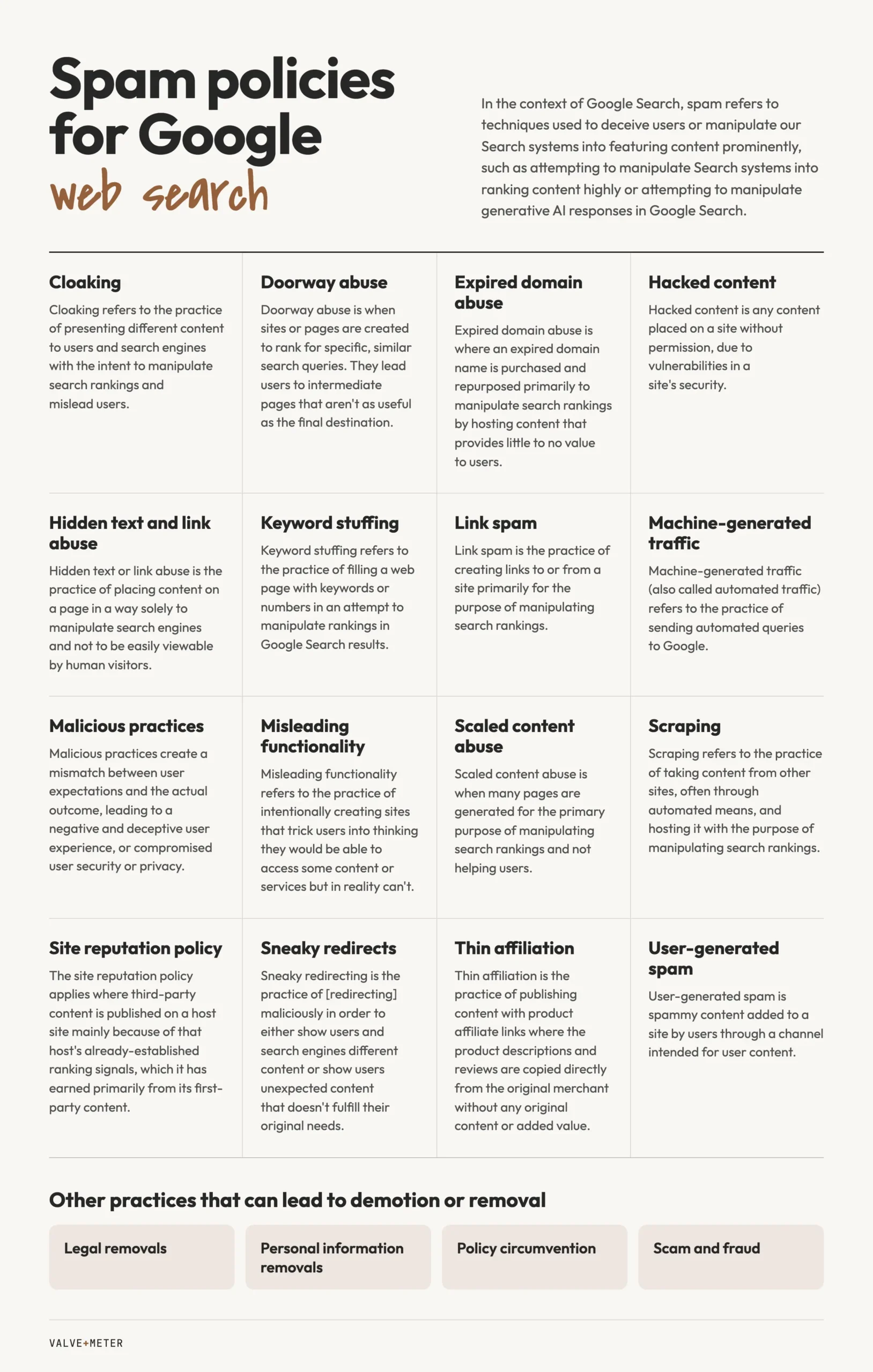
Similarity does appear in the examples. The first describes multiple websites with “slight variations,” and the fourth names “substantially similar pages” as doorway abuse. In both cases the similarity comes with a structure built to rank and pass people along: near-copies of a site spread across URLs, or pages that sit “closer to search results than a clearly defined, browseable hierarchy.” Valve+Meter’s reading is that similarity is part of the picture Google describes, and that the definition itself turns on whether the page sends the visitor somewhere else. The city example says the same thing in its own words, describing pages “targeted at specific regions or cities that funnel users to one page.”
What “funnel” means in the policy
An intermediate page sits between the search result and the page that does the work. In the version most contractors have seen, there is one page per town, each with a paragraph of general service copy, the town name dropped into the heading and the first sentence, and a “Contact us” button that goes to the same sitewide contact page from every town. A homeowner in Grove City who lands there learns nothing about whether the company works in Grove City or whether anyone nearby has hired it, so the only thing to do is click through. The page exists to rank and pass the visitor to a different URL, which matches the policy’s example of city pages that “funnel users to one page.”
Doorway pages tend to resemble one another because there is nothing local on any of them, and that is why so much advice about city pages fixes on similarity. Two city pages can share the same paragraph explaining what a furnace tune-up includes and both be destinations, as long as each gives a homeowner in that town the information they need and a way to book from the page. Two pages with completely different wording can both be intermediate pages if each exists mainly to hand the visitor to another URL.
A test you can run on your own city pages
Google does not publish a checklist for this. The three questions below are how V+M applies the policy’s wording to a contractor’s city pages.
- Does the page have its own conversion path? A phone number and a booking or quote form on the page itself count. A page whose only next step is a button to the sitewide contact page does not have one.
- Does the page answer the question the visitor arrived with? Someone who searched for AC repair in Westerville wants to know whether you work in Westerville, how soon you can come, and whether people there have used you. A page that explains what AC repair is and then hands off has not answered that.
- Is the visitor better off on this page than one click deeper? If your main AC repair page would serve a Westerville homeowner just as well, the city page is not adding anything.
A page should pass all three to count as a destination. A page that fails any of them needs work before it is worth keeping.
Here is an invented example. A heating and cooling company based in Hilliard runs four trucks and has city pages for Dublin, Upper Arlington, Grove City, Westerville and Pickerington.
The Dublin page passes all three. Dublin is about 15 minutes from the shop, and the company runs calls there every day. The page has its own call tracking number and a booking form. It names the two technicians who cover Dublin, says most Dublin calls get a same-day or next-morning appointment, describes a few recent jobs in the city (a furnace replacement, a heat pump install, a ductwork repair in an older home), and shows reviews from Dublin customers.
The Pickerington page fails all three questions. Pickerington is about 35 minutes east, across the city, and the company goes there a few times a month. The page has two paragraphs of general furnace copy with “Pickerington” inserted twice, no jobs, no reviews from the area, and a “Contact us” button pointing at the sitewide contact page, so a Pickerington visitor would do at least as well on the main furnace repair page. The owner can hold off on the page until there is work in Pickerington to show, or remove it. A removed city page should redirect to the main service page so links and bookmarks still land somewhere useful.
Westerville and Grove City sit in between. The company has a handful of jobs and reviews in each, enough to build those pages up with the same kind of detail as Dublin rather than take them down.
The tracking number on each page also shows whether the page is producing anything. Valve+Meter measures local SEO by the calls it generates, and a city page that ranks but never produces a call deserves a second look.
What usually happens to weak city pages
Google’s spam policies say that “sites that violate our policies may rank lower in results or not appear in results at all,” and that Google detects violations “both through automated systems and, as needed, human review that can result in a manual action.” Google does not publish how its systems classify any particular page.
In our client work, when a contractor has a set of weak city pages, the result we see far more often than a manual action is that the pages are not indexed. Google has visited them, they do not appear in search results, and they usually make up most of the site’s not-indexed list.
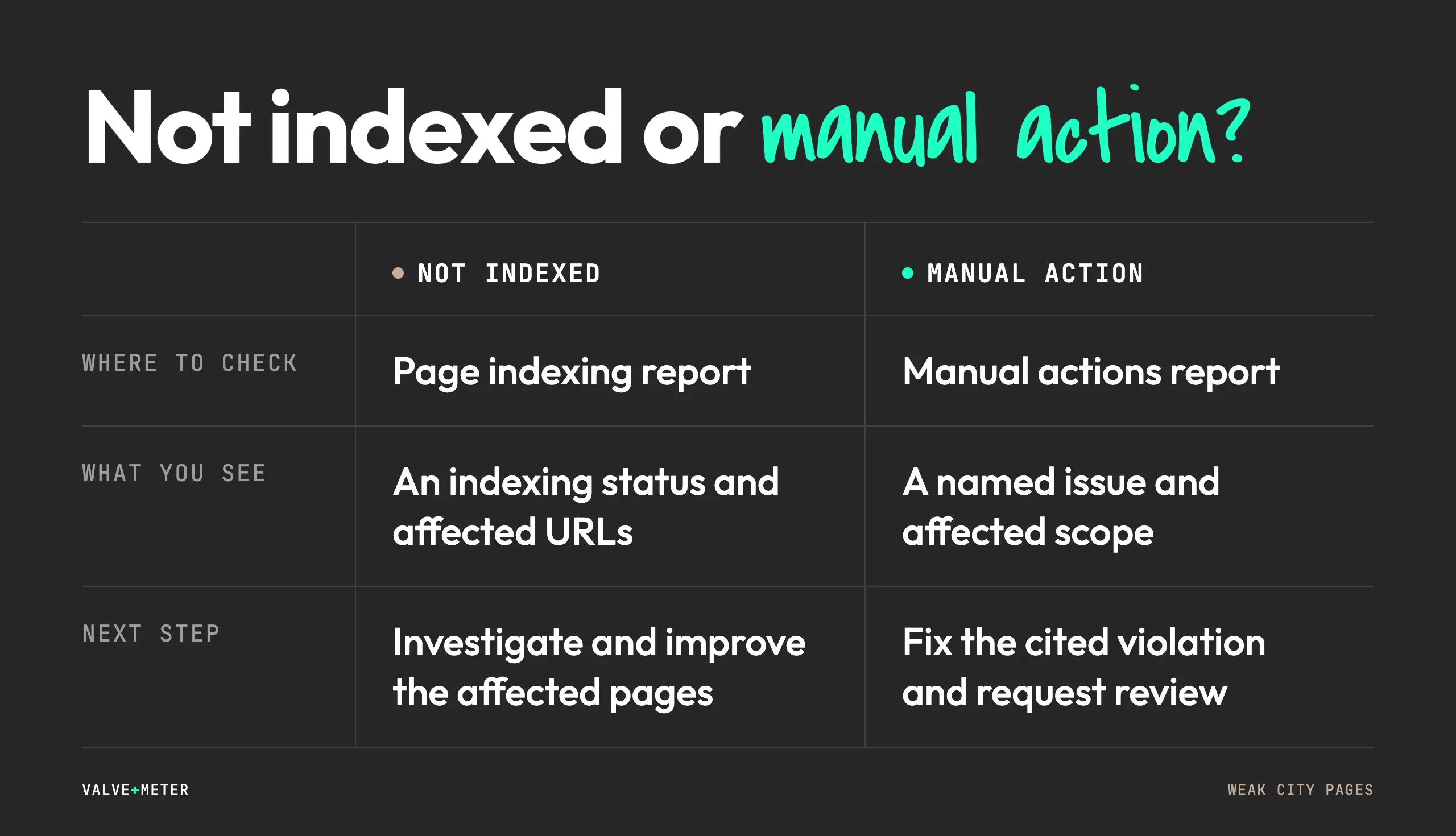
In Search Console this shows up in the Page indexing report, under Indexing, then Pages. Below the chart is a table titled “Why pages aren’t indexed,” and one of its rows is “Crawled – currently not indexed.” Clicking the row opens a list of affected URLs. Google’s description of the status reads: “The page was crawled by Google but not indexed. It may or may not be indexed in the future; no need to resubmit this URL for crawling.”
Weak city pages can turn up under other rows too. “Duplicate, Google chose different canonical than user” means, in Google’s words, that “Google thinks another URL makes a better canonical,” which is common when pages are near copies of one another. “Discovered – currently not indexed” means Google found the URL but has not crawled it yet. If your city pages are missing from one row, check the others, or run a single URL through the URL Inspection tool.
A manual action looks different. It appears in the Manual actions report and in the Search Console message center, and it names the issue. Google says that while one is in place “some or all of that site will not be shown in Google search results.” Removing it requires fixing the problem across the affected pages and submitting a reconsideration request describing what was done.
“Crawled – currently not indexed” comes with no named violation and no reconsideration process. Google’s note says resubmitting the URL is unnecessary, and in our experience repeated indexing requests do not change the outcome. What can change it is adding the local proof and conversion path that make the page worth indexing, combining pages for towns where you have little to show, or removing pages you cannot support. Knowing which of the two situations you are in tells you whether to file a reconsideration request or start working on the pages.
Thin pages at volume and the Sterling Sky case
The documented risk with city pages in large numbers sits under Google’s scaled content policy and its manual action for thin content. The spam policies page says scaled content abuse “is typically focused on creating large amounts of unoriginal content that provides little to no value to users, no matter how it’s created.” The Manual actions report lists “Doorways” alongside thin affiliate pages and scraped content under one manual action, “Thin content with little or no added value.”
The clearest public example involving location pages comes from Joy Hawkins at Sterling Sky, in a July 2023 post titled Thin Content Shock: Google Can Issue Manual Penalties for Service Area Pages. The business she describes had “over 3,000 locations and corresponding pages on their website,” and the owner had paid to have different content written for each page “by real humans.” He then logged into Search Console and found a manual action for “thin content with little or no added value.” Because that manual action covers doorways as well as other thin pages, the post does not tell us which one Google had in mind.
Hawkins explains that Google “means the same information is on the page, no matter how it is worded,” and that “Unique is not the same thing as ‘not-thin.'” The owner had followed the advice many articles on city pages give, which is to make each page unique. Each page was written separately and none duplicated another word for word, yet every page told the visitor the same things as all the others.
In the city page sets we review, that advice has usually been carried out by rewording the same content for each town, and in this case rewording changed the text without changing what a visitor learned from any page. What a visitor learns from a city page comes from local information: the jobs you have completed in that town, reviews from people who live there, which crew covers it and how quickly they can arrive. Hawkins’s own recommendation points the same way. She suggests embedding reviews from customers in that specific area, pulled from a directory profile such as Yelp or HomeStars. Pages built around that kind of local proof are the basis of service area SEO, and the same standard applies to content quality across a site.
John Mueller’s 2019 comment and the 1,300 pages behind it
The quote that turns up in many articles on this subject comes from December 2019, when Search Engine Roundtable reported an exchange on Twitter under the headline Google Warns: City Landing Pages Can Be Doorway Pages & Against Guidelines. An SEO had described a plan to build 1,300 city landing pages aimed at ranking for a keyword plus each city name. Google’s John Mueller replied: “That sounds like doorway pages, not something I’d recommend.”
Articles that cite this quote rarely mention the 1,300 pages. The post does not describe the business behind the plan, but a set that large very likely includes towns the business rarely or never works in, and pages for those towns would have nothing local to say.
The Hilliard heating and cooling company, with pages for Dublin and Upper Arlington where its trucks run every day, is in a different position, and the quote is a poor basis for warning that company off a handful of city pages.
Frequently asked questions
Will Google penalize me for having city pages?
Having city pages does not violate Google’s policies on its own. A manual action is possible for a large set of thin pages, as the Sterling Sky case shows, but the outcome Valve+Meter sees much more often is that weak city pages are crawled and not indexed.
How many city pages is too many?
Google has not published a number, and any specific threshold you read is a guess. The useful limit is the number of towns where you can show completed jobs, local reviews and a crew that covers the area.
Does rewriting each page make it safe?
Rewriting alone does not make a page safe. The business in the Sterling Sky case had separate human-written copy on more than 3,000 pages and still received a manual action for thin content.
What is the difference between a doorway page and a landing page?
A landing page is where a visitor is meant to act: call, book or request a quote. A doorway page is meant to rank and then send the visitor somewhere else to act. A city page with its own phone number, form and local proof is a landing page, while a city page whose main job is routing visitors to a sitewide contact page matches what the policy describes.
Deciding which city pages to keep, build or remove
Google’s definition of doorway pages is narrower than the warnings around it suggest, and the pages most at risk are thin ones produced in volume. Open the Page indexing report, find which of your city pages are listed as not indexed, and run each one through the three questions. Pages for towns where you have completed work can usually be built up, and pages for towns where you have none are better removed until that changes.
Get a free marketing assessment and we will go through your city pages with you as part of a local SEO review and tell you which ones are worth keeping.