





Most contractors should not build a page for every city they serve. The ones who do usually end up with a few city pages that rank and a long list that Google crawls and never indexes. A service area page is a claim that your business does real work in a particular place, and Google has little reason to believe that claim until the page gives it something to go on. Each page you publish is one more claim you have to back up with completed jobs, local customers and a technician who covers the town. For most contractors serving 15 to 60 towns from one or two shops, the number of markets they can back up is well below the number of towns their trucks visit, and that smaller number is how many city pages they should have today.
Why contractors build a page for every city
The reasoning is easy to follow: you serve Carmel, you want to show up when someone in Carmel searches for a plumber, so you build a Carmel page, and then you do the same for every town on the dispatch board. Many contractors were told to do this by a web vendor or a previous agency.
Take a plumbing contractor with a main shop in Fishers, Indiana, and a second shop in Greenwood. It runs eleven trucks and lists 34 towns on its service area map, from Tipton and Kokomo in the north to Franklin and Martinsville in the south. Its website already has a page for each of the 34 towns, most of them written from one template with the town name swapped.
Publishing a page does not by itself make Google treat the business as relevant in that town. In Valve+Meter’s client work, a city page has to clear the same bar as any other page in organic search: useful enough to index, and then better than the other pages competing for the same search. When a site has dozens of city pages that differ mainly by town name, we usually see Google index a handful and leave the rest out. The pages also divide whatever evidence the business has. A Noblesville homeowner who finds a page with twelve reviews from Noblesville customers has more reason to call than one reading a page that also tries to cover Cicero, Sheridan and Westfield.
How many service area pages is too many?
The ceiling on city pages is the amount of evidence a business has for each market and the time it has to keep that evidence current. A useful city page carries information only that contractor could supply about that town: jobs completed there, customers who live there and reviewed the work, photos from those jobs, and the technician who runs those calls. A paragraph about the town does not count, because any competitor could write the same paragraph. Each page also needs upkeep after launch: new photos and reviews as jobs come in, links from the service and regional pages, and a check every few months for stale examples. For a business where the office manager also handles marketing, that upkeep limits the number of pages about as much as the evidence does.
That gives a test you can run against your own job history in an afternoon:
For each city, can you name a completed job there, a customer who lives there, a photo from that job, and the technician who covers the town?
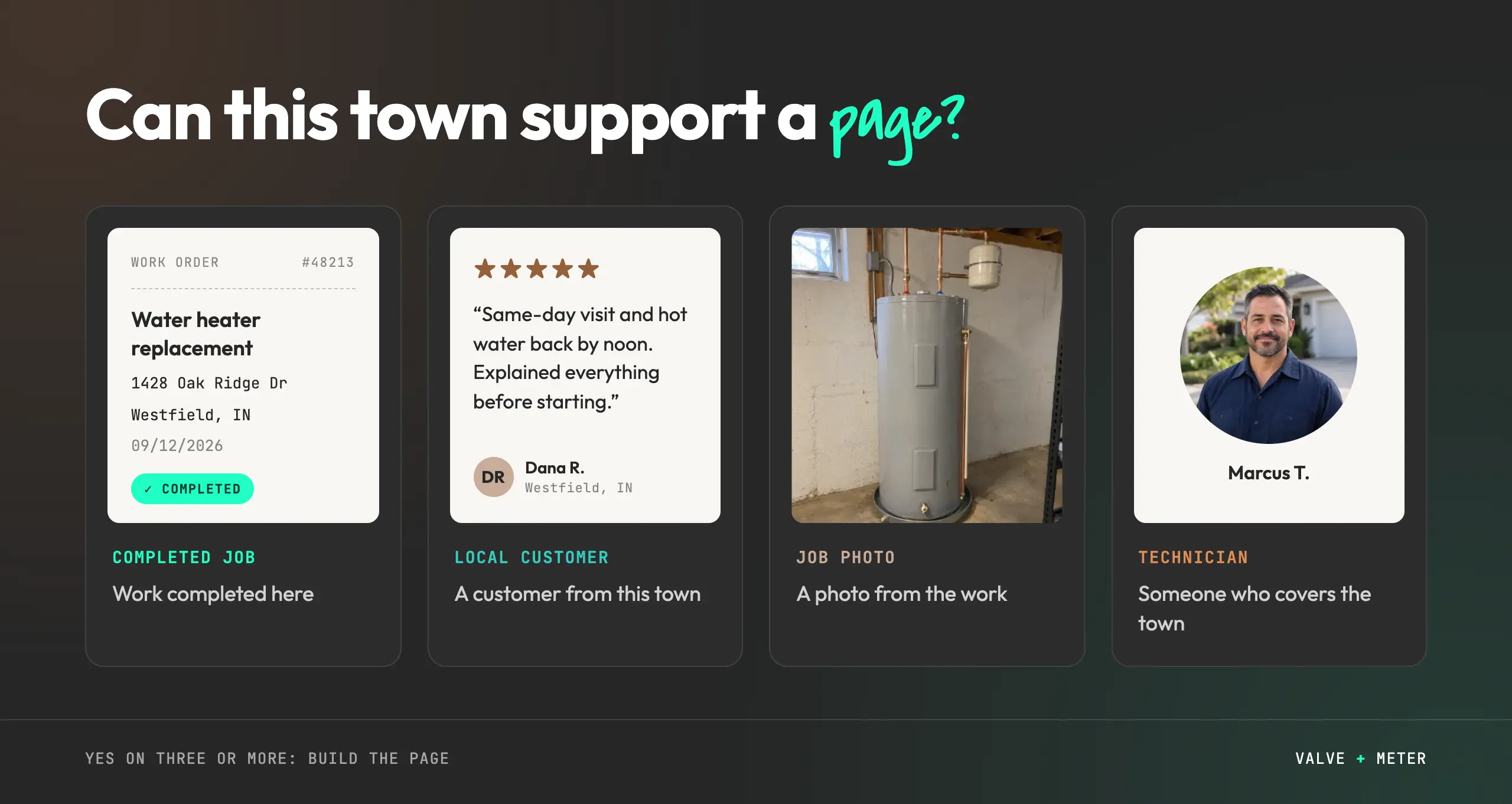
If the answer is yes on at least three, the town can support a page now. The bar is intentionally low: one job and one customer will not make a page rank by themselves, but a contractor who cannot produce even that much for a town has nothing to put on the page except the town’s name.
For the Fishers plumber, the office manager ran all 34 towns through the test in about two hours using the field service software. Six towns passed easily: Fishers, Noblesville, Carmel, Westfield, Greenwood and Franklin. Each had dozens of jobs in the past year, reviews that named the town, and a technician who lived nearby. Fourteen more had jobs and customers but no usable photos or no consistent technician. The remaining fourteen had a few scattered calls or none.
Whitespark, one of the more credible names in local search, recommends “a range of 10 to 15 city pages, max” for a business trying to rank in towns where it has no address, on the reasoning that ranking in 25 or more neighboring towns is unlikely. The post offers it as a judgment call, with no data behind it. Your own job history is a better guide to how many pages your business can support.
What happens when you overbuild
When a contractor publishes 34 city pages with real evidence for six towns, the likely result is that most of the pages never show up in search at all. In the page indexing report in Search Console, these appear as “Crawled – currently not indexed,” which Google’s documentation describes this way: “The page was crawled by Google but not indexed. It may or may not be indexed in the future.” In V+M’s experience, template city pages are some of the most common pages to end up in that state. A page in this state has not been penalized; Google has just decided not to show it.
Google’s spam policies do address city pages, under doorway abuse. Google defines doorways as pages “created to rank for specific, similar search queries” that “lead users to intermediate pages that aren’t as useful as the final destination,” and one of its examples is “having multiple domain names or pages targeted at specific regions or cities that funnel users to one page.” The problem Google describes is a page that exists to pass visitors along to a more useful page. A Westfield page with Westfield jobs, Westfield reviews and a way to book a call is a destination in its own right. A Westfield page whose only content is a paragraph and a button to the main plumbing page fits Google’s description much more closely. Even so, V+M sees far more template city pages go unindexed than receive any manual action.
When every city page on a contractor’s site has the same length, the same sections and the same review widget, V+M treats that as a reliable sign that the pages were built from a template rather than from a town-by-town review of the business. If your own pages look like this, start by giving the strongest towns their own jobs, reviews and photos.
What happens when you underbuild
Suppose the Fishers plumber stopped at its first six city pages and never added more. A year later its trucks are in Anderson every week, its reviews mention Anderson, and almost nobody searching in Anderson sees the company.
Google lists relevance, distance and prominence as the main factors in local results, and distance “refers to how far each business is from the customer who’s searching.” Relevance and prominence respond to local SEO work on the Business Profile and around it. Distance changes only when the business physically sets up somewhere new, by opening a staffed shop, stationing a crew in the area, or acquiring a local operator. A virtual office or mailbox address does not qualify. Google’s Business Profile guidelines say a rented address the business doesn’t operate from “isn’t eligible for a Business Profile.” In V+M’s view, a profile built on one fails for the same reason doorway pages do. For towns outside the radius where your Business Profile can compete, an organic city page is usually the most practical way to appear.
The usual compromise is one “areas we serve” page, or a county page that names a dozen towns in a single paragraph. In our client work these pages seldom rank for any of the towns they list, because each town gets a mention and nothing more. A town where you already have jobs, reviews and a technician should get its own page, because folding it into a list leaves that evidence unused.
The markets that should not get a page yet
Towns that fail the four-part test today still belong somewhere on the site. The Fishers plumber’s fourteen middle-tier towns have real customers, and leaving them off the site would waste that evidence.
The plumber builds two regional pages: one for the northern towns served from Fishers and one for the southern towns served from Greenwood. Each regional page names its towns, describes the work done across them, and carries whatever reviews and photos exist for those towns. These towns can also appear in the service area settings of the Google Business Profile and on the relevant service pages. A regional page is a holding place and is not expected to rank town by town. Its job is to give visitors from those towns a relevant page to land on, to keep the evidence for each town in one spot while it builds, and to link to each town’s own page once it graduates.
A town moves from the regional page to its own page when it passes the test. Technicians photograph every completed job and tag it with the town. The office sends a review request after every call, so reviews from smaller towns build up steadily. Each middle-tier town gets a named technician, even when that person also covers three other towns. The office manager checks job counts by town once a month. When Zionsville has a run of jobs, photos, reviews and a regular technician, it gets a page built from that material, and the regional page links to it.
How to sequence your service area page builds
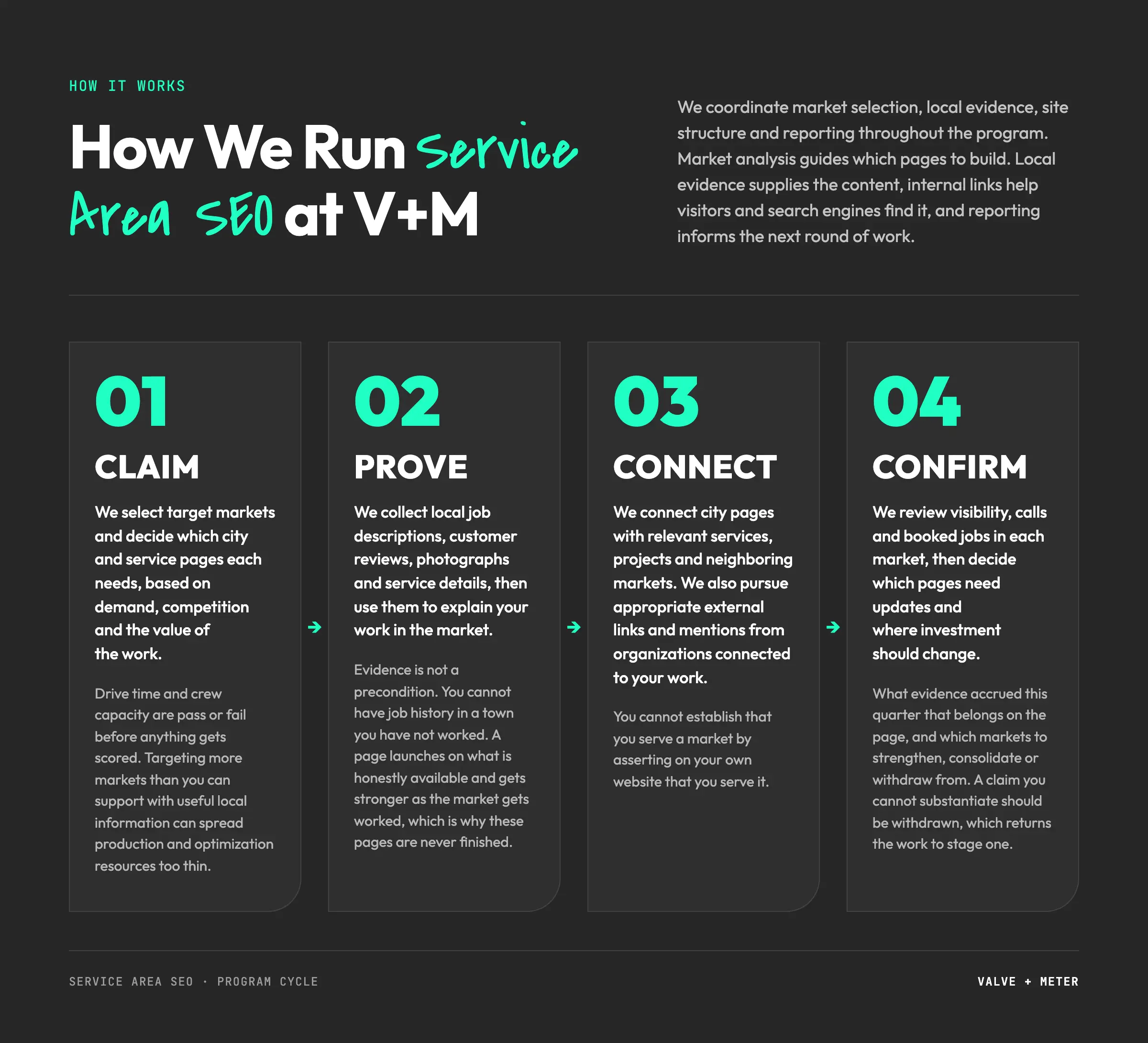
Build full pages for the towns that pass, publish them, collect evidence in the next group of towns, and add pages as those towns qualify. The Fishers plumber’s first year might look like this:
| Quarter | City pages live | Towns added |
|---|---|---|
| Q1 | 6 | Fishers, Noblesville, Carmel, Westfield, Greenwood, Franklin |
| Q2 | 10 | Zionsville, Anderson, Greenfield, Pendleton |
| Q3 | 15 | Plainfield, Avon, Brownsburg, McCordsville, Whitestown |
| Q4 | 20 | Lebanon, Mooresville, Martinsville, Cicero, New Palestine |
In the first quarter, the six pages and two regional pages get built with their full evidence, the other 28 template pages are redirected to the matching regional page, and the office starts photo tagging and review requests. Plainfield, Avon and Brownsburg wait until the third quarter because the plumber only assigned a technician to the west side in the spring. Lebanon and Cicero, at the edge of the northern routes, take the longest, and Mooresville, Martinsville and New Palestine qualify as the Greenwood shop runs more calls south. Martinsville is about as far from Greenwood as Anderson is from Fishers, which is why it makes the list and Kokomo does not.
By the end of the year all fourteen middle-tier towns have pages, twelve towns remain on regional pages, and Kokomo and Tipton have been dropped from the target list. V+M measures a new page by the calls it brings in from its town along with where it ranks. A page that ranks but produces no calls after a few months usually means demand in that town is lower than expected, which is useful to know before building the next one.
The cities you drive through but don’t want
Some towns on a service map are there because a truck can technically reach them. Kokomo is about fifty minutes from the Fishers shop, and the plumber only wants water heater replacements there and in Tipton.
Deciding not to pursue a town is a legitimate result of this exercise. The deciding factors are drive time, average job value in that town, and whether a crew can absorb more calls in that direction without hurting response times closer to home. If you would rather not have more work in a town, leave it off your city pages and remove it from the Business Profile service area so the profile matches where you want to work. The plumber still takes calls from Kokomo when they come in.
Frequently asked questions
How many city pages is too many?
There is no fixed number. Too many is any city page you cannot support with a completed job, a local customer, a photo and a technician who covers the town.
Will Google penalize me for having a lot of city pages?
A manual penalty is unlikely. In our experience, thin city pages usually end up in Search Console as “Crawled – currently not indexed.” Pages built only to send visitors elsewhere can fall under Google’s doorway policy, which is a good reason to make every city page useful on its own.
Should I delete city pages that are not ranking?
Look at the evidence for that town before deciding. If it passes the four-part test, improve the page with the jobs, reviews and photos you have. If it doesn’t, fold the town into a regional page and redirect the old URL to it.
Can I list cities on one page instead?
Yes, for towns that don’t qualify for their own page yet. Expect a regional page to rank poorly for any single town, so the towns where you do the most work should still get their own pages.
Deciding your own number
The number of city pages you should have today is the number of towns where you can name a completed job, a customer who lives there, a photo from that job and the technician who covers the town. Build those pages fully, put the other towns you want on regional pages, and add pages as towns pass the test. Towns you don’t want can come off the list. Building this way is slower than publishing 34 pages at once, but in our client work these pages get indexed and produce calls far more often than template pages do. Our service area SEO page explains how V+M runs this work for contractors.
If you’d like help running the test against your own markets, get a free marketing assessment.