




A home services marketing agency is a firm that generates booked jobs for contractors, HVAC, plumbing, roofing, electrical, and similar trades, through local search, Google Business Profile, paid ads, Local Services Ads, and reputation management. The good ones tie every dollar of spend to phone calls and revenue. The bad ones sell you traffic, lock you into a year, and keep your website when you leave.
That last sentence is the whole problem with this category. Most “best home services marketing agency” lists are written by agencies ranking themselves number one. This guide isn’t that. It’s the checklist we’d hand a contractor who called us and asked, “How do I not get burned again?”
Here’s how to evaluate an agency, what it should cost, and the questions that separate a real partner from a vendor running a playbook.
What a Home Services Marketing Agency Actually Does
Strip away the buzzwords and the job is simple: make the phone ring with people ready to hire, and prove which marketing dollar made it ring.
For contractors specifically, that comes down to a handful of channels that actually move booked jobs:
Local search and Google Business Profile. When someone types “AC repair near me,” you either show up in the map pack or you’re invisible. GBP optimization is the single highest-ROI asset most contractors own, and setting it up right costs nothing but time.
Local Services Ads (LSAs). Google’s pay-per-lead program sits at the top of the results with a “Google Guaranteed” badge. It’s built for the trades, and it’s a different animal than regular Google Ads. Specialized agencies know how to optimize the profile, dispute junk leads, and keep cost per lead down.
Paid search (Google Ads). For emergency and high-intent work, paid ads buy you the top of the page today instead of waiting months for SEO. The catch: in competitive metros like Dallas, Atlanta, and Houston, cost per click runs two to four times the national average, so wasted spend adds up fast.
SEO and service area pages. The long game. Organic rankings are the cheapest lead source per job once they kick in, but the build phase takes three to six months to show traction and a year or more in competitive markets. Worth it, because you own the asset.
Reviews and reputation. Homeowners read reviews before they call. Getting more reviews, responding fast, and showing them off in your marketing lifts your close rate more than most paid tactics.
Speed to lead. The fastest contractor to call back usually wins the job. Missed calls and slow follow-up quietly kill more revenue than a bad ad campaign ever will.
Should You Hire a Home Services Agency at All?
Honest answer: not always. Three paths exist, and each makes sense at a different stage.
| In-house | Agency | Enterprise platform | |
|---|---|---|---|
| Best for | $2M+ with a dedicated marketer | Most growing contractors | Multi-location, 3+ services |
| Cost | One senior hire often costs more than a full agency team | $1,500–$10,000/mo retainer + ad spend | $5,000–$50,000+/mo bundled |
| Speed | Slow to build, fast once staffed | Fast, they already know the trade | It depends |
| Control | Total | Shared | Least, you run their playbook |
| Watch out for | Hard to hire, easy to under-resource | Generalists who don’t know the trades | Asset ownership, thin account management |
If you’re a solo operator or a single-market shop, you probably don’t need a five-figure retainer yet. A dialed-in Google Business Profile, LSAs, and an email list of past customers can outperform a bloated agency package running channels your foundation can’t support.
The 7 Questions to Ask Before You Sign
This is the part to screenshot. Ask every agency you interview these seven questions. The answers tell you almost everything.
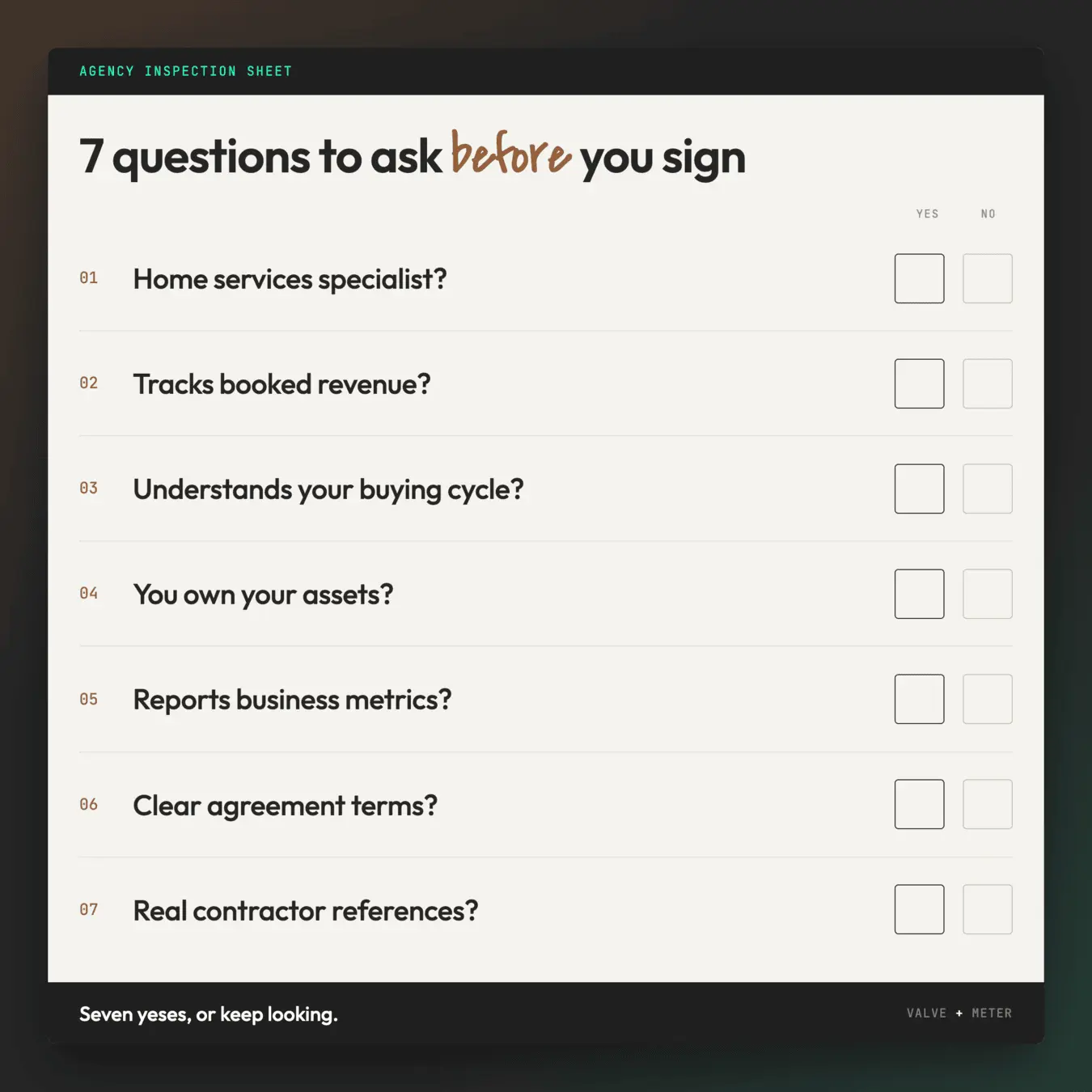
1. Do you specialize in home services, or are we one industry of many?
Roofing and plumbing are completely different businesses. Job values, customer cycles, storm season, emergency callouts, these change everything about how you market. An agency that runs the same playbook for a plumber, a SaaS company, and a dentist will burn your budget learning your trade on your dime. One franchisee signed with a generalist firm that ran ads for “window AC units” instead of central air replacements. Ask specifically. If the best they offer is “home services generally,” keep looking.
2. Can you show attribution to booked revenue, not just leads?
There’s a major difference between a lead and a booked job. A lead is a phone call or a form. A booked job is a paying customer. Ask: “How many phone calls and booked jobs did your last client get from your marketing?” If they pivot to traffic and impressions, that’s your answer. Good agencies track every dollar to jobs. Weak ones hide behind vanity metrics because the revenue numbers aren’t there.
3. Do you understand my buying cycle?
Not all trades convert the same way, and the numbers prove it. Plumbing and water treatment close at 12 to 16 percent with sales cycles measured in days. HVAC, roofing, and remodeling sit in the 3 to 7 percent range with cycles stretching 30 to 90 days. Emergency jobs close same-day. Big installs take weeks of nurture. An agency that doesn’t know this will set the wrong expectations and give up on leads that just needed follow-up.
4. Who owns my website, GBP, and ad accounts if I leave?
This is the one that costs contractors the most. Some of the biggest names in home services build your site on a proprietary CMS you don’t get to keep. When you leave, you’re handed your domain, content, and images, but not the actual website code, so you rebuild from scratch or pay your next agency to. The same trap shows up with call tracking numbers, ad accounts, and reporting dashboards. Get asset ownership in writing before you sign. An agency that keeps your assets hostage knows it can’t retain you on results alone.
5. What’s the reporting cadence, and what metrics?
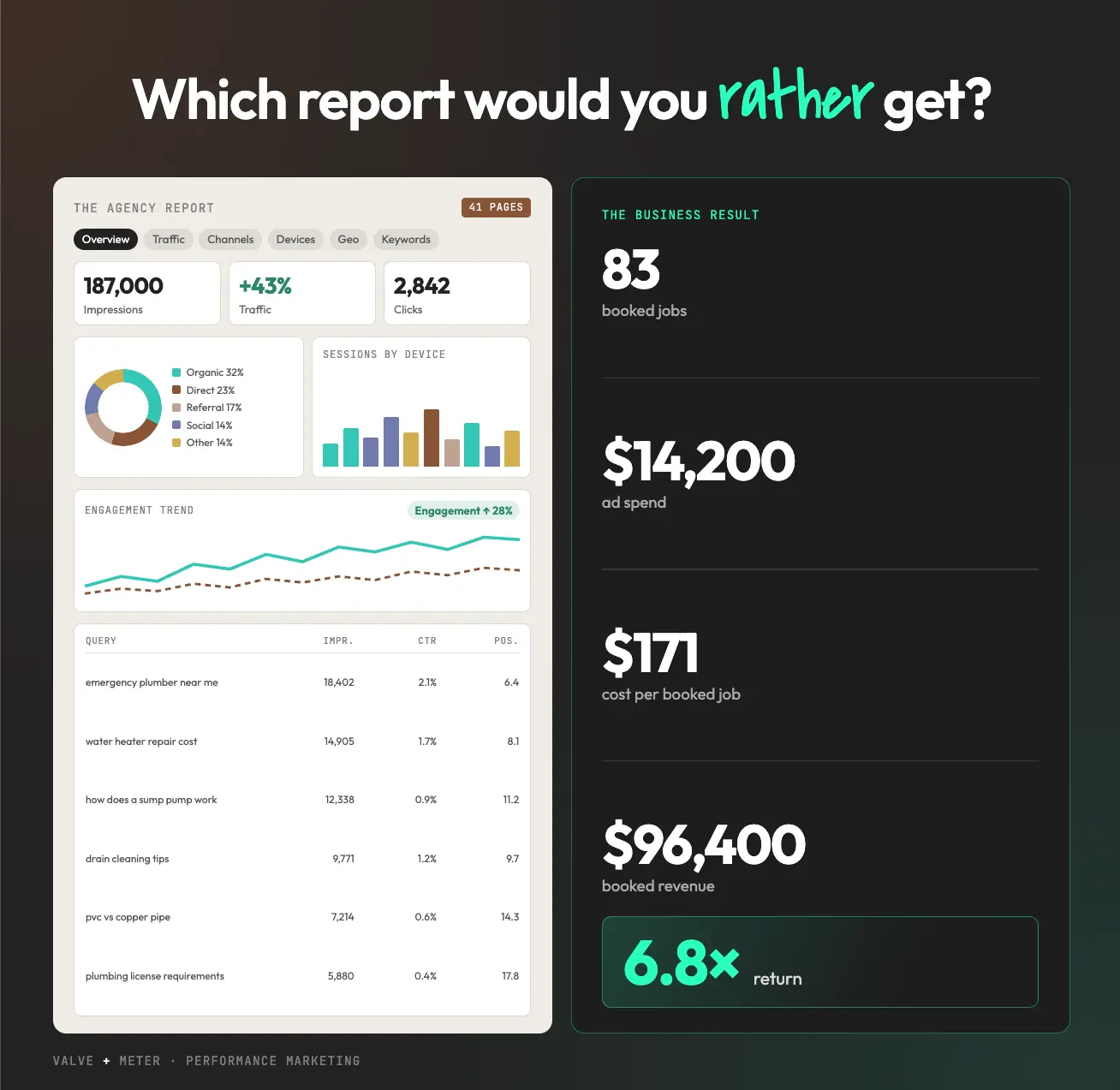
You should get a dedicated point of contact, regular reporting, and numbers you can actually read in ten minutes. The metrics that matter are calls, form fills, booked appointments, cost per job, and revenue contribution. If the report is 40 pages of charts that never mention a booked job, it’s built to impress you, not inform you.
6. How long is the contract, and how do I get out?
Plenty of agencies lock contractors into 12-month deals with zero performance guarantees. Fail to deliver in month two, and you’re still legally on the hook for the other ten. Some pair that with hidden fees, setup charges, data-extraction fees when you leave, or upcharges for basic edits (one contractor got billed $150 every time he wanted to change his holiday hours). Read the cancellation clause first. A year-long commitment isn’t automatically bad. It can align incentives, but only if you can see the exit and there’s accountability built in.
7. Can I talk to a contractor in my trade you’ve worked with?
Not a testimonial on the site. An actual phone number. Ask that reference two things: did the leads turn into booked jobs, and did the agency stay proactive after the honeymoon period? At scale, an overworked account manager juggling dozens of accounts runs the playbook, checks the boxes, and leaves it to you to notice when something needs to change. References tell you which kind you’re getting.
How to Read an Agency’s Results (green flags and red flags)
Once you know the questions, you need to know how to score the answers.
Green flags:
- They quote a real investment range before the sales call, not after a 47-page proposal that never names a number.
- Case studies name a trade, a market, a spend, and a revenue outcome. “$14,200 in ad spend, 83 booked jobs, $171 per job” beats “significant growth.”
- They separate the agency fee from ad spend clearly. Your total cost is always both.
- They ask about your close rate, your capacity, and your margins, because marketing that outruns your ability to book is wasted.
Red flags:
- “We’ll get you number one on Google.” Nobody controls rankings, and anyone promising them is selling.
- Serious lead volume promised for under $1,000 a month. Either it’s done at scale with zero attention on your account, or they’re not really running ads.
- Ownership of your website, data, or tracking numbers stays with them.
- Every case study is about impressions and traffic. Impressions don’t pay your crew.
And here’s the meta red flag for this whole category: an agency that publishes a “top 10 home services marketing agencies” list and ranks itself number one. That’s not research. It’s an ad wearing a lab coat. (Yes, we see the irony of writing that in a guide published by an agency. Which is exactly why we didn’t rank ourselves first, or at all, below.)
What Home Services Marketing Actually Costs
Nobody in this category likes to publish numbers. Here are real 2026 benchmarks so you can walk into any sales call knowing whether you’re being quoted fairly.
The revenue rule. Most growing contractors allocate 7 to 10 percent of annual revenue to marketing. A $5M contractor lands somewhere around $350,000 to $500,000 a year, split between ad spend and agency fees.
Retainer tiers (agency fee, not counting ad spend):
| Tier | Monthly fee | What you get |
|---|---|---|
| Entry | $1,000–$3,000 | Basic campaign setup and maintenance, light-touch management |
| Mid-market | $3,000–$10,000 | Dedicated account management, custom strategy, 20–40 hours of expert attention |
| Enterprise | $10,000+ | Multi-channel strategy, dedicated team, advanced analytics |
Cost per lead by trade (2026 benchmarks):
- Plumbing and pest control: high-volume, fast-converting, lower CPL
- HVAC, landscaping, electrical: roughly $100–$250 CPL, 30–90 day cycles
- Kitchen, bath, and roofing: $350–$500 CPL, but 35–40 percent margins
A few things that are almost never in the retainer: ad spend paid directly to Google, video production, advanced CRM integrations, and (watch for these) setup fees and data-extraction fees when you leave.
The number that actually matters isn’t cost per lead. It’s the cost per booked job, and then the return on that spend. A $4,000-a-month agency delivering exclusive leads that close beats a $1,000 lead vendor selling the same shared lead to four other contractors, every time.
Top Home Services Marketing Agencies to Consider
A short, honest field guide to names you’ll run into. We’ve included ourselves at the bottom, in plain language, and left the rankings off on purpose.
Scorpion. The biggest name in the space, based in Utah, backed by a $100M investment and named ServiceTitan’s preferred marketing partner. Their RevenueMAX platform is AI-driven and built for scale. The tradeoffs are the ones that come with scale: proprietary CMS you may not fully keep, and account management stretched across thousands of clients. Best fit for established contractors with clear growth targets who want a managed platform.
RYNO Strategic Solutions. Long-tenured home services specialist with a proprietary tracking platform (RYNOtrax) and deep ServiceTitan integration. Strong on paper. Contractors have reported account-manager turnover and instability following recent ownership changes, so ask hard questions about who’ll actually run your account.
Blue Corona. Frequently cited as a solid all-arounder for SEO, PPC, and web design that genuinely understands home services, with reporting contractors actually use. Geared toward larger operations.
Hook Agency. Roofing and HVAC focus, known for an SEO-and-Google emphasis, personalized service, and monthly reporting calls with real call and form-fill analysis. A more accessible price point for small-to-mid contractors.
Housecall Pro. Not an agency, a field service platform with marketing tools built in. Worth knowing about if you want software plus light marketing rather than a full-service partner.
Valve+Meter Performance Marketing. That’s us. We’re an Indianapolis-based performance marketing agency built on one idea: math before marketing. We track every dollar to booked jobs, we don’t hold your website or data hostage, and we don’t run the same playbook for a plumber that we’d run for a law firm, because we don’t work with law firms. If you want to see how we approach a specific trade, start with our home services marketing work.
Frequently Asked Questions
What does a home services marketing agency cost? Agency retainers typically run $1,000 to $3,000 a month at the entry level, $3,000 to $10,000 for mid-market, and $10,000+ for enterprise. That’s the agency fee only. Ad spend paid to Google is almost always separate. Most growing contractors budget 7 to 10 percent of annual revenue toward marketing overall.
How is a home services agency different from a general marketing agency? Specialization. The trades have unique mechanics: Local Services Ads, service-area (not storefront) targeting, seasonal demand swings, and emergency search behavior like “AC repair near me.” A generalist agency learns those on your budget. A specialist already knows that roofing and plumbing are marketed completely differently.
How long until I see results? Paid ads and LSAs can produce calls within days of launch. SEO takes three to six months to gain traction and 12+ months in competitive markets. A good agency runs both: paid for immediate jobs, organic to lower your cost per lead over time.
Do HVAC, plumbing, and roofing need different strategies? Yes. Plumbing converts fast, often same-day, at 12 to 16 percent. HVAC and roofing run longer cycles (30 to 90 days) at lower conversion rates but higher job values. Roofing leans on storm-season and financing messaging. Any agency treating all three the same is leaving your money on the table.