




Last updated: August 2026
“According to a statistic I found to prove my point…”
Throughout my career, I’ve tried to push my teams to avoid what I call “tobacco math.” That’s based on the concept of “cigarettes aren’t that bad for you, and here’s some data that proves it,” pushed by the Tobacco Industry Research Committee to craft a narrative it wanted people to believe.
If you want something to be true, you can almost always find a stat to prove it. Even if it’s completely wrong.
Most “local SEO statistics” roundups are the same 30 to 40 numbers, copied from each other, some of them a decade old, with nobody checking whether the original study still exists. Search “local SEO statistics” right now, and you’ll find the same “42% click the map pack” line quoted almost word for word across a dozen sites, and totally contradictory figures for basic questions like how many local searches Google gets.
That’s not research. It’s a photocopy of a photocopy. (And some of the data is so old, it probably remembers what a photocopy is.)
How we sourced this
We went back to the source for every number below: the actual survey, the Google support doc, the expert panel that ran the study. If a stat cites BrightLocal, Google, Whitespark, SOCi, or Semrush, that’s who did the work. Where the “real” number varies a lot by source or year, we say so instead of picking whichever version sounds most impressive.
One note on the sourcing itself: BrightLocal shows up a lot here because they’re one of only a few groups running a rigorous, recurring consumer survey on local search and review behavior specifically. That’s not the same as neutral, though. They sell local SEO software, same as SOCi does. Where a Whitespark practitioner survey, Google’s own platform data, or Semrush’s raw keyword data covers the same ground, we used that instead and said so, because it’s a different kind of evidence than a vendor-run opinion poll, not just a different logo.
In this guide
- How often people actually search locally
- Google Business Profile
- Reviews
- Mobile and “near me” searches
- What actually moves local rankings
- AI and local search
- Who’s actually doing Local SEO
- FAQ: local SEO statistics, answered
How Often People Actually Search Locally
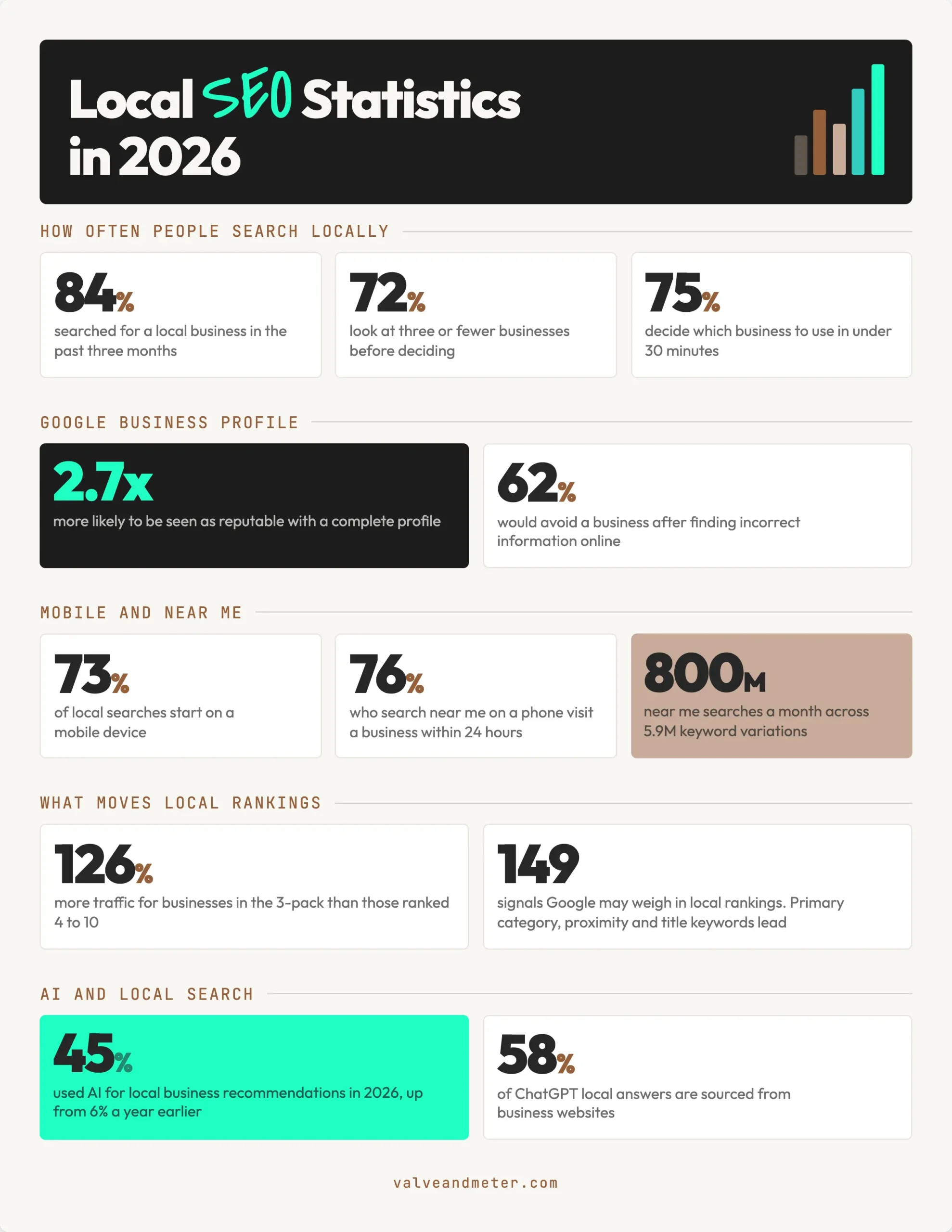
84% of consumers have searched for a local business in the past three months. This isn’t a niche behavior you’re trying to catch people doing. It’s most people, most of the time. Source: BrightLocal, Consumer Search Behavior, 2026
80% of U.S. consumers search for local businesses online at least weekly, and 32% do it daily. Your customers aren’t waiting for a burst pipe to start Googling plumbers. A lot of local search happens before anything’s actually broken. Statista’s independent consumer poll lands in the same range on daily search frequency, which matters more than either number alone. Two separate survey firms converging on it is a better sign than one vendor’s number repeated everywhere. Source: SOCi Consumer Behavior Index, 2024
72% of consumers look at three or fewer businesses before deciding, and only 1% look at more than ten. Ranking on page one isn’t enough if you’re not in the first handful of results someone actually opens. Getting shortlisted matters more than getting indexed. Source: BrightLocal, Consumer Search Behavior, 2026
75% of consumers decide which business to use in under 30 minutes, and 28% decide in under five. Your Google Business Profile and website have to answer the buying question fast: hours, service area, rough pricing, reviews. Otherwise the searcher moves to the next listing before you’ve made your case. Source: BrightLocal, Consumer Search Behavior, 2026
73% of local searches start on a mobile device. Page speed and click-to-call on your site aren’t extras. They’re most of the experience. Source: BrightLocal, Consumer Search Behavior, 2026
There are more than 5.9 million distinct “near me” keyword variations in use in the U.S., generating roughly 800 million searches a month. This one isn’t a survey response. It’s observed search volume pulled from Semrush’s own keyword index. However people describe their own habits when asked, this is closer to what they’re actually typing. Source: Semrush, keyword database analysis
Google Business Profile
A complete Google Business Profile makes customers 2.7x more likely to see a business as reputable, 70% more likely to visit it, and 50% more likely to consider buying from it. This is Google telling you directly, not a third party guessing. Completeness, meaning categories, services, hours, photos, a real description, is the cheapest lever available and it’s underused. Source: Google, official support documentation
In local search results, business websites make up 47% of the first page, directories 31%, and business mentions 16%. Your own website still earns more real estate than any directory. Don’t pour all your effort into listings and skip content on your own domain. Source: BrightLocal, Business Listings Visibility Study, 2024
96% of consumers say it’s important for a local business to actively manage its online presence, and a third call it essential. A profile you set up once and never touch again reads to a searcher like a business that might not still be open. Source: BrightLocal, Consumer Search Behavior, 2026
62% of consumers would avoid a business after finding incorrect information about it online. Wrong hours or a disconnected phone number on an old listing costs you jobs you’ll never know you lost. Source: BrightLocal, Local Business Discovery and Trust Report, 2023
Google Business Profile actions break down roughly as 56% website visits, 24% phone calls, and 20% additional searches. More than half your GBP traffic is landing on your website, not calling you directly. If that site is slow or thin, the profile did its job and your site lost the customer anyway. Source: Google
Reviews
97% of consumers read reviews for local businesses. This is close to universal. Treat review management as part of running the business, not as a marketing add-on. Source: BrightLocal, Consumer Search Behavior, 2026
Consumers check an average of six different review sites before choosing a business. Google reviews alone don’t cover it. Facebook, Apple Maps, and trade-specific directories are getting checked too. Source: BrightLocal, Consumer Search Behavior, 2026
Google’s share of review research dropped from 83% in 2025 to 71% in 2026, while Apple Maps usage nearly doubled to 27%. If Google is the only listing you’ve claimed and kept current, you’re now missing a real and fast-growing chunk of the research happening before someone calls you. Source: BrightLocal, Consumer Search Behavior, 2026
47% of consumers won’t use a business with fewer than 20 reviews. That’s a hard floor, not a preference. Five stars on six reviews still reads as thin. Source: BrightLocal, Consumer Search Behavior, 2026
74% of consumers only weigh reviews written in the last three months. A strong review from two years ago is doing almost nothing for you today. Asking for reviews needs to be a routine built into how a job closes out, not a one-time push. Source: BrightLocal, Consumer Search Behavior, 2026
For every 25% of its reviews a business responds to, conversion-oriented actions on its Google Business Profile improve by 4.1%. This isn’t someone saying they’d probably be more likely to use you. It’s measured behavior: actual calls, clicks, and direction requests, tracked across real GBP accounts. Responding to reviews, especially the bad ones, costs almost nothing and shows up in the numbers. Source: SOCi, State of Google Reviews research
When a business raises its average star rating by one full point, calls, clicks, and direction requests from its Google Business Profile improve by 44%. Same kind of evidence as above: outcome data, not opinion. Getting from 3.8 to 4.8 stars isn’t a vanity project. It moves the actions that turn into booked jobs. Source: SOCi, State of Google Reviews research
Mobile and “Near Me” Searches
76% of people who search “near me” on a smartphone visit a business within 24 hours, and 28% of those visits turn into a purchase. Near-me intent converts fast. If you’re not visible in that moment, the job usually goes to whoever is. Source: Google / Think with Google
“Near me” search interest has grown enormously over the past decade, but the exact growth number you’ll see quoted (500%, 900%, and everything between) depends entirely on which source and time window someone picked. Google’s own trend data shows the “near me” interest index sitting around 5 to 6 for most of the 2010s and holding in the mid-50s to mid-60s through 2024 to 2025. However you slice it, the growth is real and the trend hasn’t reversed. We’re flagging the range instead of repeating whichever multiplier sounded biggest, because that’s exactly the kind of stat that gets recycled without anyone checking it. Source: Google Trends, historical interest-over-time index
What Actually Moves Local Rankings
Local Map Pack rankings are most influenced, in order, by three factors: primary Google Business Profile category, proximity of the business address to the searcher, and keywords in the GBP business title. The fastest fix on this entire page is confirming your primary category is actually right. A miscategorized profile can undercut everything else you’re doing. Source: Whitespark, Local Search Ranking Factors survey, 2026
Local organic rankings are driven by a different set of factors: a dedicated page for each service, geographic keyword relevance in your content, and the quality of your inbound links. Ranking in the map pack and ranking organically are two different games. A page built for “water heater repair in [your city]” does work a generic “our services” page can’t.
Businesses that rank in the Google 3-pack get 126% more traffic and 93% more actions (calls, clicks, direction requests) than businesses ranked 4th through 10th. That’s the real size of the gap between being on page one and being in the map pack. It’s not a small edge. It’s most of the value. Source: SOCi research report
Google may weigh as many as 149 individual signals in local search rankings. No single fix carries the whole result. Worth remembering next time someone pitches you a silver bullet. Source: Whitespark, Local Search Ranking Factors survey, 2026
AI and Local Search
45% of consumers used ChatGPT or another AI tool for local business recommendations in 2026, up from just 6% one year earlier. That’s the fastest behavior shift on this page. Most local competitors haven’t adjusted their online presence for it yet, which is an actual opening rather than a reason to panic. Source: BrightLocal, Local Consumer Review Survey, 2026
Businesses generally need more review depth and more dedicated service content to show up in AI-generated local recommendations than to rank well in a traditional Google search. Ranking on Google isn’t the same as getting mentioned by ChatGPT or Gemini. AI recommendations lean harder on review volume and content that’s specific to a single service, not general “about us” copy. Source: SOCi Local Visibility Index, 2026
ChatGPT pulls its local search answers from business websites 58% of the time, business mentions 27% of the time, and online directories 15% of the time. Your own site is doing more of the work in AI answers than your directory listings are. Directories help people find you. Your website is what actually gets quoted. Source: BrightLocal, “Uncovering ChatGPT Search Sources,” 2024
Who’s Actually Doing Local SEO
58% of businesses don’t optimize for local search at all. More than half your competitors have left this on the table. That’s the opportunity, not a scare tactic. Source: ReviewTrackers
94% of high-performing brands have a dedicated local marketing strategy, compared to 60% of average performers. The gap isn’t access to some secret tactic. It’s whether there’s an actual plan behind the claimed listing. Source: BrightLocal, Brand Beacon Report, 2024
Only 35% of small businesses have a fully claimed Google Business Profile. Claiming and verifying yours is a same-day fix most competitors in your market still haven’t made. Source: SMB Marketing Report, 2025
FAQ: Local SEO Statistics, Answered
How often do people search for local businesses?
Most of the time. 84% of consumers have searched for a local business in the past three months, and 80% search at least weekly, with 32% searching daily. (BrightLocal, SOCi)
How many reviews does a local business need?
47% of consumers won’t use a business with fewer than 20 reviews, and only reviews from the last three months carry real weight for 74% of consumers. Twenty is the floor, not the goal. (BrightLocal)
Does a complete Google Business Profile actually matter?
Yes, measurably. A complete profile makes customers 2.7x more likely to see a business as reputable, 70% more likely to visit it, and 50% more likely to consider buying from it. (Google)
How much local search happens on mobile?
73% of local searches start on a mobile device, and 76% of people who search “near me” on a smartphone visit a business within 24 hours. (BrightLocal, Google)
Are people using AI tools like ChatGPT to find local businesses?
Increasingly, yes. 45% of consumers used ChatGPT or another AI tool for local business recommendations in 2026, up from 6% a year earlier. (BrightLocal)