




Google does not publish a formula for local search rankings. It does, however, tell us the broad criteria it uses. Local results are primarily determined by relevance, distance, and prominence: how closely a business matches the search, how close it is to the searcher, and how established or well known it appears to be. Google also specifically points to links, reviews, and ratings as inputs that can contribute to prominence.
That leaves a large gap between knowing how Google describes local search and knowing what to do about it. For nearly two decades, local search practitioners have tried to close that gap through testing, observation, and research. The best-known example is Whitespark’s Local Search Ranking Factors report, which collects the opinions of experienced local search professionals about the signals most likely to influence Local Pack, Maps, organic, and now AI search visibility. The 2026 edition continues a study first developed in 2008 and maintained by Whitespark since 2017.
These studies are valuable, but they can be misused. A list of ranking factors is a description of the environment in which a business competes. It is not a universal local SEO plan. Two businesses can have the same objective, operate in the same city, and need completely different work because their existing strengths and weaknesses are different.
For businesses that depend on a local market, particularly home service companies covering large metropolitan service areas, that distinction matters. The goal of local SEO is not to accumulate as many optimizations as possible. It is to improve visibility in the places, for the services, and among the customers that can create business value.
What Are Local SEO Ranking Factors?
Local SEO ranking factors are the signals that appear to influence whether and where a business is shown for geographically relevant searches. Some are explicitly described by Google. Others have been identified through industry research, testing, and repeated observation.
They affect several related but distinct search environments. A business can appear in Google’s Local Pack, in Google Maps or the Local Finder, and in the traditional organic results underneath them. Increasingly, businesses also need to consider whether they are visible when AI-powered systems answer local questions.
Those surfaces overlap, but they do not weigh every signal equally. Moz notes that the same business may rank differently in Maps, the Local Finder, and organic search, and that ranking-factor research remains observational rather than a window into Google’s proprietary algorithm.
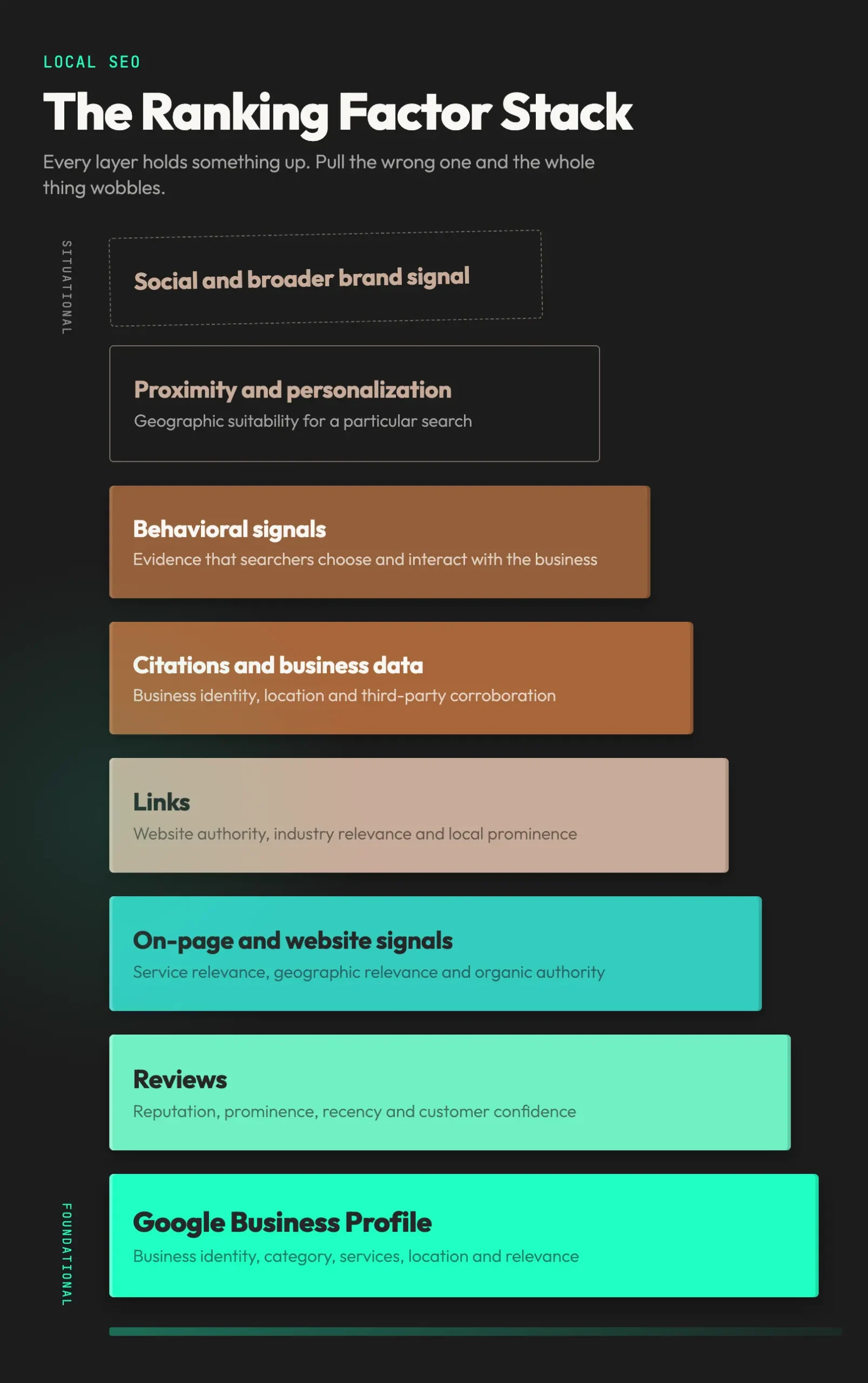
Most local SEO factors can be organized into several broad groups:
| Ranking factor group | What it helps establish |
|---|---|
| Google Business Profile | Business identity, category, services, location and relevance |
| Reviews | Reputation, prominence, recency and customer confidence |
| On-page and website signals | Service relevance, geographic relevance and organic authority |
| Links | Website authority, industry relevance and local prominence |
| Citations and business data | Business identity, location and third-party corroboration |
| Behavioral signals | Evidence that searchers choose and interact with the business |
| Proximity and personalization | Geographic suitability for a particular search |
| Social and broader brand signals | Recognition, mentions, engagement and external validation |
The importance of those groups changes depending on whether the objective is Maps visibility, localized organic rankings, or visibility in AI-generated answers.
Google’s Three Core Local Ranking Factors
Google’s own description is the safest place to begin. It says local search is primarily based on relevance, distance, and prominence. Virtually every specific ranking factor discussed in the local SEO industry can be understood as contributing to one or more of those concepts.
Relevance
Relevance describes how closely a business matches what someone is searching for. A company may be geographically close and extremely well reviewed, but Google still needs enough information to determine that it provides the service the searcher needs.
Google Business Profile categories are an obvious relevance signal. So are the services associated with the profile, the page connected to the listing, service pages on the website, headings, copy, structured data, internal links, and language customers use when describing the business in reviews.
For a plumbing company, there is a meaningful difference between Google understanding that the company is generally a plumber and understanding that it offers sewer line replacement, tankless water heater installation, emergency drain cleaning, and sump pump repair. Greater clarity increases the number of relevant situations in which Google can confidently consider the business.
Distance
Distance is the physical relationship between the business and the person conducting the search, or between the business and a geographic location specified in the query. When a location is not explicitly included, Google uses the location information available to it about the searcher.
This makes proximity unusually important and unusually frustrating. An SEO team can improve a website, build links, earn reviews, and optimize a Business Profile. It cannot change where the searcher happens to be standing.
Service-area settings do not turn a single business address into a physical presence throughout an entire metropolitan area. A contractor headquartered on one side of Indianapolis may serve customers 30 or 40 miles away, while Google still evaluates the physical relationship between that business and searchers throughout the market.
Strong relevance and prominence can overcome some geographic disadvantage; Google explicitly notes that a business farther away may still be selected if its algorithm believes it is a better result. But proximity remains one of the defining constraints of local search.
Prominence
Prominence is Google’s assessment of how well known and established a business appears to be. Google’s documentation specifically mentions information such as websites linking to the business, the number of reviews it has, and positive ratings.
In practice, prominence is assembled from a much broader online footprint. Reviews, backlinks, local news coverage, industry associations, citations, brand mentions, community relationships, and other independent evidence can all help establish that a business is a legitimate and recognized participant in its market.
Prominence also illustrates why local SEO cannot be reduced to GBP optimization. A Google Business Profile may be the most visible local search asset, but the website and the larger digital footprint surrounding the business help Google understand what that profile represents.
Local Pack Rankings and Local Organic Rankings Are Different Competitions
One of the most consequential distinctions in local search is also one that many ranking-factor articles move through too quickly.
The businesses appearing in the Local Pack are not necessarily the websites appearing first in the organic results below it. The two search environments share information, but the relative influence of that information differs.
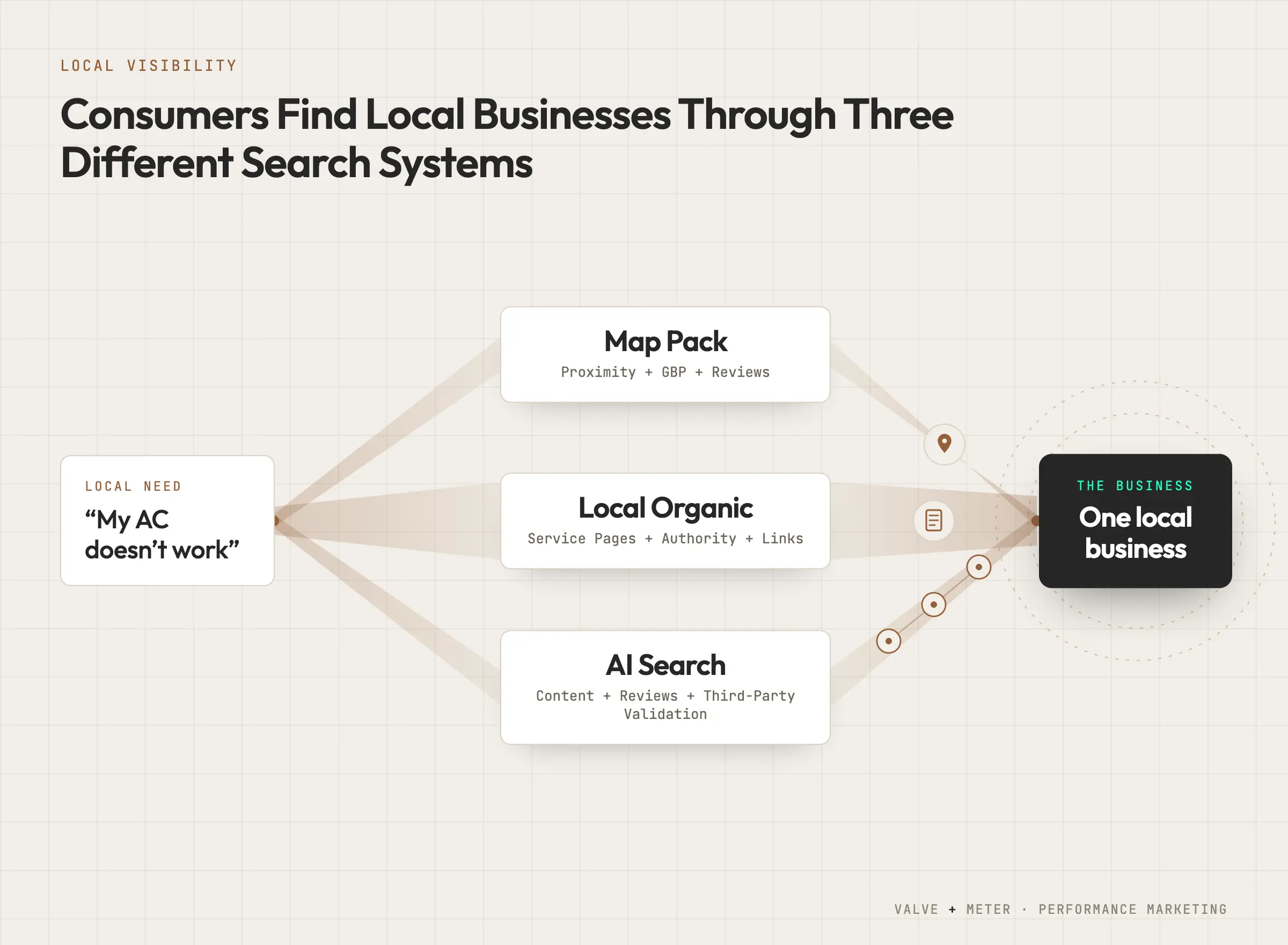
BrightLocal’s summary of the current Whitespark research places Google Business Profile signals and reviews at the top of the grouped Local Pack factors. For localized organic results, on-page signals and links carry substantially more weight in the expert survey.
The individual factors tell a similar story. Among the strongest Local Pack factors identified by the survey are primary GBP category, proximity to the searcher, keywords legitimately present in the business name, the business’s physical location, operating hours, ratings, reviews, and additional GBP categories. For localized organic search, dedicated service pages, geographic relevance, inbound links, internal linking, service-related website content, and title and heading optimization feature prominently.
For a home service company, that difference can produce a familiar pattern. An HVAC contractor may perform extremely well in Maps within a few miles of its office but fade quickly as searches move toward the edges of its service territory. The same company can simultaneously rank organically for service-and-city searches throughout the metro because its website is not subject to the same point-to-point proximity constraint.
A useful local SEO program has to measure and work on both.
Google Business Profile Ranking Factors
A Google Business Profile is Google’s most direct source of structured information about a local business. Google itself recommends keeping the profile complete and accurate and specifically calls attention to address, hours, categories, and other business information.
Not every field has the same value, however, and profile optimization is more useful when the work reflects how each element contributes to relevance, visibility, or conversion.
Primary Business Category
The primary category is consistently identified by local search practitioners as one of the strongest controllable Local Pack signals. In the current Whitespark-derived ranking list summarized by BrightLocal, it is the highest-rated individual Local Pack factor.
The category should describe what the business actually is, using the most specific accurate option available. An HVAC contractor that qualifies for a more specific category may create a stronger match than a business relying on an unnecessarily broad classification.
Category selection is not something that should be completed at launch and forgotten. Google’s available categories change, businesses expand their services, and competitors can reveal category opportunities worth examining.
Additional Categories
Secondary categories broaden Google’s understanding of the legitimate services associated with the business. They should reflect genuine business activities rather than becoming a list of every category that might produce search volume.
For a home service company offering HVAC, plumbing, and electrical services, additional categories can be particularly important because the business may need to establish relevance across multiple distinct service categories without obscuring its primary identity.
Business Name
Keywords in a legitimate business name can create an uncomfortable competitive reality in local search. Businesses whose actual names happen to contain a high-value service or geographic term may receive a relevance advantage.
That does not make keyword stuffing a viable optimization tactic. Google’s guidelines require the profile name to reflect the business’s real-world name. Adding services or locations that are not part of the actual name introduces policy risk and should not be confused with optimization.
The Website Page Connected to the Profile
The page associated with a Google Business Profile helps connect Google’s business entity to the company’s website. For a single-location business, that may be the homepage. For a multi-location business, a dedicated location page may provide a clearer relationship between the profile and its corresponding physical location.
The authority and relevance of that landing page matter. A weak location page containing little more than an address and phone number provides Google and customers with much less information than a page containing legitimate location-specific services, people, reviews, projects, service areas, and internal links.
Business Hours and Availability
Operating hours have become especially consequential for searches in which immediate availability matters. The current expert ranking-factor research places being open at the time of the search among the leading Local Pack factors.
That has obvious implications for restaurants and retail, but it can also matter substantially in home services. Searches for an emergency plumber, no-heat furnace repair, electrical problems, or emergency water damage restoration often have an immediate need behind them.
Hours should reflect actual operations. Extending them solely to appear available creates a poor customer experience and can create problems well beyond SEO if calls consistently go unanswered.
Business Description
The GBP description gives a business inexpensive additional space to describe its services, specialties, geographic context, and differentiators in language that both customers and machines can process.
The industry is not unanimous about whether description optimization produces a direct Local Pack ranking improvement. We view that uncertainty differently from a reason to leave the field underdeveloped. It is a low-cost opportunity to provide additional business context, and there is little justification for forcing Google or an AI system to infer information that the company can state accurately itself.
Posts, Photos and Ongoing Profile Content
Google Business Profile posts and fresh visual content provide another layer of business information beyond the static profile fields. Posts can describe services, recent projects, offers, community activity, seasonal needs, and other current information about the company.
In our own work, we find that GBP posting contributes to local visibility and AI search performance, even though some industry surveys rate post quantity as a weak direct Local Pack ranking factor. We do not treat that discrepancy as a reason to stop posting. The cost of publishing useful profile content is relatively low, while the same activity can support discovery, entity understanding, conversion, and visibility beyond the conventional Local Pack ranking model.
The same principle applies to photographs. Authentic photos of employees, vehicles, storefronts, projects, equipment, and completed work provide evidence about the actual business in a way a stock-photo library cannot.
Reviews and Local Search Rankings
Reviews occupy an unusual position in local SEO because they can affect visibility while also influencing what happens after the business becomes visible.
The current Whitespark-derived survey gives reviews considerably more importance for Local Pack results than for localized organic rankings. Google itself says that more reviews and positive ratings can help local ranking.
There are several dimensions to consider.
Review Quantity
The raw number of reviews is easy to see, but there is no universal number that makes a business competitive. A contractor with 125 reviews may appear extremely credible in one market and dramatically under-reviewed in another where the leading competitors have thousands.
Review quantity therefore needs competitive context. The practical issue is not whether the company has reached an arbitrary benchmark, but whether its review profile provides enough evidence of customer activity and reputation compared with the businesses Google is already rewarding.
Review Recency and Velocity
A business earning reviews steadily presents a different picture from one whose review count was accumulated several years ago and has barely changed since.
Industry research regularly identifies both review recency and steady review growth among the meaningful review signals. The current BrightLocal summary of the Whitespark study includes both recency and steady growth among the top Local Pack factors.
For an active home service company completing hundreds or thousands of jobs each year, an absence of recent reviews can also create an obvious disconnect between business activity and public reputation.
Rating
Ratings affect more than algorithmic prominence. They influence which result a customer is willing to call.
A business competing in the Local Pack is not simply trying to become one of three businesses Google displays. It is competing for selection once the searcher sees those businesses side by side. Review count, rating, recency, and the substance of the reviews all contribute to that decision.
Review Content
Review text gives Google additional information about the work a business actually performs. When customers naturally mention an air conditioner installation, water heater repair, neighborhood, technician, or specific problem, those comments create context that a star-only review cannot provide.
Review acquisition should not become a keyword-generation scheme. Businesses should ask customers for authentic feedback and make it easy for them to describe the experience in their own words.
Website and On-Page Local SEO Signals
The website plays a larger role in local visibility than a GBP-centric view of local SEO suggests. That becomes particularly apparent in localized organic search, where on-page signals lead the grouped ranking factors in the current expert survey.
A well-structured local website helps Google understand which services the company provides, which markets matter, how those services relate to one another, and whether the business has enough depth to deserve organic visibility.
Dedicated Pages for Core Services
A company offering ten materially different services usually should not expect a single generic services page to perform equally well for all ten.
Dedicated pages allow the website to develop depth around high-value services. An HVAC company can explain AC repair differently from AC replacement, heat pump installation, furnace repair, indoor air quality, and maintenance. A plumber can separate drain cleaning, sewer repair, water heaters, repiping, sump pumps, and emergency plumbing.
The current Whitespark-derived research places a dedicated page for each service at the top of the individual localized organic factors.
Those pages also become destinations for internal links, local links, GBP landing-page relationships, paid traffic, and supporting informational content.
Location and Service-Area Pages
Location pages need to correspond to how the business actually operates.
A company with five staffed physical locations has five distinct local entities that should have meaningful location pages supporting their respective Google Business Profiles. A service-area company may also need pages addressing important markets where it performs significant work, but those pages serve a different purpose.
Simply producing dozens of pages in which only the city name changes creates very little local evidence. Strong service-area content can incorporate the services that matter in that market, actual work completed there, testimonials, geographic considerations, operating details, and useful information specific to customers in that area.
For a company serving Indianapolis and surrounding communities such as Carmel, Fishers, Noblesville, Westfield, and Greenwood, the objective is not to mention every suburb as many times as possible. The website should contain enough meaningful geographic structure for Google to understand how the company serves the larger market and enough unique local evidence for the pages to deserve individual visibility.
Geographic Relevance
Geographic optimization becomes weak when it is treated as an exercise in inserting place names. Search engines already know that a page containing “Carmel” 27 times is about Carmel. The harder question is whether the page contains anything demonstrating that the business has a credible relationship with Carmel.
Local projects, customer stories, neighborhoods served, local operating considerations, photographs, directions, employees, community participation, and other genuine information can create geographic specificity without turning the page into a collection of location modifiers.
Internal Linking
Internal links help search engines discover pages, understand their relationships, and distribute authority throughout the site. The current ranking-factor research includes internal linking among the leading localized organic signals.
For local businesses, internal linking is particularly valuable because service and geography create overlapping content structures. A central AC repair page may connect to relevant market pages, repair-cost content, emergency service information, related HVAC services, and local case studies. Those pages can link back to the central service resource where doing so is useful to a reader.
Over time, this creates a coherent body of content around the services that drive revenue instead of a collection of isolated pages competing for authority.
Structured Data
Structured data makes business and page information easier for machines to interpret. LocalBusiness schema can help connect business names, addresses, phone numbers, hours, locations, and other attributes to a defined entity.
Schema should reinforce information already visible and accurate on the website rather than becoming a parallel version of the business that tells a different story.
Its value is also broader than conventional rankings. As local discovery expands into AI-generated results, reducing ambiguity about what an organization is, what it offers, and where it operates becomes increasingly worthwhile.
Site Performance and Mobile Experience
Many local searches occur on mobile devices and lead quickly to a call, form submission, directions request, or booking. A slow or difficult website creates friction precisely when the user has already expressed intent.
Technical SEO should therefore be approached as both a search and conversion concern. Search engines need to crawl and render the site reliably, while users need to find the service, location, proof, and next step without fighting the website.
Links and Local Authority
Backlinks remain a significant part of local search, particularly in localized organic results. The current expert research gives links substantially more influence in organic local rankings than in the Local Pack.
The most useful local links are often not produced by conventional large-scale link-building campaigns. They come from relationships the business has or can legitimately develop within its market and industry.
A contractor may earn links through a chamber of commerce, trade association, manufacturer relationship, local sponsorship, supplier, community organization, school, charity, regional publication, or local news story. An HVAC company being cited by a respected HVAC publication provides topical validation. The same company being mentioned by a local newspaper provides geographic validation. A link with both qualities is particularly useful.
That makes local authority harder to manufacture than directory volume, but it also makes it harder for competitors to copy. A competitor can reproduce a title tag in minutes. It cannot instantly reproduce years of community participation, media mentions, professional relationships, and third-party recognition.
Citations, NAP and Business Information
Citations are third-party references to a business, traditionally organized around its name, address, and phone number. Structured citations appear in directories and business databases, while unstructured citations appear in articles, sponsorship pages, local lists, publications, and other content.
The role of citations has changed as search engines have become better at understanding entities. The old model encouraged businesses to accumulate enormous quantities of directory listings. Modern citation work is more usefully centered on accuracy, authority, relevance, and coverage of important platforms.
A wrong phone number on a major directory matters. An old location associated with the business can matter. Duplicate or conflicting profiles can matter. Whether the company has 147 versus 163 obscure directory listings is usually much less interesting.
Important citation sources vary by industry, but the broader principle is consistent: a business should be represented correctly on the platforms customers, search engines, maps, directories, review sites, and AI systems are likely to encounter.
Unstructured citations deserve increasing attention as well. A local newspaper story that names a company without linking to it still provides independent evidence that the business exists and participates in its community. Industry “best of” lists, local roundups, association websites, sponsorships, and media mentions can help establish the same kind of external corroboration.
Behavioral Signals
Behavioral signals describe what people do after a business appears in search. Potential examples include clicks, calls, requests for directions, website visits, bookings, and subsequent interaction with the website.
The local SEO industry has long debated how directly and consistently Google uses these behaviors as ranking inputs. Moz appropriately describes many of them as believed or potential ranking factors rather than settled facts.
Fortunately, the best response to that uncertainty is not complicated. A business should create a search result people are more likely to choose.
Strong reviews, compelling photos, accurate hours, clear services, recognizable branding, good offers, responsive call handling, and useful landing pages all make the business more competitive when it appears. If those interactions influence rankings, the company benefits. If their algorithmic influence is smaller than suspected, the company has still improved the conversion rate of the visibility it already has.
Artificial click manipulation solves neither problem.
Proximity Changes How Local Rankings Should Be Measured
Traditional rank tracking creates a particular problem for local search because a single ranking position can hide most of the market.
Consider an HVAC company headquartered in the northern portion of a metropolitan area. For the same keyword on the same day, it might rank first near its office, fourth several miles away, and outside the Local Pack entirely farther south. Reporting one of those positions as “the ranking” strips away the defining characteristic of local search: geography.
Geo-grid rank tracking measures a query from many points throughout a market and creates a map of visibility rather than a single position. That allows marketers to see how proximity, competition, and authority interact across the territory where the business actually wants customers.
For a service-area company, this is much more useful than reporting that “AC repair” ranks third.
The company may be highly visible in an area generating little revenue while remaining nearly invisible in affluent suburbs with high replacement demand. It may dominate around its headquarters while disappearing ten miles away despite sending trucks there every day. It may perform well for repair terms throughout the market while replacement visibility remains concentrated in only a few neighborhoods.
Those patterns create different marketing priorities even when an average ranking number looks identical.
Some Local SEO Activities Are More Valuable Than Their Ranking-Factor Weight Suggests
Ranking-factor studies naturally encourage marketers to ask how strongly a particular activity affects position. That is useful, but it can obscure inexpensive activities that strengthen multiple parts of a local presence at once.
GBP descriptions are an example. Even when a study assigns little direct ranking weight to keywords in the description, completing the field with useful information gives Google, customers, and other systems additional context about the business at negligible incremental cost.
GBP posts are another. Our data supports their continued use for local visibility and AI search, and they can also communicate current services, offers, projects, and activity. Their value does not need to depend on proving that one additional post produces a measurable movement of one Maps position.
The same reasoning can apply to photographs, structured data, review responses, and other relatively inexpensive improvements. Local SEO programs become unnecessarily narrow when every activity has to be justified as an isolated direct ranking factor before it can be considered worthwhile.
The more useful distinction is between work that adds credible information and business value at reasonable cost and work that consumes substantial resources without addressing a meaningful constraint.
Ranking-Factor Percentages Are Not Resource-Allocation Percentages
Whitespark’s ranking-factor research is frequently summarized as percentages. Those numbers are useful for understanding how experts collectively perceive the relative influence of different signal groups. They should not be interpreted as Google’s published weights; Whitespark itself describes the report as an industry resource based on expert experience rather than access to Google’s internal algorithm.
They also should not determine how a company divides its local SEO budget.
If GBP signals account for a large estimated share of Local Pack influence, that does not mean every business should devote a corresponding share of its local SEO effort to GBP optimization. A company with a well-managed profile may have very little remaining GBP opportunity. Meanwhile, its weak website architecture, lack of local authority, or poor geographic coverage may be suppressing growth.
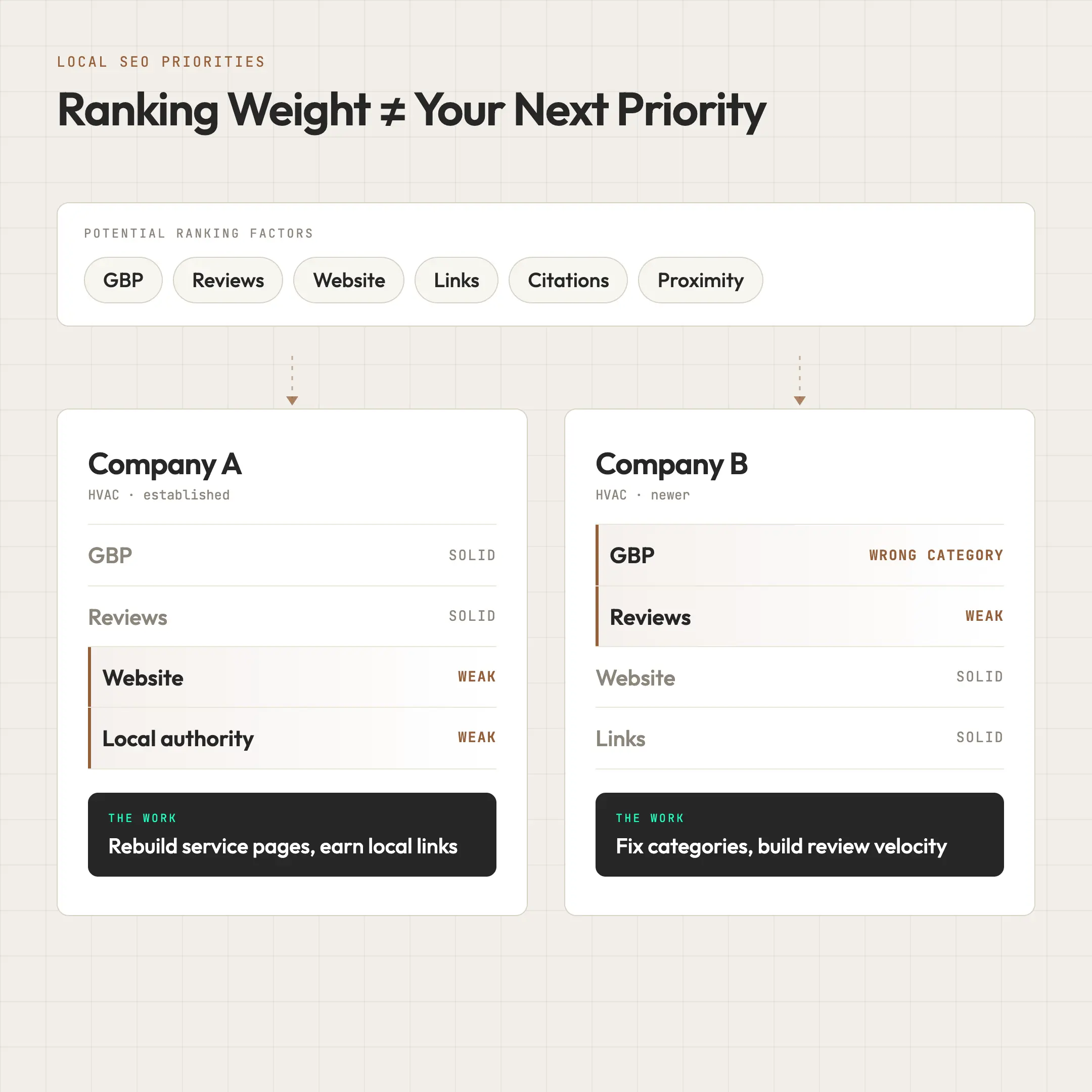
Consider two HVAC companies competing in the same market.
The first has the correct primary category, hundreds of fresh reviews, strong Maps visibility near its location, but weak service pages and almost no organic visibility throughout the surrounding suburbs.
The second has a strong website and useful service-area content but has selected the wrong GBP category and accumulated relatively few reviews.
The same ranking-factor study applies to both companies. The work that should happen next is almost opposite.
Prioritizing Local SEO Work
Local search becomes easier to manage when ranking factors are treated as diagnostic inputs rather than a master task list.
The first consideration is whether a factor has enough influence to matter for the search environment being targeted. The second is the size of the competitive deficit. A company that already has significantly more reviews than its competitors may have less marginal opportunity in review quantity than a company with an otherwise strong presence but one-tenth the market’s review count.
Controllability matters as well. Proximity may be enormously important, but an SEO team cannot optimize an office from one side of a city to another. It may instead strengthen service-area content, local authority, reviews, and organic visibility in the portions of the market where Maps performance is constrained by geography.
Finally, the opportunity needs an economic context. Improving visibility for a low-value service in a low-priority geography may have less value than moving a commercially important service from weak to moderate visibility in a market with greater demand.
This is why competitive local SEO requires diagnosis. Knowing that reviews, links, GBP categories, service pages, and proximity matter provides the menu of possible causes. The useful work is determining which of them is currently limiting growth.
How Local SEO Priorities Change by Business Situation
A new business needs enough information and corroboration for Google to understand what it is. That usually makes GBP fundamentals, a strong website foundation, dedicated service content, initial reviews, and accurate core listings disproportionately important.
A mature company that performs poorly in the Local Pack has a different problem. Category selection, profile configuration, review competitiveness, proximity, operating hours, and the strength of the page associated with the GBP deserve scrutiny before the company publishes another dozen blog posts.
A business with excellent Maps visibility near its office but weak coverage throughout the metro may need to invest more heavily in service-area content, locally relevant links, internal linking, market-specific authority, and localized organic rankings.
A company with thousands of reviews may still benefit from continued review acquisition because freshness matters and reviews affect conversion, but increasing an already dominant review count may not represent its largest available opportunity. Weak service coverage or geographic authority could be more limiting.
Multi-location brands introduce another layer. Each location needs enough individual local evidence to compete as a business in its own market, while the locations collectively benefit from the authority of the larger brand. Strong corporate domain authority cannot completely compensate for a weak location profile, thin location page, poor local review base, or inconsistent business information.
Local SEO Ranking Factors for Home Service Companies
The underlying local search system does not become a different algorithm when the business is an HVAC contractor, plumber, roofer, electrician, or restoration company. The commercial environment does change which factors deserve attention.
Home service companies commonly serve territories far larger than the geographic footprint within which one office can consistently dominate Maps. They also offer multiple services with radically different economics. A $150 repair call and a $15,000 replacement may occur in the same service area but should not necessarily carry the same search priority.
Emergency intent creates another complication. A customer with no heat, an overflowing drain, or standing water may care about availability, proximity, reputation, and response speed differently from someone researching a future HVAC replacement.
Multi-location operators add still more complexity. Five legitimate locations create five physical centers from which Local Pack visibility can spread. They do not create one enormous unified Maps footprint, even if every truck serves the same metropolitan market.
That is why home service local SEO benefits from a market-wide view. Service, geography, competition, visibility, lead value, and operational capacity all need to be considered together. A company does not need the maximum possible ranking for every combination of service and city. It needs enough visibility in the combinations that can produce profitable work.
Local SEO Ranking Factors and AI Search
Local discovery is no longer limited to Google’s conventional Local Pack and organic results. AI systems increasingly answer questions that previously would have produced a list of businesses or websites, which introduces another environment in which a local company has to be understood and corroborated.
The current Whitespark research includes AI visibility for the first time. BrightLocal’s summary of the study places on-page signals, reviews, citations, links, GBP information, social signals, and other forms of third-party validation among the groups believed to influence local AI visibility.
Much of the work is familiar. A business with dedicated service pages, clear location information, consistent entity data, strong reviews, relevant third-party mentions, useful profile content, and independent authority gives an AI system more evidence to work with than a business whose existence is primarily asserted on its own homepage.
That does not justify inventing new universal thresholds for AI visibility. Claims that a business suddenly becomes eligible for AI recommendations after exactly 150 reviews, for example, go considerably beyond what the available evidence supports. One of the competing ranking-factor pages makes precisely that kind of claim, including a supposed 150-review “AI citation threshold,” without establishing a reliable basis for treating it as a universal rule.
AI search adds another reason to build a coherent local entity. It does not eliminate the need for evidence.
Measuring Local SEO Performance
Ranking factors help explain why visibility changes. They are not the final measures of whether a local SEO program is successful.
Maps visibility should be measured geographically, using grids that show where the business appears throughout the portions of the market that matter. Local organic visibility should be tracked separately because it responds to a different combination of signals and can extend far beyond the geographic reach of a single GBP.
Those visibility measures then need to be connected to actual search behavior and business outcomes. Search impressions and visibility can produce website traffic, calls, messages, direction requests, or booked appointments. Leads need to become booked jobs. Booked jobs need to produce revenue.
This also prevents optimization work from drifting toward metrics that are easy to improve but commercially unimportant. A ranking gain for a low-volume informational query is not equivalent to gaining meaningful Maps coverage for an emergency service. Neither is equivalent to increasing visibility for a high-margin replacement service across the neighborhoods where the company most wants to grow.
Which Local SEO Ranking Factor Should You Work on First?
There is no universal sequence that applies to every local business.
Start by identifying the services and geographic markets that create the greatest business opportunity, then measure Maps and organic visibility across them. Compare the business with the competitors currently winning those searches and identify the most consequential gaps in relevance, prominence, authority, reviews, website coverage, and geography.
From there, priority should go to improvements that combine meaningful ranking influence, a genuine competitive deficit, reasonable controllability, and commercial value.
Sometimes that is fixing a primary GBP category. Sometimes it is building a missing service page, improving a weak location page, earning locally relevant links, correcting business data, or increasing review acquisition. Sometimes the company has already exhausted the easy local search improvements and the next meaningful gain requires opening and staffing an additional legitimate location.
Ranking-factor research is useful because it narrows the field of things worth investigating. Strategy begins when those factors are applied to the circumstances of a specific business.
Frequently Asked Questions About Local SEO Ranking Factors
What is the most important local SEO ranking factor?
There is no single factor that determines every type of local result. For Google’s Local Pack, primary GBP category and proximity are among the strongest individual factors identified by current industry research. Localized organic results depend more heavily on website relevance, dedicated service content, internal linking, and authority.
Does Google Business Profile affect local SEO rankings?
Yes. Google Business Profile information helps Google understand the business’s category, location, hours, services, and other attributes. Google recommends maintaining complete and accurate profile information to improve the business’s ability to appear for relevant local searches.
Do Google reviews improve local rankings?
Google explicitly says that reviews and positive ratings can help local ranking. Industry research also identifies review volume, rating, recency, text, and steady review growth as meaningful Local Pack signals.
Do citations still matter for local SEO?
Yes, although citation strategy has evolved beyond accumulating as many directory listings as possible. Accurate business information on authoritative and relevant platforms helps corroborate the identity and location of the business. Unstructured citations such as press coverage and other third-party mentions can also contribute to the business’s broader online authority.
Do backlinks matter for local SEO?
Yes. Links are particularly important for localized organic search, where current expert surveys place link signals among the leading ranking-factor groups. Locally and topically relevant links can also contribute to prominence.
Do Google Business Profile posts help local SEO?
Our own data supports continuing to use GBP posts as part of local visibility and AI search programs. The direct Local Pack ranking effect remains debated within the industry, but posts provide an inexpensive way to publish current service, project, offer, and business information directly on an important local search asset.
Does the Google Business Profile description matter?
We treat the GBP description as a low-cost relevance and entity signal. It gives the business another opportunity to state accurately what it does, where appropriate, instead of leaving that information for search and AI systems to infer elsewhere.
Does proximity affect local rankings?
Yes. Google identifies distance as one of the three primary considerations in local results. Its impact is particularly obvious in Maps and the Local Pack, where rankings can change dramatically as the searcher’s physical location changes.
Can a service-area business rank in a city where it does not have an office?
A service-area business can earn organic visibility for cities it legitimately serves and may achieve some Maps visibility beyond its immediate location, but listing a city as a service area does not create a new physical location there. Maps performance remains heavily influenced by the distance between the business and the searcher.
Are local SEO ranking factors different for home service companies?
Google does not publish a separate home-services ranking algorithm. The practical priorities differ because home service companies often cover large territories, offer many distinct services, depend heavily on calls, and encounter high-intent and emergency searches. Those characteristics change which ranking factors represent the greatest opportunity at any given time.
Local SEO Ranking Factors Are a Starting Point for Diagnosis
There is good reason so many local SEO resources discuss the same categories. Google Business Profile, reviews, website relevance, links, citations, user behavior, and proximity repeatedly appear because there is substantial evidence that they contribute to local visibility.
A company can understand every one of those factors and still allocate its effort poorly.
A business with an incorrect primary category does not need the same local SEO plan as a competitor with excellent Maps visibility and weak service-area organic coverage. A contractor with 2,000 reviews has a different constraint from one with 30. A company located far from the portion of a market it wants to penetrate may have an excellent website and still face a proximity problem that content alone cannot erase.
Ranking factors identify the variables worth examining. Effective local SEO comes from finding the variables that are actually constraining a particular business, improving the ones that can be influenced, and measuring whether those changes produce greater visibility, more qualified leads, booked work, and revenue.