




Picture an AI system trying to figure out whether your HVAC business is worth recommending. It reads your website, but it doesn’t stop there. It can pull in a review on Google, a mention in the local paper, a dealer directory listing, or a comment on a home-improvement forum.
None of that is inside your control, and taken together, those third-party sources can end up telling an answer engine more about your business than your own website does—which is exactly why AI seeks it out. Those systems are looking at your brand as a single entity that’s constructed out of signals from across the web: citations, brand mentions, backlinks, and recommendations.
You can use digital PR for AI search to strategically go after three of them: Earning a mention, a link, or the kind of association that becomes evidence about your business. Whether that evidence turns into a citation or a recommendation is still the answer engine’s call, not yours. These four terms are not interchangeable, and each one is important if you want to compete in AI search responses.
Citations and Mentions Are Not the Same Thing
When an answer engine points to a specific source it used to build a response, it creates a citation, which is the equivalent of a footnote. ChatGPT Search, for instance, shows inline citations to the sources behind a web-grounded answer.
A brand mention just means your name shows up somewhere in a generated response. The source may or may not get credited for it.
A recommendation is a specific kind of mention where the system places your brand into a shortlist or names it as a choice rather than just referencing it in passing.
A backlink is a link from one web page to another. It can sit on the same page that produces a citation or a mention, but it’s a property of the web, not of the answer itself.
These differences make a real impact in how your brand shows up in AI search. Say a homeowner asks an AI platform “What temperature should I set my thermostat to in winter?” Your HVAC company’s blog article could get used as a cited source in the answer without your business ever being named.
Another one asks “Which HVAC companies should I consider for heat pump replacement in Indianapolis?” Now, your company could get named even if your website is never cited, because the system found information about you through a local publication, a manufacturer directory, a review platform, or some other third-party source.
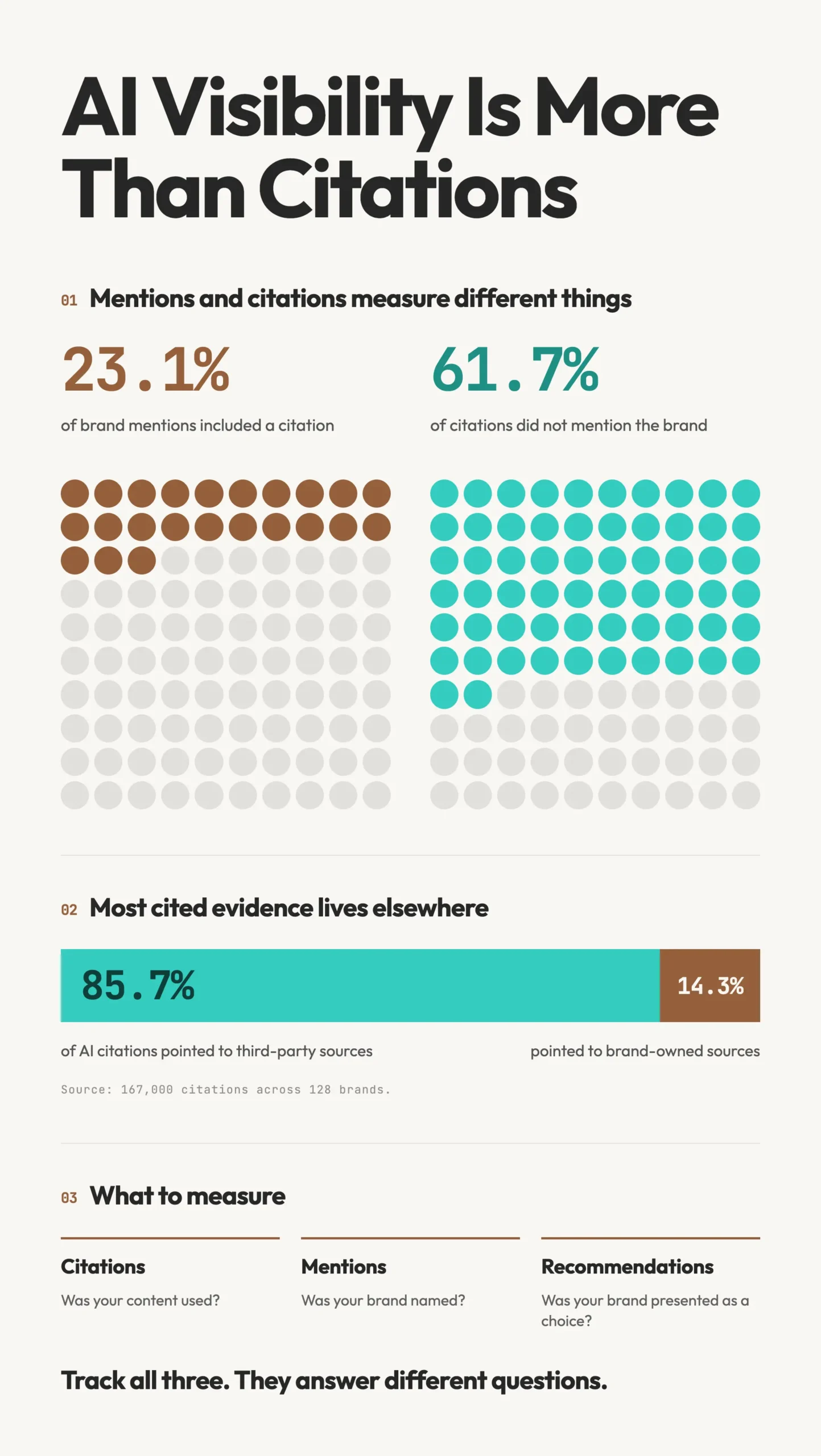
The reason to keep these terms separate isn’t academic. BuzzStream’s 2026 analysis found that only 23.1% of brand mentions in its dataset included a citation, meaning your brand can show up by name without your site (or anyone else’s) getting cited as the source. Semrush found close to the opposite: 61.7% of the citations in its study were “ghost citations,” a page cited as a source with no brand mention anywhere in the answer. Because citation share and brand visibility measure two different things, if you only track one, you miss real information about the other.
Why Third-Party Sources Matter in AI Search
What a company says about itself on its own site is an owned claim, and owned claims don’t mean much to an answer engine. Every business describes its work, its reviews, and its expertise favorably, so a system built to weigh evidence has to look for corroboration it can’t get from the business itself before it can decide if a brand is an authoritative source.
A 2026 study that looked at more than 167,000 AI citations across 128 brands found that 85.7% of them pointed to a source the brand didn’t own. That’s one dataset built from a specific set of brands and prompts, not a universal law, but it’s a meaningful signal that the information environment around a business matters as much as the business’ own site.
That corroboration shows up in places that don’t look like traditional SEO assets, such as:
- Trade association profiles
- Supplier or partner pages
- Local news stories
- Podcast appearances
- Industry comparisons
- Awards announcements
- Review platforms
- Relevant directories
- Mentions on social media
- Unlinked references buried in an article about something else
None of those exist because a marketer optimized something for AI search. They exist because the business has real relationships and activity in the world, and that activity leaves a trail an answer engine can find, whether the business is managing it or not.
Digital PR for AI Search is Source Development
The goal of traditional public relations (PR) is to raise awareness among target audiences about things a brand does, by gaining coverage in different kinds of media: print, TV, radio, and online. The payoff can be increased brand awareness, driving participation in a program or offer, new partnerships or relationships, and changed perceptions. Digital PR targets only online media coverage that results in a backlink that builds domain authority for a website to improve rankings.
For AI search, we use digital PR to build entities for businesses that systems retrieve. Yes, we still want backlinks. But we are also looking to gain brand mentions, associations, and uses as a source. All of those add to the digital footprint that answer engines crawl and use to determine whether or not information about a business is trustworthy or carries authority.
For example, suppose a local business publication profiles an HVAC contractor’s expansion into heat pumps. That one placement does several things at once. It links to the contractor’s site and repeatedly connects the company to heat pumps and its city, and includes quotes from the owner. The information on that web page is rich with detail and lives on a trusted, local media site. That makes it a source an answer engine would be more likely to retrieve when researching a query about heat pump services in that city.
Quality matters much more than quantity when it comes to digital PR wins. A hundred low-relevance mentions scattered across unrelated topics do less than a handful of placements inside the source ecosystem that actually gets used for the questions that matter to a business’ buyers. Full disclosure: Digital PR tactics can influence whether or not your brand is considered for citations, recommendations, or mentions by answer engines. It cannot guarantee a system will deliver on any of those things.
Which Sources Matter? It Depends on The Question
You’ve likely heard AEO advice that centers around one kind of source to get your business mentioned in. Reddit was popular for a while. So was Forbes. There’s no fixed list of sites that answer engines trust, and even if there were, these systems are evolving so quickly that what’s important today may become irrelevant tomorrow.
Profound’s analysis of 11.84 billion citations across ChatGPT, Claude, Google AI Mode, AI Overviews, Gemini, Grok, Copilot, and Perplexity found source composition varies substantially by industry, from roughly 74% brand-owned citations in cybersecurity to under 16% in government and nonprofit categories. A separate study found query language reshapes the source mix too. A generic list of “sites LLMs trust” doesn’t survive that much variation.
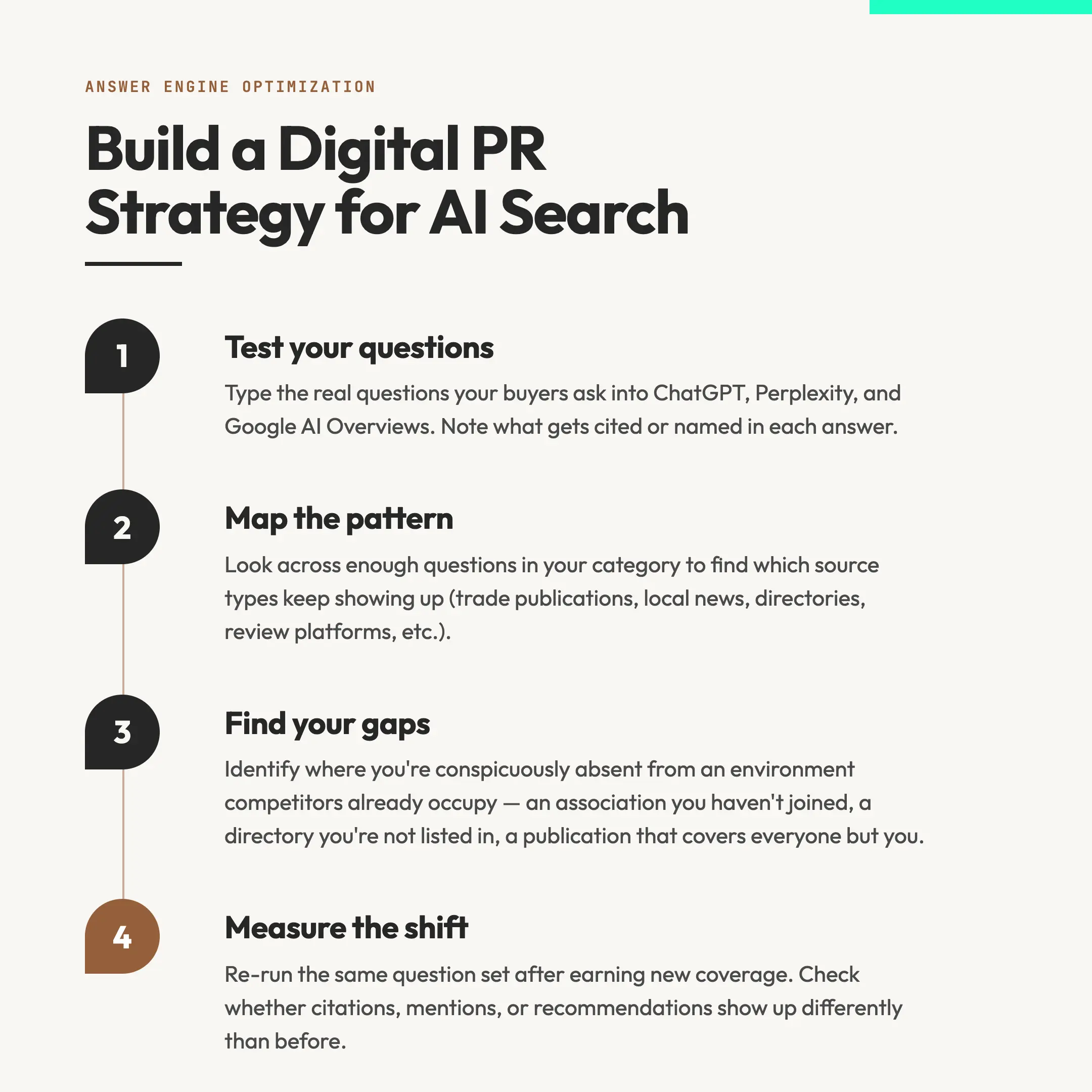
The question you need to answer is which sources do AI platforms look at when answering the questions your buyers ask? Then you need to test them to find out. Type real questions your buyers ask into ChatGPT, Perplexity, or Google’s AI Overviews, and look at what gets cited or named in the answer. Do that across enough questions in your category, and a pattern shows up.
For one category, that pattern might be trade publications and comparison sites. For another, it might be YouTube reviews or local news. For a home services business specifically, expect that pattern to point toward manufacturer or dealer network pages, licensing-body listings, chamber of commerce profiles, and review platforms more than national press, since those are the places a local contractor’s real activity shows up.
Once you have identified a pattern and a list of sources within these ecosystems, you can work backward to get coverage in those places, rather than starting from someone else’s list of AI-friendly sites.
Do Unlinked Brand Mentions Matter for AEO?
Ahrefs studied roughly 75,000 brands and found meaningful correlations between web mentions and AI visibility, with YouTube mentions the single strongest predictor, ahead of most traditional SEO metrics. The same research found only a weak relationship between raw content volume and AI visibility, which cuts against the instinct to just publish more pages as a fix. It’s worth taking that seriously as evidence that consistent, widespread mention of your brand’s name alongside relevant topics tracks with AI visibility.
It’s also important to recognize what it doesn’t show. A correlation across 75,000 brands doesn’t prove that adding 10 unlinked mentions to random pages causes a measurable jump in recommendations. What it does suggest is that co-occurrence (your name appearing near relevant terms across many independent sources) works as a signal a system can use to connect your business with a topic.
None of this argues that links don’t matter, or that unlinked mentions are more valuable than backlinks. They’re not competing for the same job. A link still drives referral traffic and supports crawlability and discovery. An unlinked mention delivers a different kind of value, not a replacement for what a link provides.
Digital PR Should Build Associations, Not Just Awareness
“ABC Heating” mentioned in isolation tells an answer engine almost nothing about what the company does, where it operates, or what it’s good at. “ABC Heating, an Indianapolis HVAC contractor specializing in heat pump installations,” mentioned in a local news story or an industry roundup, tells AI considerably more, and it does so the same way a person might describe the business to a friend.
That’s the kind of coverage and mentions you want to aim for; ones that consistently connect your brand to the services, markets, expertise, people, and categories you want to be known for. A mention without any of that context is still useful for audience reach, referral traffic, and a link, but it does less to build the association an answer engine can use.
Something to avoid at all costs: Keyword-stuffing press materials or forcing a phrase into every quote. Use language a real person would use to create the context around your name, in bios, quotes, and coverage. Be honest about services and claims. That’s a writing discipline more than a technical one, and most PR practitioners already understand it, even where they haven’t connected it to AI visibility yet.
How to Build a Digital PR Strategy For AI Search
A useful digital PR strategy for AI search starts with questions instead of a list of publications to pitch. Run the same test described earlier, then use the results as a map of where your business already shows up in AI search results for questions your customers are likely to ask and where competitors keep showing up instead.
Once the recurring source types are clear, the next task is to find where you’re conspicuously absent from an environment your competitors already occupy. They might be an association you haven’t joined, a directory you aren’t listed in, or a local publication that’s covered every competitor but you. Maybe the leading cited pages in your category are research or resources you’ve never produced. That gap is the real opportunity, specific to your business.
From there, the work looks like earned media always has: Developing real relationships, stories, and reviews with none of it fabricated. Manufacturing fake Reddit threads, incentivized reviews, or undisclosed paid editorial only creates the exact low-trust evidence search and answer engines have real incentive to detect and discount.
The last step is measuring whether any of this new coverage changed the pattern. Do citations, mentions, or recommendations show up differently for the same question set than they did before? That’s the real test of whether the work mattered.
How to Measure Citations, Mentions, and PR Impact
Digital PR’s metrics differ greatly from those used in SEO.
Citation frequency and share describe how often your own domain gets used as a source across a relevant set of questions, compared to competitors. Brand mention rate is a separate measure of how often your name shows up in generated answers at all, citation or not. Recommendation rate narrows further to how often you get actively placed into a shortlist. Source mix (which third-party domains keep showing up around a category’s questions) shows where the evidence environment lives and where you’re present or absent. Sentiment and context matter too; getting mentioned isn’t automatically a good thing.
Unfortunately, attribution here is genuinely incomplete. Someone who sees your business recommended by an AI system may never click a citation; they might just search your name later that day. One study linking opt-in AI conversation data with browsing behavior found that previously unengaged users who saw an AI brand recommendation showed measurable increases in later branded searches and direct site visits. However, the researchers called the finding observational and suggestive rather than a controlled, conclusive proof of causation.
It’s also important to remember that citation count isn’t revenue, and mention share isn’t a booked job. They’re diagnostic indicators, useful for figuring out where visibility is or isn’t showing up and why. A digital PR program aimed at AEO should connect a shift in citation, mention, or recommendation patterns to a shift in AI-referred traffic and branded search volume first, then to those downstream numbers, even when that fuller connection takes longer to surface than a rank-tracking report would.
FAQ
Does a brand mention need a backlink?
No. BuzzStream found more than three-quarters of brand mentions in its dataset had no citation to any source, let alone a backlink. A mention is your name appearing in the answer; a backlink is a separate signal that may or may not come with it.
Can PR make ChatGPT recommend a company?
No single placement can do that, and any pitch promising one is overselling what’s controllable. Digital PR can build the consistent, corroborated evidence, coverage, associations, and reviews that make you more likely to be part of what an answer engine draws on. That’s improved odds, not a guarantee.
Are Reddit mentions important?
Sometimes, depending on category and platform, not as a universal rule. Profound’s research across billions of citations found source composition varies by industry, answer engine, and even query language, so check it for your own business instead of assuming it as a default tactic.
Is digital PR part of SEO or AEO?
Both, and that overlap is the point. Digital PR has always supported SEO through links, authority, and referral traffic. Applied deliberately, it now also supports AEO through mentions, associations, and citation opportunities, an expanded set of objectives, not a new discipline.
How do you track AI citations?
Through AI-visibility monitoring tools that check citation and mention frequency across a defined set of questions, direct testing of important prompts, and analytics for AI-referred traffic where platforms make that identifiable. Rank tracking alone won’t catch it, since you can be cited or mentioned without any page ranking for the phrase.
Learn About Valve+Meter’s AEO approach
Digital PR for AI search isn’t a new department bolted onto a marketing plan. It’s earned media aimed at a wider goal of becoming part of the evidence answer engines encounter when they build the response your next customer sees.
Our AEO approach treats that evidence environment as part of the work, alongside the on-site fundamentals covered in our What AEO Means and AEO vs. SEO: What Actually Changes in AI Search? articles. Request a free marketing assessment, and we’ll show you where your business currently stands.