




Your local business does not need the internet to think it is famous.
It needs Google and other search systems to understand where that business belongs, what it does, and whether other entities in that market recognize it.
That is the real job of local link building.
A backlink from a local newspaper, trade association, supplier, Chamber of Commerce, neighborhood organization, customer, school, nonprofit, or complementary business is more than another URL in an Ahrefs report. It is evidence of a relationship between your business and the market you claim to serve.
Enough of those relationships create something much more valuable than a large backlink count: a believable local authority footprint.
This is also why some conventional link-building advice is not especially useful for local SEO.
The industry tends to divide links into neat moral categories: earned links are good, paid links are bad, relationships are good, exchanges are bad, and anything involving money should immediately make everyone very concerned about Google’s guidelines.
Actual business is messier than that.
Businesses pay Chamber dues. They sponsor Little League teams. They join professional associations. They fund nonprofits. They attend home shows. They hire PR firms. They advertise with local publishers. They give products to creators. They support community events.
Sometimes those relationships result in links.
The useful question for a local marketer is not simply whether money changed hands somewhere in the relationship. It is: “Does this link create credible evidence that this business is legitimately connected to this market?” That is a much better place to start.
What Is Local Link Building?
Local link building is the practice of acquiring backlinks from websites and organizations connected to the geographic markets your business serves.
Those links might come from local news organizations, business associations, industry groups, community organizations, event websites, other businesses, local bloggers, directories, schools, nonprofits, suppliers, or other entities with a legitimate connection to your area.
That geographic dimension is what makes link building for local SEO different from traditional backlink acquisition.
Traditional link building often emphasizes broad topical relevance and website authority. Local SEO link building adds another question:
Why is this website connected to this place?
A link from an Indianapolis business organization to an Indianapolis HVAC contractor establishes something a generic national lifestyle website cannot establish as clearly, even if the national website has substantially more authority according to third-party SEO metrics.
BrightLocal specifically cautions against evaluating local link prospects primarily through proxy authority metrics such as Domain Authority or Trust Flow because many valuable local websites will not score particularly well using those measures.
Moz makes essentially the same point from another direction: when building links for a local company, marketers should prioritize opportunities inside the market they actually care about rather than assuming that an industry-relevant link from another city carries the same local value.
Local relevance changes the math.
Local Backlinks, Citations, and Mentions Are Not the Same Thing
These terms frequently get lumped together, but they represent different signals.
- A backlink is a clickable hyperlink from another website to yours.
- A citation is a reference to your business information, typically some combination of your name, address, and phone number. A citation can include a backlink, but it does not have to.
- A brand mention may simply reference your company by name without linking or providing complete business information.
- A linked citation combines both: the publisher identifies the business and provides a clickable link.
Moz describes these as distinct but related parts of a local search strategy, noting that backlinks transfer link equity while citations primarily help verify a company’s existence, location, and contact information.
The strongest local visibility strategies tend to generate all of them.
That matters because local SEO is not just an exercise in accumulating hyperlinks. Search engines are trying to reconcile information about real businesses across a messy collection of websites, platforms, publications, directories, profiles, organizations, and relationships.
Your backlink profile is part of that evidence.
Why Local Links Work: The Local Web Is a Relationship Graph
Imagine a residential HVAC company in Indianapolis.
Across the web, that company might be connected to:
- Indianapolis
- Carmel
- a major HVAC manufacturer
- the Better Business Bureau
- a local Chamber of Commerce
- an Indiana trade association
- a youth sports organization
- a local home show
- a plumbing company it frequently refers
- a television station that quoted its owner
- a utility rebate program
- local customers and commercial partners
None of those relationships exists in isolation.
Together they form a web of evidence about the company.
The business is not merely claiming that it serves Indianapolis. Other Indianapolis entities repeatedly connect themselves to the company.
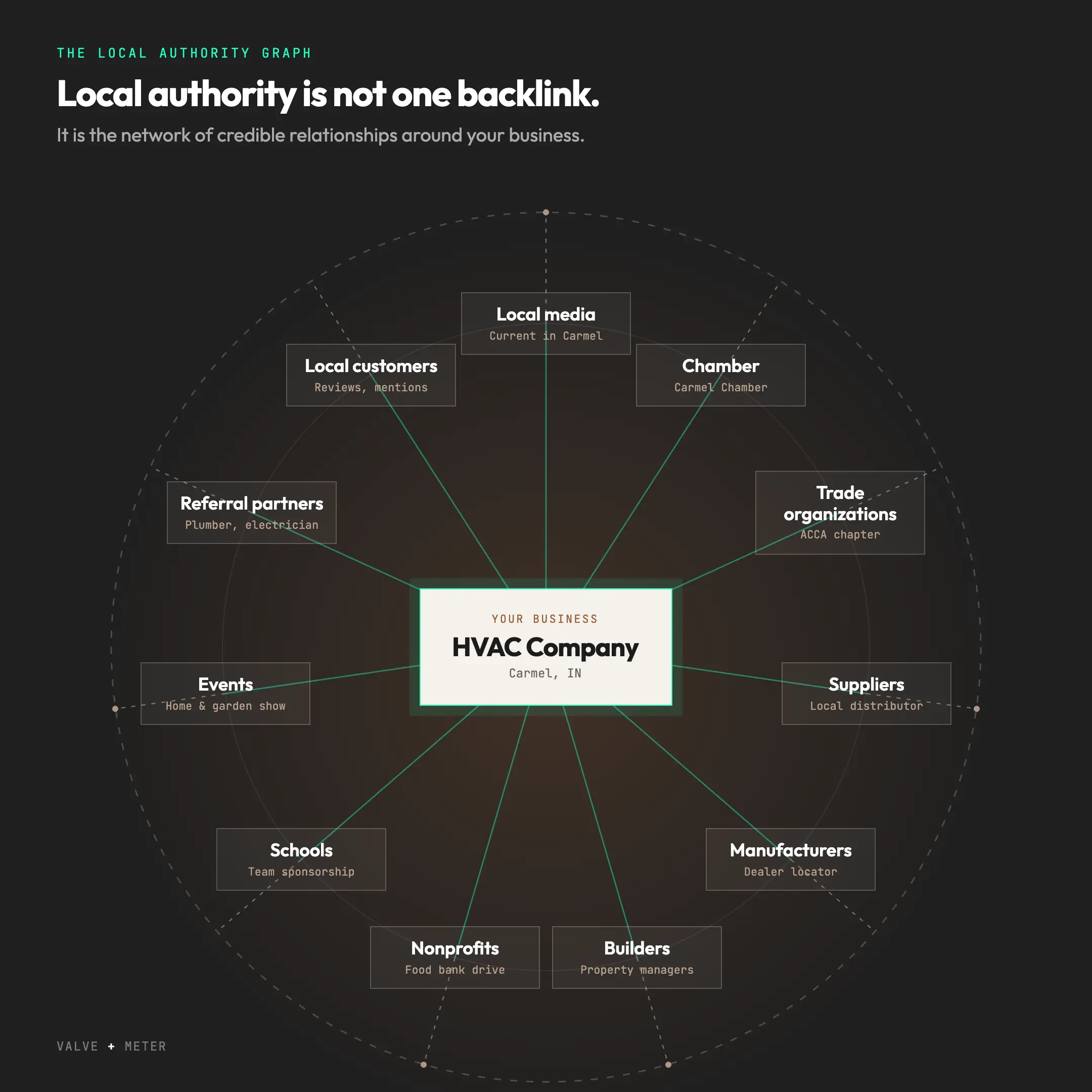
That is the part of local link building that gets lost when SEO teams reduce the conversation to Domain Rating and referring-domain counts.
A backlink is a connection between entities.
Local backlinks add geographic context to those connections.
The more credible and coherent the graph becomes, the easier it is for search systems to understand that your business actually belongs in that market.
This does not mean every link needs to come from a website physically headquartered within five miles of your office. Industry associations, manufacturers, trade publications, national partners, and other relevant sources can still contribute meaningful authority.
But if you are trying to win local search visibility and almost none of your backlink profile has anything to do with the places you serve, something is missing.
What Makes a Local Backlink Valuable?
Local links are difficult to judge with a single metric because the value often comes from context that SEO tools are not designed to measure very well.
A high-authority website can still be a mediocre local link if it has no meaningful connection to the market, the business, or the audience. At the same time, a modest local website can be extremely useful if it represents a real organization that is deeply embedded in the community you are trying to reach.
That is why we look first at the relationship behind the link.
A link from a Carmel neighborhood organization to a Carmel contractor has obvious geographic relevance. A link from a builder to an HVAC company has an obvious business relationship. A Chamber profile, supplier page, local news story, nonprofit sponsorship, or trade association listing each tells a slightly different story, but in every case there is a credible reason the link exists.
That matters more than whether the linking domain happens to have a DR of 21 or 61.
Local websites are often imperfect by traditional SEO standards. Some are old. Some are ugly. Some publish sporadically. Many have relatively weak authority metrics because they serve a narrow audience and have never had a reason to attract thousands of backlinks.
None of that automatically makes them weak local entities.
A historical society, neighborhood association, school foundation, municipal program, or regional trade group may have relatively little national authority while still being strongly associated with the exact community your business is trying to influence.
Placement still matters. A useful contextual mention on a page that is linked internally, indexed, and likely to remain live is different from a logo buried on a forgotten sponsor archive. The domain may be the same, but the practical value of the placement can be very different.
The other factor we care about is how easily the link can be reproduced.
Anyone can submit to the same large directory. Most businesses can join the same Chamber. Those links may still be worthwhile, but they do not create much separation.
A preferred-vendor relationship with a major local builder is different. So is recurring local media coverage, a long-standing nonprofit partnership, original research that local publications continue to cite, or a supplier relationship your competitors do not have.
Those links are valuable partly because they are connected to something real and partly because the competitor down the street cannot simply add them to next month’s link-building order.
That is the kind of authority worth building.
Think in Terms of a Local Link Portfolio
The strongest local backlink profiles are rarely built from one tactic repeated over and over. They are usually a mixture of easy-to-replicate foundational links, ordinary business relationships, community participation, editorial coverage, and a smaller number of assets or relationships that are difficult for competitors to copy.
That mix is more useful to think about than a list of “local link-building tactics,” because each type of link plays a different role.
Most businesses should have a basic layer of links and citations from the places where legitimate companies in their category are expected to appear. That can include major directories, Chambers of Commerce, licensing organizations, trade associations, manufacturer directories, dealer programs, and relevant industry platforms.
These links are important, but they usually do not create much competitive advantage. They establish a baseline. If every credible HVAC contractor in a market can join the same association or create the same directory profile, having that link keeps you from falling behind; it does not necessarily move you ahead.
The more interesting opportunities usually come from the relationships the business already has.
A home service company may work with distributors, builders, property managers, real estate agents, financing partners, manufacturers, referral partners, commercial customers, and complementary contractors every week. Some of those relationships already have an online expression: preferred-vendor pages, partner directories, dealer locators, case studies, testimonials, project pages, or customer stories.
Others do not.
That is often where local link building becomes less about “finding websites” and more about identifying places where the business has real-world authority that has never been translated onto the web.
Community activity works the same way. Sponsorships, charities, schools, nonprofit boards, festivals, local events, and civic organizations are not valuable because they happen to have sponsor pages. They are valuable because they connect the company to institutions that are genuinely part of the market.
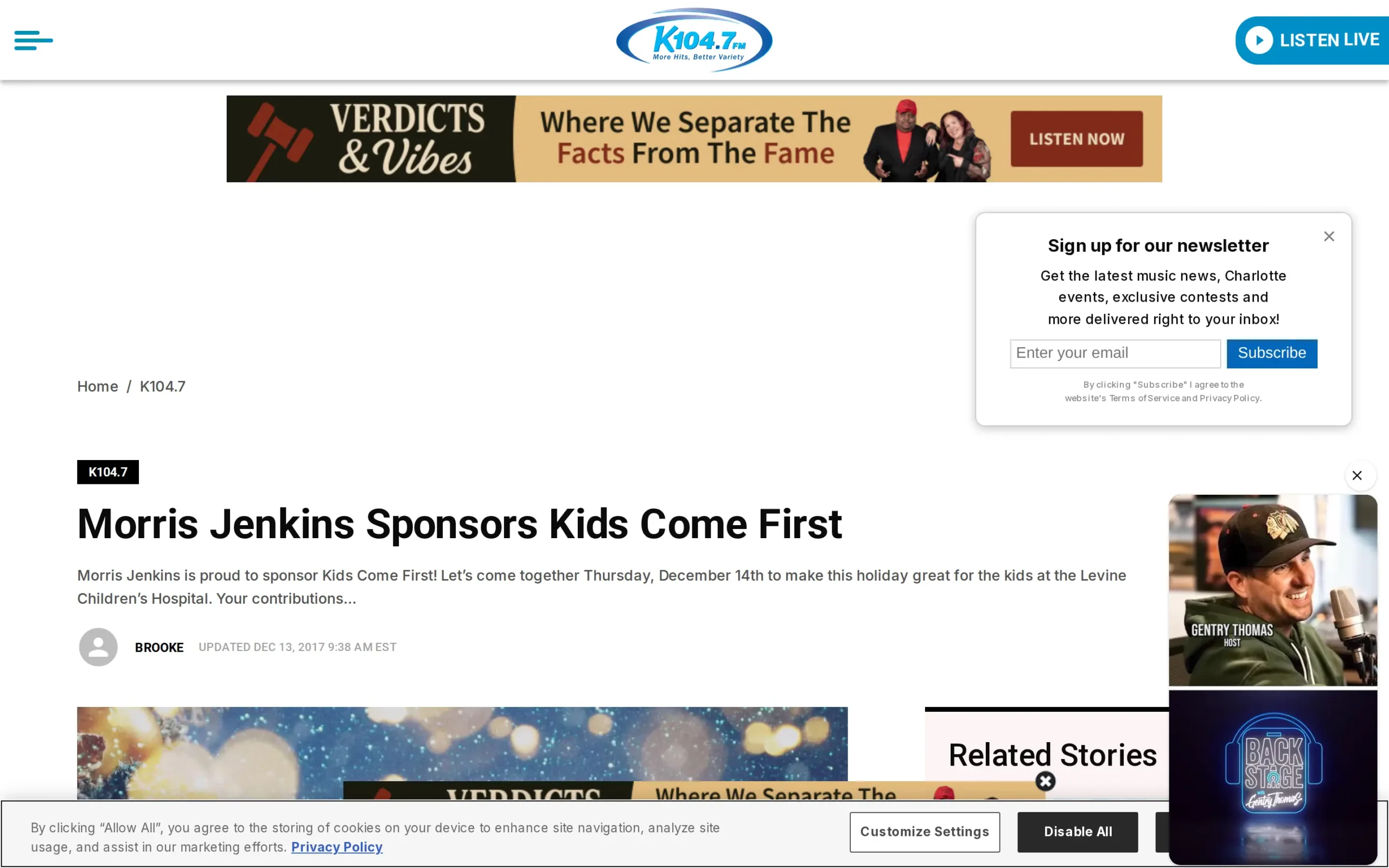
The backlink is evidence of that connection.
Some of those relationships involve money. A company may pay dues, sponsor an event, fund a team, or contribute to a nonprofit. That is normal business activity. The fact that a backlink may accompany the relationship does not make the relationship meaningless.
Editorial coverage sits in a different category because the validation comes from a third party deciding the business is worth mentioning. A local newspaper asking the owner for comment during a heat wave, a business journal covering an expansion, or a neighborhood publication writing about a community project creates a kind of authority that cannot be reproduced simply by filling out a form.
These links are usually harder to obtain, but they are also harder for competitors to copy.
The same is true of useful local assets. A company that publishes original market data, a regional cost study, a calculator, a storm report, a local regulation guide, or another resource that publishers and organizations actually use can create its own reason for people to link.
That is a different model from acquiring one placement at a time. Instead of asking, “Where can we get another backlink?” the business creates something that becomes part of the local information ecosystem.
A healthy local link profile therefore should not look perfectly uniform. It should look like the business itself.
There will be some links almost every competitor has. There should be others that come from the company’s specific relationships, history, community participation, expertise, and information.
The more the second group grows, the harder the backlink profile becomes to reproduce.
Local Link Building for Home Service Companies
Home service businesses have an especially interesting advantage. They are embedded in the communities they serve.
An HVAC, plumbing, roofing, electrical, restoration, or home services company may have relationships with manufacturers, distributors, builders, real estate agents, property managers, utilities, financing companies, trade schools, apprenticeship programs, municipalities, community organizations, local media, charitable groups, neighborhood associations, and thousands of homeowners.
Yet it is common to open an SEO tool and find almost none of that reflected in the company’s backlink profile. That represents a huge missed opportunity. For home service businesses, we would start by asking a different set of questions.
- Who sends you business?
- Who do you send business to?
- Whose products do you install?
- Which certifications have you earned?
- Which local organizations do employees belong to?
- Where do you recruit technicians?
- Which community events do you already support?
- Which organizations have received donations?
- Which builders, property managers, or commercial clients have worked with you for years?
- Which local reporters call when there is a heat wave, freeze, storm, flood, or unusual weather event?
Those are potential local link relationships hiding inside ordinary operations.
The SEO job is often not “How can we manufacture 20 backlinks?” but instead “Where does this business already participate in the local economy, and why isn’t the web showing it?”
Where Should Local Backlinks Point?
Another common local link-building mistake is sending almost every backlink to the homepage.
Sometimes that is unavoidable.
A Chamber profile will probably link to the homepage. A local newspaper may link to the company rather than the exact service page an SEO strategist would prefer.
That is fine.
But local link building should still be planned alongside site architecture.
Suppose an HVAC company wants to improve rankings for:
- air conditioning repair in Indianapolis
- furnace repair in Carmel
- HVAC services in Fishers
Those searches may map to specific service and location pages.
Whenever the context allows, links should support the pages that matter commercially.
Collaborator recommends identifying target pages before outreach and prioritizing service and location pages most closely tied to leads and sales.
When outside publishers naturally link to your homepage, research, case studies, or other resources instead, your internal linking system needs to do the rest.
Authority enters the site through many doors.
Your architecture determines where it goes next.
That means external link building and internal linking should not be managed as unrelated SEO activities.
Local Link Building Across Multiple Locations
Multi-location and service-area businesses have a different problem than single-location companies: authority does not distribute evenly just because the domain is strong.
A company can be well established across Indianapolis and still have a relatively weak local footprint in Carmel, Fishers, Noblesville, Westfield, or Greenwood. The domain benefits from the company’s overall authority, but that does not mean every suburb inherits the same degree of local relevance.
This matters when the business is trying to rank dedicated location or service-area pages.
If nearly all of the company’s external signals come from Indianapolis organizations, Indianapolis media, Indianapolis sponsorships, and Indianapolis business relationships, then a Noblesville page is relying heavily on domain authority and on-page signals to establish its connection to Noblesville. That may be enough in some markets. In others, the competitors winning locally have a much denser set of relationships tied specifically to that community.
The practical mistake is going too far in either direction.
One extreme is assuming that a strong backlink profile at the domain level solves every local market. The other is trying to manufacture an entirely separate backlink campaign for every suburb, as though Carmel and Fishers each need their own independent SEO universe.
Usually, the better strategy sits between those two.
Broad industry links, regional media coverage, major partnerships, manufacturers, and other brand-level authority strengthen the company as a whole. Metro-area organizations and publications reinforce the business’s presence across the wider market. Then, in the locations where visibility matters most or competition is strongest, more specific local relationships can help close the gap.
For a home service company, that might mean the overall domain earns authority from a manufacturer, a regional trade association, and Indianapolis media, while the Carmel branch also appears through a Carmel business organization, a local sponsorship, a builder relationship, or coverage tied specifically to that community.
The goal is not equal backlink counts by city. It is to look for places where the company’s claimed market presence and its visible online relationships are badly out of balance.
If a business says it has been serving six communities for 20 years but almost nothing on the web connects it to five of them, that is not necessarily a ranking problem by itself. It is, however, a useful place to start looking.
How to Find Local Backlink Opportunities
The easiest local link opportunities are often not discovered through outreach software. They are found by examining the business itself.
Before building a prospect list, take inventory of the relationships that already exist.
For a home service company, that means looking beyond the marketing team. Talk to ownership, branch managers, operations, recruiting, sales, community relations, and anyone else who regularly interacts with outside organizations.
Ask who the company buys from. Who refers work. Who receives referrals. Which manufacturers certify the business. Which distributors it uses. Which builders or property managers it works with. Which trade associations employees belong to. Which schools recruit its technicians. Which charities and events it supports. Which local organizations have asked for sponsorships. Which reporters have called for expert commentary. Which customers operate businesses of their own.
That exercise often uncovers opportunities that no backlink database will surface because the relationship exists offline but has never been represented online.
After that, audit the company’s existing backlink profile and citations. The objective is not merely to identify missing links. It is to understand what kinds of local evidence already exist and where the profile is thin.
You may discover, for example, that the company has plenty of directory coverage but almost no links from actual local organizations. Or that it has strong regional authority but nothing connected to a suburb it is aggressively targeting. Or that years of sponsorships and partnerships have produced brand mentions without links.
Only then would I move heavily into competitor research.
Look at the businesses actually ranking for the searches and locations you care about and examine the sources behind their authority. The useful questions are not simply, “Which domains link to them but not to us?” They are:
Where are their local relationships coming from? Which sources appear repeatedly across several strong competitors? Which links are clearly foundational and easy to replicate? Which ones reflect deeper relationships, editorial coverage, or assets that would be harder to reproduce?
That turns backlink research into market research.
The result should be a list of opportunities organized by why the link exists, not simply by whether a competitor has it.
That distinction matters because the best local link-building ideas usually come from understanding the mechanisms behind the links: membership, partnership, sponsorship, editorial coverage, customer relationships, community participation, useful data, or some other legitimate connection to the market.
Once you know the mechanism, you can decide whether to replicate it, improve on it, or find a better version that fits the business.
Use Competitor Backlinks as Intelligence, Not a Shopping List
Competitor backlink research is useful, but the common approach to it is too literal. Export the links of the businesses outranking you, find the domains you do not have, and start trying to replicate them. That can uncover some easy opportunities, but it also assumes that every backlink in a competitor’s profile is contributing to their success.
It probably isn’t.
A backlink profile is the accumulated result of years of marketing, business relationships, old SEO campaigns, sponsorships, partnerships, acquisitions, directory submissions, PR efforts, and plenty of junk. Treating all of those links as equally desirable is a good way to spend money reproducing someone else’s mistakes.
The more useful analysis is to look for patterns across the competitors that consistently rank well. If several leading contractors in a market are members of the same builders association, appear repeatedly in local media, or have links from a group of regional suppliers and community organizations, that tells you something about the local authority structure around that industry. Those are not simply domains to add to an outreach list. They show you the kinds of relationships that appear repeatedly among businesses Google already associates with that market.
The opposite can be useful too. You may find that a competitor has accumulated dozens of links from generic blogs, expired-domain networks, paid guest posts, or sites with no meaningful connection to the market. Some of those links may be helping. Some may be doing nothing. Either way, their existence does not create an obligation to match them.
Competitor analysis is therefore most useful when it helps you answer a broader question: what seems to be creating the authority advantage? Once you understand that, you can decide which parts are replicable, which parts are worth improving upon, and which parts are better ignored.
What About Paying for Local Backlinks?
The discussion around paid links tends to become useless very quickly because “paying for a link” can describe several very different transactions.
A contractor might spend $600 a year to join a Chamber of Commerce and receive a member profile with a backlink. The same company might spend $2,500 sponsoring a community event and be listed on the event website, pay a PR firm to pitch local media, or compensate a creator for producing sponsored content. In each case, money is part of the relationship and a link may be one of the outcomes.
That is materially different from paying an SEO broker $300 for a followed link on a website whose primary reason for existing is to sell placements.
Google’s policies on links intended to manipulate rankings are clear, and companies should understand the risk they are taking when they cross that line. But from a marketing perspective, simply asking whether money was involved is not a very useful way to evaluate an opportunity. Money is involved in an enormous percentage of legitimate business relationships.
The more useful question is what the link represents.
A Chamber link represents membership in a local business organization. A sponsorship link represents participation in a community event. A supplier link may represent an actual commercial relationship. A newspaper link may result from PR work that the company paid someone to perform. Those links have an underlying reason to exist beyond transferring authority.
At the other end of the spectrum are placements where the backlink itself is essentially the product. The website does not particularly care who the business is, where it operates, whether its readers would find the company useful, or whether there is any genuine relationship between the two entities. The buyer wants ranking equity, the publisher has inventory, and the transaction exists to connect the two.
That distinction is more useful than pretending SEO operates in a clean division between links that cost money and links that do not.
For local businesses in particular, some of the best link opportunities come from activities that already have a budget attached to them: memberships, sponsorships, partnerships, events, PR, community involvement, and trade organizations. The SEO opportunity is often to recognize the value of those relationships and make sure the digital evidence of them exists.
That is very different from building a strategy around purchasing links simply because an SEO tool says the domain is strong.
How to Prioritize Local Link Opportunities
Most businesses do not have an opportunity problem. They have a prioritization problem.
You can usually find dozens of directories, associations, sponsorships, publishers, partner sites, community organizations, and local resources that could produce a backlink. The harder question is deciding which ones deserve your time and budget.
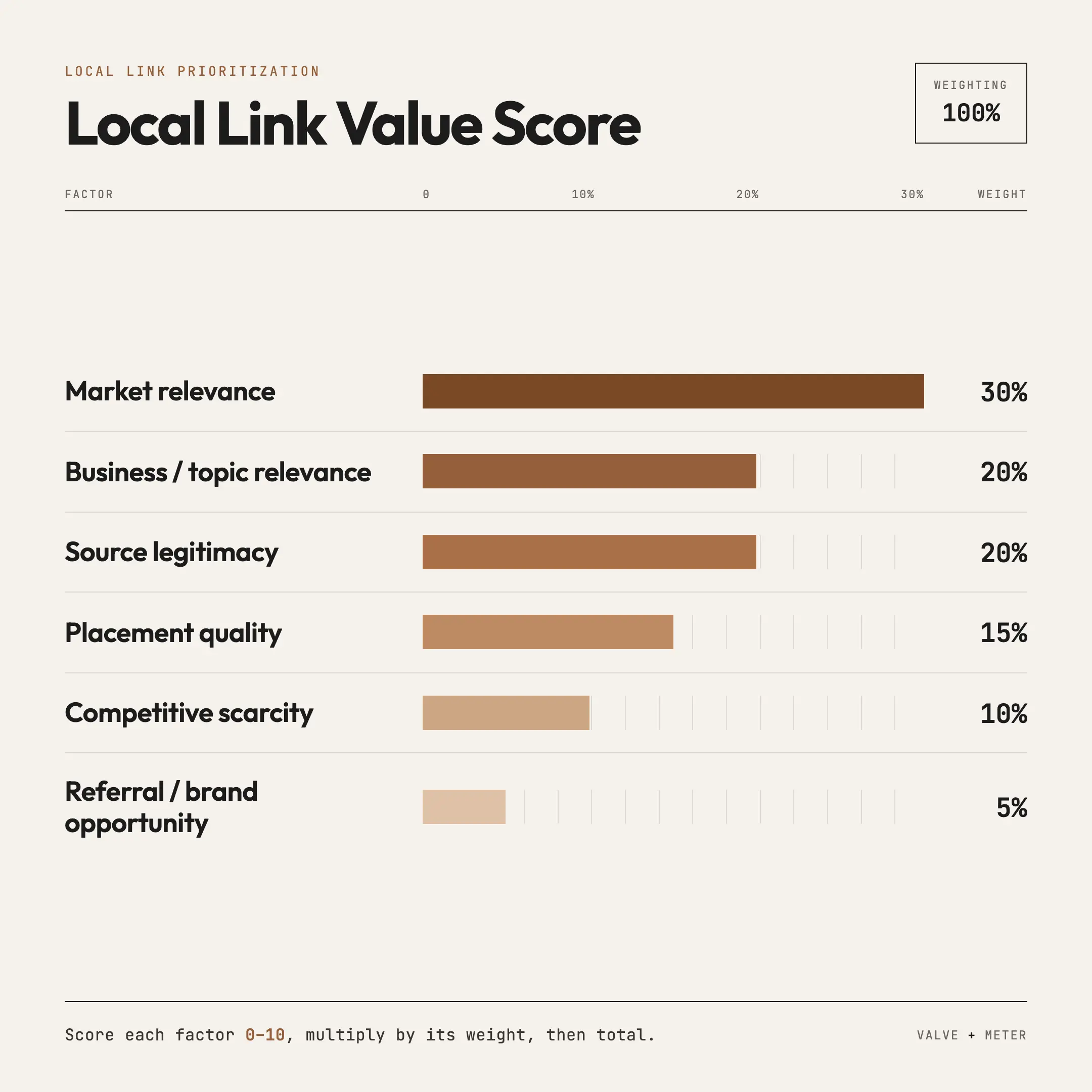
We use a simple Local Link Opportunity Score to force that decision. It is not intended to reverse-engineer Google’s algorithm. The weighting is deliberately practical: it reflects the characteristics we care about when deciding whether a local backlink opportunity is actually worth pursuing.
Local Link Opportunity Score
Market relevance — 30%
How strongly is the source associated with the city, suburb, neighborhood, or region you are trying to win?
Business or topical relevance — 20%
Does the relationship between the linking site and your business make sense?
Source legitimacy — 20%
Is this a real organization, publisher, business, association, school, nonprofit, or community resource with an actual purpose beyond selling links?
Placement quality — 15%
Will the link appear on a page that is useful, crawlable, visible, reasonably durable, and connected to the rest of the site?
Competitive scarcity — 10%
How difficult would it be for the competitor down the street to reproduce this exact relationship or placement?
Referral and brand opportunity — 5%
Could the placement also create real exposure, traffic, referrals, recruiting value, reputation, or other business benefits?
You can score each category from 0–10 and apply the weighting. The point is not whether a link earns an 82.4 instead of an 81.7. The score simply prevents one familiar SEO metric from dominating the decision.
Consider two hypothetical opportunities for an HVAC company trying to improve visibility in Carmel, Indiana.
Option A: DR 68 generic guest-post site
The website looks impressive in an SEO tool. It has a high Domain Rating and will publish a contractor article for $300. But it has no meaningful connection to Carmel. It publishes everything from cryptocurrency to dentistry to HVAC. Hundreds of businesses can buy essentially the same placement. A reasonable score might look like:
- Market relevance: 0/10
- Business relevance: 6/10
- Source legitimacy: 3/10
- Placement quality: 5/10
- Competitive scarcity: 0/10
- Referral and brand value: 1/10
High DR. Weak local link.
Option B: DR 21 Carmel neighborhood organization
Now imagine a legitimate Carmel neighborhood or community organization with a modest website. The business supports one of its programs and receives a permanent link from a community partners page. The website may look unimpressive in Ahrefs. But the organization is clearly connected to Carmel, serves actual residents, has existed for years, and does not provide the same placement to any HVAC company willing to send $300. Its score might look more like:
- Market relevance: 10/10
- Business relevance: 5/10
- Source legitimacy: 10/10
- Placement quality: 7/10
- Competitive scarcity: 8/10
- Referral and brand value: 7/10
For a Carmel local SEO campaign, we would take the second opportunity all day.
That does not mean Domain Rating is useless. We look at DR, referring domains, traffic, indexing, link history, and other SEO metrics when evaluating opportunities. They are diagnostic inputs. They are not the strategy. Local link building requires context, and the most useful local backlink is often not the one with the biggest number next to the domain.
How Many Local Backlinks Do You Need?
There is no universal answer.
The right benchmark is the competitive environment around the searches and locations you actually want to win. Some local SERPs can be won with relatively modest backlink profiles. Others, particularly legal, home services, medical, and other commercially aggressive categories in large markets, can be extremely competitive.
BrightLocal recommends comparing your backlink profile with actual local ranking competitors rather than pursuing an arbitrary target. That is the approach we prefer.
Look at the businesses winning the queries that matter. Then examine how many unique domains link to them, which links are actually local, where those links point, how difficult they would be to replicate, and whether the competitors’ advantage appears to come from raw authority or deeper market relevance.
You do not need the most backlinks. You need enough of the right authority to compete with the businesses currently winning.
How to Measure Whether Local Link Building Is Working
Counting acquired links is easy.
Proving that they mattered is harder.
That distinction is important because link building often gets reported as production:
- 6 links acquired
- average DR of 42
- 4 dofollow links
- 2 local publications
- 1 Chamber listing
That tells you what the SEO team did.
It does not tell you whether the work changed the competitive position of the business.
A better measurement model looks at local link building in three layers.
1. Did the authority of the target page actually change?
Start with the pages the campaign was intended to strengthen.
If the goal was to improve visibility for a Carmel HVAC location page, then the most relevant questions are not about total domain backlinks. They are about that page and the pages feeding authority into it.
Track:
New referring domains to the target page
Did the page itself earn new links, or did all of the links land on the homepage?
Internal authority paths
If links landed elsewhere, are those pages meaningfully connected to the target through internal links?
Link quality and concentration
Did you add genuinely new authority, or five links from websites that are effectively the same type of source?
Link retention
Are the links still live three, six, and twelve months later?
This matters because ten links to the wrong pages can look productive in a report while doing very little for the page you actually need to rank.
2. Did your competitive position change?
Local link building should be measured against the businesses already winning the market.
Suppose the three companies ahead of you for “AC repair Carmel” have 18, 24, and 31 relevant referring domains to their important local pages. You have seven. That is a useful gap.
If six months later you have 17 while the competitors are still around the same level, the campaign has materially changed your competitive position even before you attribute every ranking movement directly to a specific backlink.
The important measurements are therefore not simply “How many links did we build?” but rather:
- How much of the authority gap did we close?
- Did we acquire the same classes of links competitors rely on?
- Did we create links they do not have and cannot easily reproduce?
- Did our local authority become broader or merely larger?
That last distinction matters. Adding ten more generic guest posts may increase a backlink count. Adding links from the Carmel Chamber, a local builder, a regional news outlet, and a community organization changes the composition of the profile. Those are different outcomes.
3. Did search visibility move where the links were supposed to matter?
This is the lagging evidence. Track rankings at the same geographic level as the campaign. A business may improve from position 9 to position 4 when searched from one side of the market and remain invisible five miles away. A single citywide rank number will hide that.
For competitive local campaigns, we prefer to look at geographic ranking grids and compare them over time. The question becomes “Did the area in which the business is competitive expand?” That can be more informative than asking whether the “average rank” moved from 6.8 to 5.9.
For organic local pages, look at impressions, ranking distribution, non-brand clicks, and traffic to the specific service and location pages being strengthened. The strongest evidence is directional agreement across several signals:
- new relevant referring domains appear,
- the authority gap narrows,
- target pages gain visibility,
- the geographic ranking footprint improves,
- and organic demand to those pages grows.
No single metric proves causation. Together, they give you a much stronger case that the link strategy is working.
Measure links as a portfolio, not a monthly quota
There is also a longer-term question: Is the backlink profile becoming more representative of a prominent business in this market?
A healthy local authority profile should gradually become more diverse. You should see evidence from business organizations, customers, suppliers, media, community groups, industry entities, partnerships, useful content, and other legitimate parts of the local ecosystem.
If twelve months of “local link building” produces 72 new backlinks but almost all of them come from the same type of paid publisher, you may have increased the number without materially improving the local graph. That is why our preferred reporting view is not about links built this month, but is closer to:
- Authority gap closed
- Target pages strengthened
- New local entities connected to the brand
- Geographic visibility gained
- Durable links retained
That is a much better description of whether local link building is actually working.
Build for Local Authority, Not Link Volume
Local link building works best when it is treated as a market-specific authority strategy rather than a backlink production exercise.
The objective is not to collect the largest number of referring domains or chase the highest possible Domain Rating. It is to build a backlink profile that reflects the markets your business is trying to win.
That usually means a mix of foundational links, real business relationships, community connections, editorial coverage, and locally relevant resources. Some will be easy to acquire. Some will require money. Some will require outreach, participation, data, or relationships that take years to develop.
The mix will also look different from one business to another. A home service company in Carmel should not have the same ideal backlink profile as a restaurant in downtown Indianapolis or a law firm operating statewide.
That is why local link building should start with the competitive environment and the market itself.
Look at who is ranking. Understand where their authority comes from. Identify which local relationships your own business already has but has not translated to the web. Then invest in the opportunities that strengthen the pages and locations that matter most.
The result should not simply be more links.
It should be a stronger and harder-to-replicate position in the local market.