




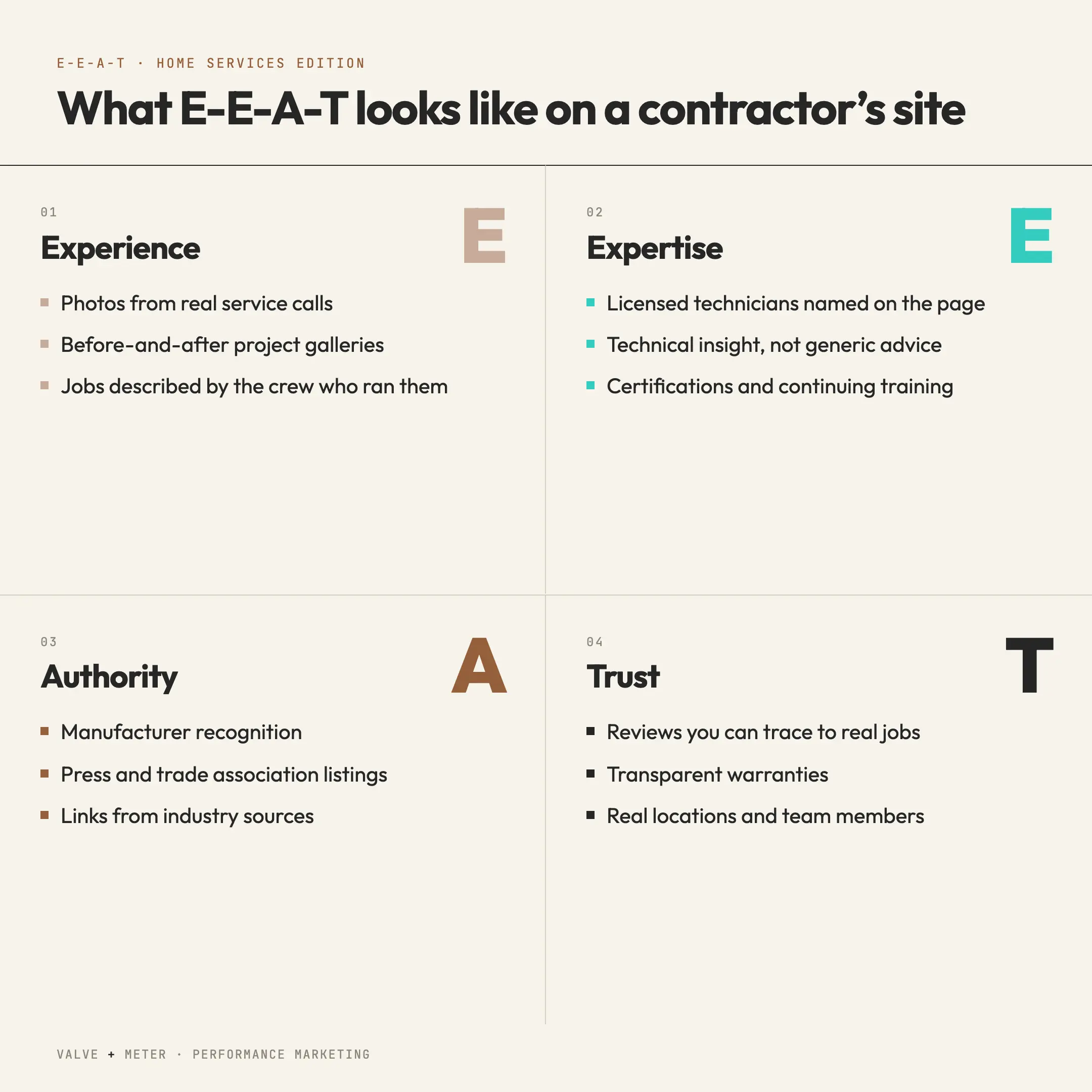
Experience. Expertise. Authoritativeness. Trustworthiness.
Together, those concepts make up EEAT, a framework Google uses in its Search Quality Rater Guidelines to describe the characteristics of high-quality, trustworthy content.
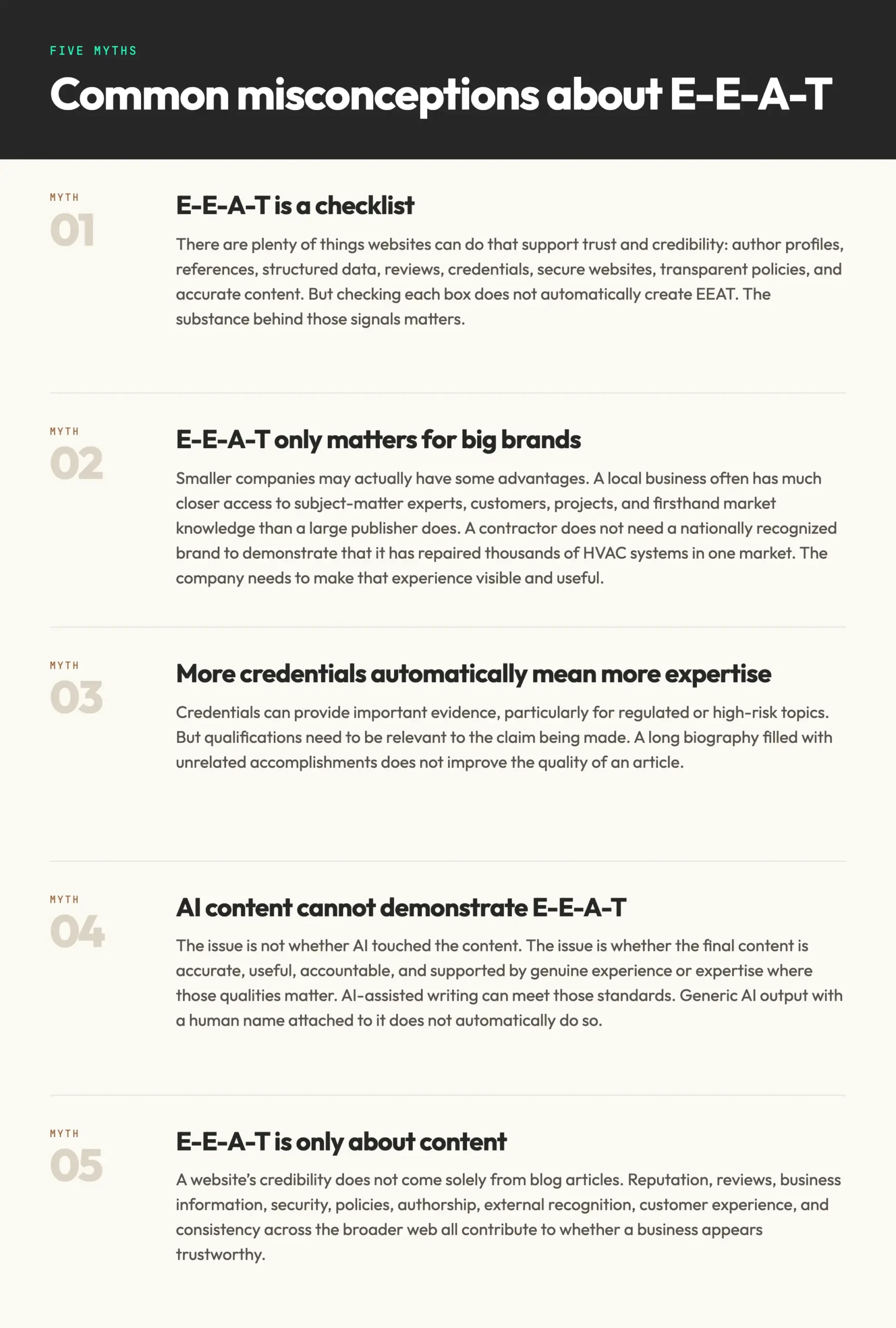
EEAT is also frequently misunderstood. It is not a score you can improve by adding an author bio, inserting a few citations, or putting credentials in the footer. It is not a single ranking factor, and it is not something you can simply “optimize” into a website.
A better way to think about EEAT is this:
EEAT is evidence.
Your website should give people—and, by extension, search engines—reasons to believe that the person or business publishing information has real experience, understands the subject, has earned credibility, and can be trusted.
That distinction becomes especially important as producing generic, technically competent content gets easier. Anyone can summarize what is already known. Firsthand experience, genuine expertise, and a real-world reputation are much harder to manufacture.
Key Takeaways
EEAT stands for Experience, Expertise, Authoritativeness, and Trustworthiness. Google uses the framework to help its quality raters evaluate whether content appears useful, reliable, and worthy of trust.
EEAT itself is not a single Google ranking factor. Rather than treating it like an SEO checklist, businesses should focus on making real evidence of their experience, expertise, reputation, and trustworthiness visible.
For service businesses in particular, that evidence often already exists. Technicians, completed jobs, customer reviews, licenses, certifications, original photos, case studies, local knowledge, and years of firsthand experience can all strengthen credibility. The opportunity is to bring that evidence into the website and content instead of publishing generic information anyone could reproduce.
What Does EEAT Mean?
EEAT stands for:
- Experience: Has the creator actually done, used, visited, purchased, repaired, tested, or otherwise experienced the subject being discussed?
- Expertise: Does the creator have the knowledge and skill necessary to explain the subject accurately?
- Authoritativeness: Is the creator or publisher recognized by others as a credible source on the subject?
- Trustworthiness: Is there good reason to believe the information, author, and website are accurate, transparent, and reliable?
Google originally discussed EAT—Expertise, Authoritativeness, and Trustworthiness—before formally adding an additional “E” for Experience in 2022.
That addition is meaningful because experience and expertise are not the same thing. A person can understand a topic intellectually without ever having experienced it firsthand, while someone with deep practical experience may possess knowledge that never appears in a textbook or certification course.
Someone who has installed hundreds of heat pumps may know things that cannot be learned from manufacturer documentation alone. A homeowner who has lived with a heat pump through five winters may offer a different kind of useful experience. An engineer may bring deeper technical expertise than either.
The right kind of EEAT depends on the question being answered.
Experience: Has Someone Actually Done the Thing?
Experience refers to firsthand involvement with a subject. That might mean using a product, performing a repair, visiting a destination, operating a business, completing a project, or dealing directly with a particular problem.
This is where many websites have a substantial untapped advantage. The internet is full of content that can explain what a furnace ignitor is, but far fewer pages can explain what an HVAC technician repeatedly encounters when diagnosing failed ignitors in actual homes. A technician may know which symptoms homeowners consistently misread, which failures tend to occur together, or what a particular diagnostic reading means in practice rather than in a manual.
For a home services company, that firsthand experience can appear naturally throughout the content. A technician can explain what a failed component actually looks like. A roofer can show damage uncovered during a tear-off. A plumber can explain why a repair that appears simple from above a slab may become more complicated once work begins.
Original photographs, project examples, technician commentary, service data, customer questions, before-and-after examples, and observations from the field can all make experience visible.
The goal is not to repeatedly tell readers, “We have experience.” It is to show evidence that could only come from having done the work.
Expertise: Does the Person Know What They’re Talking About?
Expertise is related to experience, but it is not interchangeable with it.
A person may have experienced something without possessing deep technical knowledge of it. Conversely, someone may have extensive formal expertise in a subject without having personally encountered every scenario firsthand.
Google’s standards also vary according to the nature of the topic. For subjects that can significantly affect someone’s health, financial stability, safety, or broader welfare—often referred to as YMYL, or “Your Money or Your Life,” topics—credible expertise becomes particularly important.
A medical diagnosis requires a different standard of expertise than a restaurant review.
For businesses, relevant expertise may be demonstrated through professional licenses, certifications, training, education, trade experience, job responsibilities, or demonstrated subject-matter knowledge. But credentials alone should not carry the entire burden.
An author biography can tell users why someone may be qualified to write about a topic. The content itself still needs to demonstrate that qualification.
A boiler technician’s name and certifications at the bottom of a generic article do not magically turn that article into expert content. A much stronger article incorporates that technician’s actual knowledge into the explanation itself.
Authoritativeness: What Do Other People Think of You?
Authoritativeness is where EEAT becomes less self-declared.
You can tell people you are an expert, but authority becomes more meaningful when other people and organizations recognize you as one. An industry publication might quote one of your experts. A manufacturer may recognize your company as an authorized dealer. A trade organization may list your business as a member. A respected website might cite your research, or customers may consistently recommend your company.
This is also one reason backlinks still matter within a broader SEO strategy. A legitimate editorial link can represent more than an algorithmic signal. It can be evidence that another publisher considered your content worthy of reference.
Authority, at least in part, is bestowed by others.
That makes it fundamentally different from adding a claim like “the area’s trusted experts” to a homepage.
Trustworthiness: Can Users Believe You?
Google’s Quality Rater Guidelines describe trust as central to the EEAT framework, and that makes intuitive sense.
A website could contain substantial expertise and still be difficult to trust if it hides who is responsible for the information, makes misleading claims, publishes inaccurate material, or gives users no clear way to understand the business behind the site.
Trust is demonstrated through transparency and consistency. For a business website, that can mean clearly identifying the company, its people, its locations, its policies, and ways to contact it. It also means providing accurate information, correcting outdated material, representing credentials honestly, and avoiding claims that cannot be supported.
For ecommerce or lead-generation sites, trust can also involve clearly explaining payments, guarantees, warranties, privacy practices, financing, cancellations, or other information that affects a customer’s decision.
Trust is not purely an SEO issue. It is a business issue that becomes visible through the website.
Why Does Google Care About EEAT?
Google’s goal is to return helpful, reliable, people-first content to people who search.
That becomes more difficult when the web contains enormous quantities of content that may be technically readable but lacks meaningful experience, originality, or accountability. EEAT provides a useful framework for thinking about the difference between content that merely contains information and content users have reason to trust.
Consider two articles explaining whether a homeowner should repair or replace a 15-year-old furnace.
One might summarize common rules of thumb gathered from other websites. The other might include input from an experienced HVAC service manager, explain how repair decisions change depending on heat exchanger condition and parts availability, discuss what technicians actually evaluate during diagnosis, and provide examples from real replacement scenarios.
Both pages may contain many of the same keywords.
They do not provide the same level of evidence.
That distinction matters even more in a world where producing the first article is cheap and easy.
Is EEAT a Google Ranking Factor?
Not in the way marketers typically mean when they use the phrase “ranking factor.”
There is no known EEAT score that Google calculates and plugs directly into its ranking systems. Google’s quality raters use concepts such as EEAT when evaluating search results and content quality, and those evaluations help Google assess whether its search systems are producing the kinds of results it wants.
That does not mean marketers should ignore EEAT. It means the objective should not be “raise our EEAT score.”
The objective should be to create a website and body of content that exhibits the qualities Google associates with reliable, useful information.
Those same qualities also tend to matter to users.
EEAT Matters Most When Trust Matters Most
Not every search carries the same risk.
Bad advice about a television show may waste someone’s time. Bad medical, financial, electrical, legal, or safety advice can cause significant harm.
Google refers to topics that can meaningfully affect people’s health, financial stability, safety, or well-being as YMYL topics. For those subjects, the standard for trustworthy information should understandably be higher.
Home services can intersect with these concerns more often than many marketers realize. Electrical work can affect fire and electrocution risk. HVAC advice can involve combustion, carbon monoxide, electrical systems, refrigerants, and indoor air quality. Roofing decisions can involve structural and safety concerns, while plumbing information may involve gas lines, sanitation, water contamination, or serious property damage.
That does not make every home services blog post a high-risk YMYL page. It does mean that publishing technically confident advice without qualified input can be a poor strategy.
What EEAT Looks Like for a Home Services Company
Home services businesses have an unusual advantage when it comes to EEAT: they do real work every day.
They employ people who diagnose real problems, work with real equipment, enter real homes, and answer real customer questions. Yet many contractor websites publish content that could have been written by anyone.
A generic article might say that homeowners should schedule annual AC maintenance. A stronger article might explain what the company’s technicians actually inspect during maintenance, which failures they see most often, which measurements indicate a developing problem, and what homeowners routinely misunderstand about the process.
The difference is not keyword usage. It is evidence of experience.
The same principle applies across the website. A stock photo of a technician communicates very little. Original jobsite photography can demonstrate that the company actually performs the work.
A claim that a company has “decades of experience” is easy to make. Employee histories, company milestones, licensing records, project examples, and customer reviews make the claim more tangible.
A generic city page can say a contractor serves Indianapolis. A company with genuine local expertise can discuss housing stock, seasonal conditions, common equipment, local utility programs, regional building practices, or other issues that arise from actually operating in that market.
For home services businesses, EEAT is often less of a content problem than an evidence problem.
The evidence exists. The website simply fails to capture it.
Local Experience Can Be a Major Content Advantage
Local expertise deserves particular attention because it is difficult to reproduce at scale.
Large national publishers can create excellent general information about plumbing, roofing, HVAC, or electrical systems. They cannot easily recreate knowledge that comes from working in a specific market every day.
A local HVAC contractor might know that a particular type of home commonly has undersized return ductwork. A roofer may encounter specific storm patterns or roofing materials in one region. A plumber might understand recurring issues associated with local water quality or older neighborhood infrastructure.
That type of knowledge is useful because it helps answer a question more precisely. It also creates content competitors cannot reproduce simply by researching the same keyword.
This is one of the most underused opportunities in local SEO.
Reviews Are More Than Conversion Proof
Most businesses think of reviews primarily as conversion assets, and they certainly are. Prospective customers want to know whether previous customers were satisfied.
But reviews also represent something broader: third-party evidence about a business.
A company’s marketing department controls the claims on its website. It does not fully control what hundreds or thousands of customers say about their actual experiences.
Reviews may reinforce what services a company performs, where it operates, which employees customers interact with, and whether the company’s stated promises line up with customer experience. In aggregate, they can provide a body of external evidence that is difficult for the business to create on its own.
For local businesses, that makes reputation inseparable from the broader question of trust.
A polished website cannot fully compensate for a poor reputation.
Author Bios Help, but They Are Not the Strategy
Author information has become a common recommendation in EEAT discussions, and there is good reason for that. Readers should be able to understand who created information and why that person might be qualified to provide it.
But author bios are often implemented mechanically.
A company adds a photo, a job title, several credentials, and Person schema to every article, then considers the EEAT work complete. The better question is whether the author’s expertise actually affected the content.
If an article is attributed to a master electrician, the content should ideally contain insight consistent with the knowledge of a master electrician.
That does not mean subject-matter experts need to become professional writers. Writers and marketers can interview experts, collect voice notes, review service calls, gather common customer questions, obtain technical explanations, and incorporate that knowledge into professionally edited content.
The technician does not need to become the writer.
The marketer needs to make sure the technician’s knowledge gets into the writing.
Using AI Without Losing EEAT
AI has dramatically lowered the cost of producing competent prose. That creates efficiency, but it also changes where differentiated value comes from.
AI can summarize how a heat pump works. It can describe common signs of a sewer-line problem. It can explain the typical steps involved in replacing a roof.
Those explanations may be accurate and useful.
But they are also increasingly easy for anyone to produce.
The competitive advantage comes from adding information that is not merely reconstructed from commonly available material. That might include a technician’s observation, proprietary data, a real case study, original photography, a customer example, a local insight, a unique testing process, or a meaningful point of view.
This is why human involvement in AI-assisted content should mean more than proofreading.
Human editors should verify accuracy, certainly. But the larger opportunity is to add knowledge the model did not already have.
AI can help organize, draft, summarize, or transform expertise. It should not be mistaken for the expertise itself.
Maintaining Accurate, Current Content
Trust also depends on accuracy over time, but that does not mean every article needs to be refreshed on an arbitrary six-month schedule.
Some information changes frequently. Other information remains accurate for years.
The right reason to update content is that reality has changed or the page can materially be improved. A government incentive may expire. A manufacturer may discontinue equipment. Building codes can change. New regulations may take effect. Pricing information becomes stale. A company may change its service area or policies. Better firsthand information may become available.
Those are legitimate reasons to revisit a page.
Simply changing a publication date and rewriting a few sentences does not make content more trustworthy.
Freshness should be a consequence of maintaining accuracy, not an SEO ritual.
How to Improve EEAT on Your Website
The best place to start is not with an EEAT checklist. Start by asking where your site’s claims are unsupported.
If your website says your company is experienced, where can users see that experience? If it says you employ experts, where does their expertise become visible? If you claim to be trusted locally, what independent evidence supports that claim?
The same question applies to individual pieces of content. If an article gives consequential advice, who is responsible for that advice, and what qualifies them to provide it?
Then look at the information your company already produces during normal operations.
Service businesses generate useful knowledge constantly through customer calls, technician notes, project photographs, estimates, inspections, reviews, sales conversations, support questions, and completed jobs. A strong content process captures that knowledge instead of leaving it trapped inside employees’ heads or operational systems.
That tends to create better evidence than adding another generic “Why Choose Us” paragraph.
A Better Way to Think About EEAT
Instead of asking “How do we optimize this page for EEAT?”, ask “Why should someone believe us?”
Then look for the evidence.
Have you done the work? Can you demonstrate expertise? Do others recognize you? Are your claims transparent and verifiable? Is the information accurate? Can users tell who is responsible for it? That framing makes EEAT much easier to understand. It also makes it much harder to fake.
Summary
EEAT is useful because it encourages marketers to think beyond whether a page contains the right keywords.
Experience asks whether someone has actually encountered the subject. Expertise asks whether they understand it. Authority asks whether credibility has been earned beyond their own claims. Trust asks whether users have good reason to believe what they are being told.
Those are not merely SEO concepts. They are qualities of good information and credible businesses.
For home services companies in particular, much of the evidence already exists: real employees, real jobs, real customers, real expertise, and real local experience. The opportunity is to stop hiding that evidence behind generic marketing content.
As producing average information becomes easier, firsthand knowledge becomes more valuable.
The companies that understand that distinction will have much more to say than the ones simply publishing more content.
Frequently Asked Questions
What does EEAT stand for?
EEAT stands for Experience, Expertise, Authoritativeness, and Trustworthiness. Google uses these concepts in its Search Quality Rater Guidelines to describe characteristics associated with high-quality and reliable content.
Is EEAT a Google ranking factor?
EEAT is not a single ranking factor or publicly documented score. Google’s quality raters use EEAT concepts when assessing content quality, and Google uses those evaluations to understand how well its search systems are performing.
What is the difference between experience and expertise?
Experience comes from firsthand involvement with a subject. Expertise comes from having substantial knowledge or skill in that subject. A person can possess one without necessarily possessing the other, although strong content often benefits from both.
How can a business demonstrate expertise?
Businesses can make expertise visible through qualified authors and reviewers, professional credentials, original explanations, case studies, real project examples, relevant data, and content that incorporates the knowledge of subject-matter experts.
Do author bios improve EEAT?
Author bios can help users understand who created content and why that person may be qualified to do so. However, a bio alone does not make weak or generic content authoritative. The author’s expertise should also be evident in the content itself.
Can AI-generated content have EEAT?
AI can assist with research, drafting, editing, and content production. The final content still needs to be accurate, useful, trustworthy, and supported by genuine experience or expertise where appropriate. Human involvement is most valuable when it adds knowledge, judgment, and firsthand insight rather than simply proofreading AI output.
Why are reviews important for EEAT?
Reviews and testimonials provide independent evidence about customer experiences with a business. They can strengthen trust and reputation while helping prospective customers understand whether the claims a company makes about itself are consistent with real customer experiences.
How can home services companies demonstrate EEAT?
Home services companies can use real job examples, technician expertise, licenses and certifications, original project photography, customer reviews, local knowledge, case studies, manufacturer relationships, and transparent business information to demonstrate real-world experience and credibility.