




What is Local SEO for Solar Companies?
At Valve+Meter Performance Marketing, we build custom marketing strategies for the solar industry from manufacturers and distributors to solar consultants and installation contractors. Every business model requires a tailored approach.
One constant across all solar companies is how customers find them. Google dominates how homeowners and businesses discover solar services. For any solar contractor to reach new customers and expand within their service area, it must appear prominently in Google search results.
There are two primary channels to visibility: buying ads or earning organic results. Pay-per-click (PPC) and Google Local Services Ads (LSA) can be highly effective for capturing solar leads. The downside of relying exclusively on paid ads is the ongoing expense and constant bidding against competitors. Additionally, many prospects prefer organic results over paid ads.
Search engine optimization targets organic search results. Solar SEO enhances the credibility, authority, and online visibility of a solar company.
For national brands, traditional SEO is important. But for a local solar installation contractor, local SEO is the smarter approach. Local search dominates customer acquisition for service-area businesses.
This article explains how solar contractors can use local SEO and build visibility through the key components of local search engine optimization.
Understanding Local SEO: A Primer For Local Solar Companies
Google and other search engines use sophisticated algorithms to deliver the most relevant results for users. With over 90% of searches happening on Google, SEO professionals focus on understanding hundreds of ranking factors that determine which businesses appear at the top of results.
For a local business serving a specific geographic area, local SEO outperforms general SEO strategies.
More than 46% of all Google searches have geographic intent. Google provides distinct, location-specific results for each user, especially for localized keywords and queries.
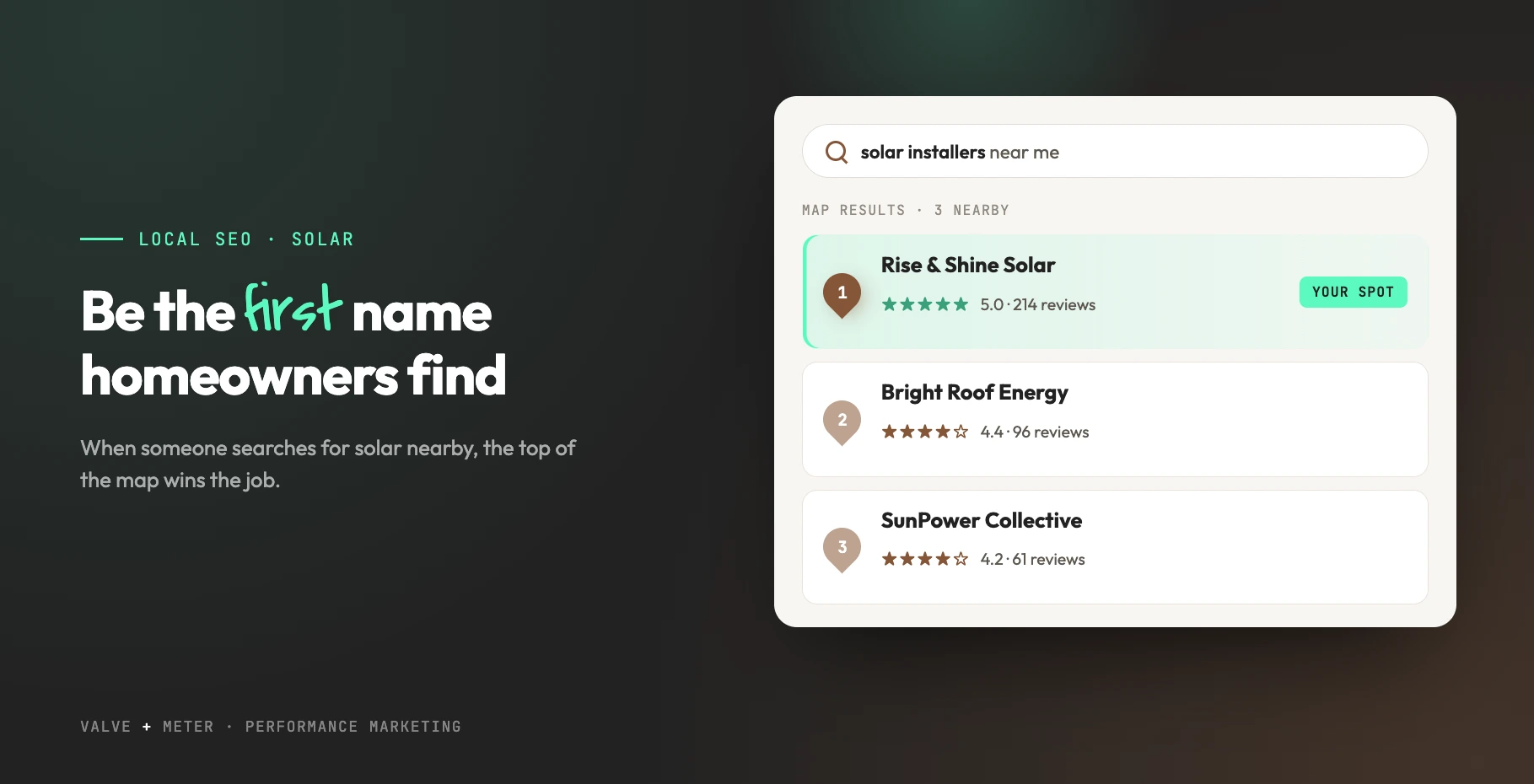
When someone searches “solar panels near me” or “solar energy services in [City],” both paid and organic results display local options. Instead of competing nationally, local SEO helps contractors outrank local competitors in organic results, Google Maps, and directories.
This is efficient. Prospects searching for local solar services are typically ready to engage.
“Solar Panels Near Me” 3.6K
The term “solar panels near me” is searched 3.6K times each month across the US.
Local Intent 46%
More than 46% of all Google searches have geographic intent.
What Makes Up A Successful Local SEO Strategy?
What Are 6 Local SEO Components Every Local Solar Company Should Know
If you operate a solar installation company or provide solar consultation, and you serve a defined service area, there are six essential local SEO components to understand.
Whether you build local SEO in-house or partner with a digital marketing agency, success requires clear goals and measurable tracking. Research from SearchEngineJournal found 50% of small businesses lack a marketing plan. Without a plan, marketing spending becomes scattered and inefficient.
Valve+Meter uses these components to assess your current position, define where you want to go, and recommend the most effective methods for your local business to succeed.
To use local SEO effectively, solar companies should focus on these six elements:
Optimizing Your Google Business Profile
You may know Google Business Profile by its former name, Google My Business.
Google Business Profiles are feature-rich and more capable than most local directories. When users search for solar services nearby, results appearing in Google Maps or the local map pack display business name, address, phone number, hours, and customer reviews.

Optimizing your Google Business Profile is like building your company’s digital storefront. A complete, accurate profile is crucial for local search visibility. Keep contact information current, provide detailed service descriptions, and use high-quality images showcasing your best installations.
You don’t need an agency to optimize your GBP. When prospects search for solar energy experts, dynamic images and detailed business information capture attention and generate phone calls.

A complete profile allows you to add products, services, answer customer questions, and post updates. In many ways, GBP is Google’s social media platform for local businesses. It’s often the first impression your audience has of your company online. Updating your profile regularly and earning customer reviews builds visibility and credibility with Google and potential customers.
Improving Your Solar Company’s Website for Local SEO
While most companies can optimize a GBP effectively, ranking in organic search results requires a supercharged website.
Any business can quickly create a bad website, and many do. This creates a challenge for search engines and frustration for customers.
Solar panels aren’t commodities. Homeowners and businesses must research technology, learn about incentives, and understand system sizing and configuration. Successful solar companies build performance-focused websites that operate as lead generation tools and serve as the anchor of your online identity.
Your solar website is more than a digital brochure. At Valve+Meter, we assess your website before discussing local SEO or marketing. Poor website design and performance is a non-starter for marketing success.
If you’re evaluating your current website or planning a redesign, these requirements are non-negotiable:
- Mobile-friendly: Approximately 60% of all searches are mobile. Ignoring 6 out of every 10 solar leads is a mistake. Your website must function flawlessly on mobile devices.
- Site speed: A fast-loading site leaves a good impression, just like efficient installation work does. Slow sites frustrate visitors, increase bounce rates, and harm search engine rankings. SEO developers optimize images, use caching, and minimize redirects to improve speed.
- Website Content: On-page optimization includes title tags, meta descriptions, headers, text, images, and video. Everything that creates user experience matters. Ask yourself: Does each page provide a clear answer about what you offer and include a clear call to action?
- Technical SEO: Ensure your website is easily crawlable by search engines, includes a well-structured sitemap, and is free from technical issues hindering performance. Regular SEO audits identify and fix issues limiting your visibility.
By focusing on these four aspects, you’ll understand whether your website is built to perform and compete with other local solar installers.
The goal of local SEO isn’t simply ranking high in Google; it’s generating solar leads for your business. If users don’t engage with your website, rankings will suffer and you won’t capture sales opportunities.
Lack Of Strategy 50%
50% of small businesses lack a marketing plan.
Mobile Search 60%
60% of all searches are mobile.
Keyword Research and Optimization
Your website is built for performance and now you need to signal to Google that you’re a solar energy expert.
Keyword research identifies the specific terms and queries local customers use when searching for solar businesses. Effective research considers search intent and volume:
- Broad terms: “Solar panels” returns vague results, often shopping pages ahead of local contractors.
- Medium-tail keywords: “Solar panel contractors” are moderately specific, medium search volume, less competitive, and more relevant.
- Long-tail keywords: Highly specific terms have lower volume per term but also lower competition.
For local companies, keyword research also examines search intent. Are users looking for information or ready to buy? Use informational keywords for blogs and videos. For your primary service pages, target commercial intent keywords.
Finding the right keywords is like finding the perfect spot for a solar installation—it maximizes exposure. For solar companies, target keywords that local customers use: “solar panel installation in [City]” or “residential solar installers near me.”
Creating Quality Local Content
Once you identify the right keywords, deploy a campaign thinking beyond search results.
High-quality, local content is the fuel powering your local SEO. Informative, engaging content addressing your target audience’s needs helps establish your company as a trusted authority, attracting more visitors and generating leads.
Determine where organic traffic should land. Deploy high-volume, medium-tail keywords on primary service pages. Use long-tail keywords on location-specific pages. Internal links connect these pages to primary services, helping algorithms understand your business, your services, and the areas you serve.

In an era of AI and generic content creation, local SEO demands quality. Informative, relevant, and engaging content provides genuine value. Each page should answer specific customer questions about your keywords and show how your company solves their needs.
Building Local Citations and Links
Once your website performs and quality local content is live, it’s time to build reputation.
Local citations and backlinks are like the wiring connecting solar panels to the grid—they strengthen your online presence. Getting your business listed on reputable local directories and earning backlinks from authoritative websites improves search rankings and attracts local customers.
Ensure your citations and inbound links come from reputable sources. A link from a high-authority website endorses your content. Google and customers both notice this credibility signal, similar to how prospects notice reviews on your GBP.
Measuring the Success of Your Local SEO Efforts
To ensure your local SEO strategy performs, track results using Google Analytics and Google Search Console. These tools reveal how your pages rank, how much traffic your site receives, and how many visitors convert to leads or customers.
Additional tools help track solar SEO performance:
- Semrush: suite for keyword research, backlink analysis, competitor research, technical audits, and content planning.
- Ahrefs: Renowned for backlink data and analysis, also offers keyword research, rank tracking, content exploration, and site audits.
- Moz Pro: Focuses on technical SEO, on-page optimization, backlink analysis, and competitive research. Includes learning resources.
- Screaming Frog SEO Spider: Powerful desktop tool for crawling websites, identifying technical issues, and generating reports.
By tracking SEO metrics, solar companies gauge the effectiveness of local SEO efforts and make data-driven decisions to optimize strategy further. Monitor rankings, traffic, and conversions regularly to understand what’s working and what needs improvement, enabling you to refine your approach and maximize online visibility.
Summary
Local SEO is a vital tool for solar companies looking to increase their presence in the online marketplace.
By optimizing your website and online listings for local search, you’ll attract more potential customers in your service area actively seeking solar solutions. Investing in a well-crafted local SEO strategy leads to increased visibility, more leads, and ultimately, more successful solar installations.
At Valve+Meter, our SEO specialists help research, develop, and manage local SEO strategies tailored to your solar business. Don’t let competition overshadow your business—embrace local SEO and connect with our team for a free analysis.
Connect With Our Team For More SEO Insights
Request A Free Marketing Assessment
Frequently Asked Questions
What are local listings in SEO?
Local listings in SEO refer to online profiles of your business on platforms like Google Business Profile, Yelp, and other local directories. These listings provide essential information including your business name, address, phone number, and services offered, helping potential customers find you in local search results.
How does Google determine local ranking?
Google uses hundreds of ranking factors to deliver local results. Generally, three key factors dominate: relevance (how well your business matches the searcher’s query), distance (proximity of your business to the searcher), and prominence (your business’s reputation and authority based on reviews, backlinks, and other online signals).
How much does local SEO cost?
The cost of local SEO varies by scope, market competitiveness, and provider experience. Small businesses typically spend from a few hundred to several thousand dollars monthly on SEO services.
Valve+Meter provides thorough assessments and clear recommendations on whether to build in-house SEO or hire an agency.
Consider SEO an investment in long-term growth. Unlike paid advertising, high-quality content published on your website generates organic results lasting years and creating unlimited solar leads for your business.