




What separates a plumbing company that ranks atop Google search results from those that flounder?
The answer: Search engine optimization.
From the initial design of your plumbing company website to ongoing digital marketing strategies, effective search engine optimization (SEO) starts with the right keywords.
In this article, Valve+Meter’s SEO specialists explain the importance of plumber keywords and how our content creators strategically craft your campaigns for success.
Key takeaways
- Understanding the role of keyword research in SEO for plumbers.
- The importance of relevance, search volume, and search intent in selecting the right keywords.
- How to balance broad and long-tail keywords for optimal results.
- The significance of local SEO and targeting local keywords for plumbing businesses.
- The need for continuous monitoring and adjusting of your keyword strategy.
Why do plumbers need SEO?
Search engines have revolutionized how people find plumbers and other local businesses. When you launch a plumbing website, Google and other search engines crawl your content to understand how your site fits within the vast landscape of the internet.
Search engine optimization (SEO) enhances your website’s content, structure, and overall online presence. This signals to search engines that you’re a relevant, credible, and trustworthy source when someone searches for “plumber near me.”
This is where keyword research comes into play. By understanding the terms and phrases potential customers use when searching for plumbing services, you can tailor your website’s content to directly match their needs.
This strategic alignment makes your website more likely to appear in search results, driving relevant traffic to your site and ultimately boosting your business.
Number of websites: 1.09 BN
There are more than 1.09 billion active websites known to search engines.
Local intent: 46%
46% of all online searches have local intent, and 80% of those local searches convert into customer action.
Why is keyword research important for my plumbing business?
Search engine algorithms use hundreds of ranking factors to sort through billions of websites scattered across the internet.
Your plumbing business does not need to compete with every website in the world, but you do need to rank higher than local competitors for the specific words and phrases your local customers use when searching for plumbing services.
Designing or optimizing a website is not as simple as making a keyword list and stuffing pages with new content.
SEO specialists execute competitive analysis of search engine results and design plumbing SEO strategies around various factors.
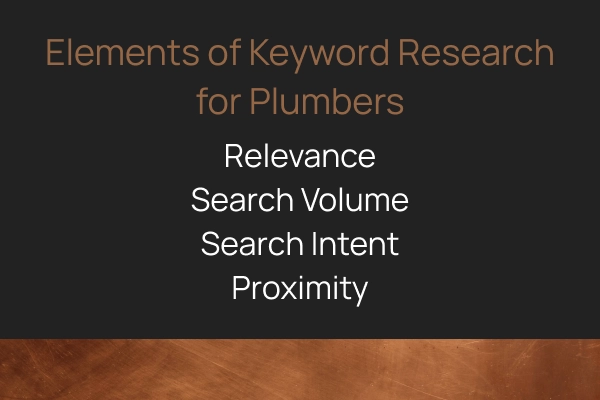
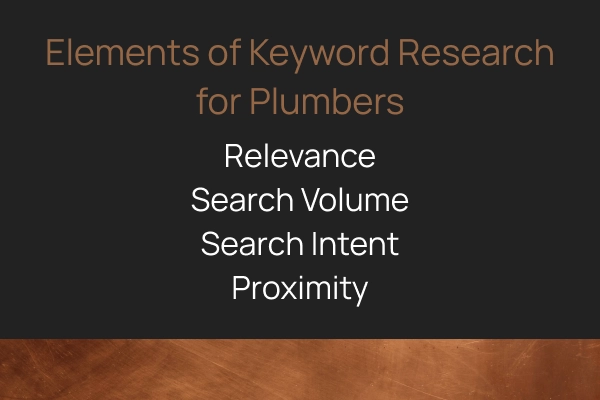
Relevance
Keyword research is pivotal in shaping your website design and broader digital marketing strategy. By strategically using the right keywords across your website, online directories, social media, and other content, you clearly signal to search engines that your plumbing business is relevant to potential customers’ needs.
Search volume
The key is to balance search volume with competition. High-volume keywords indicate strong interest, but they can also be difficult to rank for. Conversely, low-volume keywords might be easier to rank for but will attract less traffic overall.
The goal is to find plumbing keywords with enough volume to drive results, without being so competitive that ranking becomes near impossible.
Search intent
Another critical aspect of plumber keyword research is understanding search intent—the reason behind a user’s search query. SEO specialists identify the best plumbing keyword to use on each web page.
The different categories of intent include:
- Informational: A user is seeking general or introductory knowledge about a plumbing topic (e.g., water heaters).
- Navigational: Someone is searching for a specific section of your website or a particular piece of information you provide (e.g., water heater cost).
- Commercial: Someone researching specific plumbing services or products with the intent to compare options (e.g., water heater repair).
- Transactional: Someone ready to make a decision and looking for information to complete a purchase or booking (e.g., water heater repair near me).
Plumbing SEO should use all relevant keywords, but certain webpages like your primary services will feature commercial keywords, while informational keywords may be featured on blogs that link to primary services.
Proximity
Nearly half of all online searches have local intent.
This means your digital marketing strategy shouldn’t focus on global search engine dominance. For many plumbing keywords, search results focus on businesses located close to the person searching.
Demonstrating your relevance, prominence, and proximity to search engines is key to winning more local customers ready to book services.
Can I do plumbing keyword research myself?
SEO keywords for plumbers: industry-leading companies use professional marketers. You can build an in-house team or hire a trusted partner, but to compete effectively, you need expertise.
The decision to DIY your marketing and SEO comes down to expertise, tools, and time. Navigating plumber SEO is complex and constantly changing. Using the wrong keywords can actually harm your search visibility.
Many plumbing businesses successfully handle basic SEO tasks, like setting up a Google Business Profile, making simple website edits, and basic keyword research. However, to truly thrive in a competitive landscape, partnering with SEO professionals offers significant advantages.
Just like fixing a botched DIY plumbing project, if your team lacks experience and the right tools, you risk doing more harm than good.
Targeting the wrong keywords in a blog, for example, can increase traffic but lower conversions if it outranks a key service page.
Valve+Meter brings specialized expertise and advanced keyword research tools to the table. Our SEO experts conduct deep analytics dives, develop sophisticated keyword strategies, and set up advanced optimization techniques. Working with a professional team of SEO strategists, writers, and web designers dramatically accelerates your keyword research and, ultimately, your ability to reach your target audience faster and more effectively.
Interested in professional SEO services?
Connect with Valve+Meter to learn more about our team and keyword tools for plumbers. Start with a free one-to-one consultation.
Crafting a winning keyword strategy
Developing any marketing strategy begins with examining your target audience and your current situation.
A winning keyword research strategy for plumbers goes beyond simply identifying popular terms. Professionals in the field take a multi-faceted approach to ensure that the keywords chosen align with the business’s goals and the audience’s needs.
Remember, plumber keywords are the bricks in your content. To build an exceptional plumber website, you need mortar: proper structure and strategy.
Competitive analysis
Long before selecting keywords, experts analyze what terms competitors are ranking for and identify gaps in the market. This helps in finding opportunities where your plumbing business can stand out.
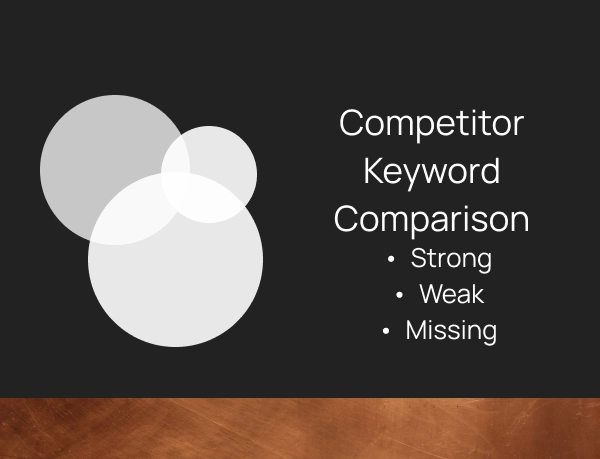
A thorough marketplace audit includes comparing your website with local competitor domains. Keyword research tools help organize plumber keywords into three rankings:
- Strong: Keywords where your website ranks favorably compared to competitors.
- Weak: Keywords where competitors outrank your website.
- Missing: Keywords relevant to your services where competitors rank well, but your website doesn’t appear in search results.
This direct overlap and organization helps you focus on the new keywords your website needs and the best opportunities to strengthen your existing web pages.
Hierarchical structure
A common mistake when using keyword tools is focusing solely on search volume. Overlooking intent and proximity when designing a website or optimizing your current site misses opportunities.
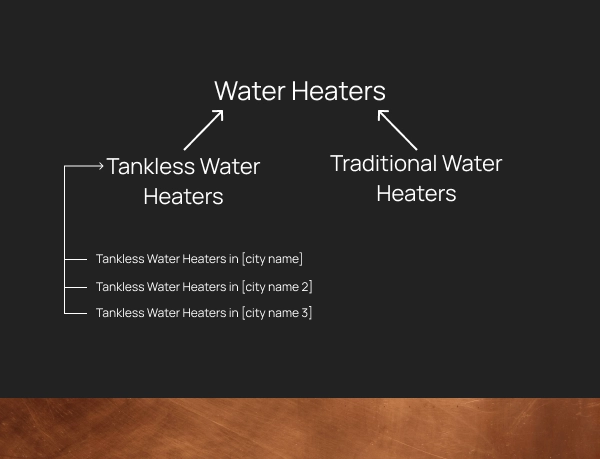
If your website is missing crucial keywords or performs poorly compared to local competitors, you need to both pinpoint priority keywords and determine your website’s hierarchy.
Keyword hierarchy balances broad terms with long-tail keywords, targeting both general visibility and users with specific needs. Here’s the breakdown:
- Broad keywords: Short-tail keywords like “plumber” are highly competitive and usually reflect informational search intent.
- Long-tail keywords: Commercial and transactional terms like “tankless water heater installation in [city name]” are more specific and often easier to rank for. Long-tail keywords make up over 90% of all searches.
Understanding semantic search, professionals also include related terms and synonyms to match how people naturally search.
When designing content, target broad keywords on main pages. Use internal linking from blogs and service area pages to show your website’s structure to visitors and search engines.
Local keywords
Local SEO is invaluable when identifying the right keywords to attract and engage with your actual customers.
Creating dedicated web pages for cities and neighborhoods in your service area helps potential customers find your business when searching for things like “plumbers near me” and “plumbers near [city name].”
Given the importance of local searches for plumbing businesses, experts incorporate geographic terms and local landmarks into their keyword strategy. Narrowing your website’s focus to your local plumber keywords helps your business appear in searches by people looking for plumbing services in your area.
Monitoring and adjusting
Focusing solely on high-volume broad plumbing keywords is a common mistake, but lack of data analysis is another pitfall for inexperienced marketers.
Keyword research tools specifically for plumbers allow professionals to continuously monitor the performance of your chosen keywords. As Google, Bing, and user behavior evolve, so must your keyword strategy. Regularly analyzing data and making adjustments based on what’s working (and what’s not) is essential.
This agile approach ensures your plumbing business stays competitive search engine optimization.
How to use plumbing keywords in content marketing
Crafting a keyword research strategy is just the first step toward smarter, more effective content across your website, social media, Google Business Profile, and broader digital marketing.
Professionals take these additional steps to ensure the keyword strategy drives relevant traffic that’s likely to convert into paying customers for your plumbing business.
Organizing keywords helps align writers and other creatives with your SEO goals. This leads to more effective website design, stronger ad copy, and ultimately, a clear path to attracting more customers and growing your revenue from booked jobs.
Frequently asked questions
How often should I update my keyword list?
Plumbing SEO is constantly evolving. Keyword research tools help professionals both plan content and monitor performance.
It’s advisable to review and update your keyword list regularly, setting clear tasks to review weekly and adjust strategy at least one per quarter.
This ensures that your SEO strategy stays aligned with current search trends, customer behavior, algorithm updates, and any changes in your services or target market.
What’s the difference between short-tail and long-tail keywords?
Short-tail keywords are broad, general terms with high search volume, like “plumber.” These terms may be searching for plumbing services or simply researching the occupation. Short-tail keywords lack specificity and defined intent.
Long-tail keywords are more specific phrases with lower search volume but higher intent, such as “emergency plumber in [city name].”
Understanding how to blend both types of keywords into your website content is key to reaching potential customers and helping search engines understand your business.
How can I measure the success of my SEO efforts?
Success can be measured using specialized keyword research tools like SemRush, Ahrefs, Moz, and many others.
Free tools like Google Analytics and Google Search Console track metrics such as organic traffic, search engine rankings, and conversion rates.
Regularly monitoring these metrics will help you assess the effectiveness of your SEO strategy and make necessary adjustments.
Can I do SEO for my plumbing website myself, or should I hire a professional?
While basic SEO tasks can be handled by yourself, partnering with SEO professionals is recommended for more advanced strategies and competitive markets.
Professionals have the expertise and tools to conduct in-depth keyword research, optimize your website effectively, and keep up with the latest SEO trends.
The leading plumbing websites in competitive markets use professional marketers either as internal marketing departments or trusted outside partners to execute strategies that generate booked jobs.
Learn more with Valve+Meter
Request a free marketing assessment or read other insightful plumbing marketing content in the blogs below.