



Can you improve the sales response process for your plumbing company?
Absolutely.
Research shows that **35-50% of sales go to the vendors that respond first. The dispatchers or customer service reps** that pick up the phone fastest, stay modest, ask thoughtful questions, and offer helpful guidance all aid in closing jobs. But there’s more to the equation.
For plumbing businesses, speed separates leaders from the pack. A well-oiled dispatch system that consistently books jobs quickly improves your bottom line. Your CSRs and dispatchers are your front line. They directly impact how many of the leads you pay for actually turn into booked jobs.
Your marketing team generates leads. Your sales and dispatch process converts those leads into revenue. If you’ve got the proper response system in place, your team will be positioned to succeed. Neglect it, and you’ll watch leads slip away to competitors.
What are some concrete steps you can take to improve this?
The Catalyst to Improve Your Sales Response Process
Honestly, it comes down to one critical factor.
Speed.
Speed wins in sales, every single time.
When your team responds quickly to inbound leads, you dramatically improve your odds of booking the job. The odds of connecting with a new lead increase 21x when calling them back within the first five minutes instead of waiting 30 minutes. That’s not incremental improvement. That’s transformational.
If your team drags its feet and doesn’t respond to inbound leads for hours or days, you’ve lost what may have been a paying job.
We recently investigated the sales response process for the plumbing industry, secret shopping 466 companies nationwide. Some companies we tested were heating and cooling contractors, plumbers, landscapers, garage door repair, electricians, painters, window repair, and other home service professionals.
We wanted to see how fast these companies called us back after we submitted their website forms.
The results were brutal. (<a href=”https://marketing.valveandmeter.com/speed-to-lead-home-services/?utmcampaign=V%20M%20Speed%20to%20Lead&utmsource=Website&utm_medium=blog%20post”>See the data yourself)
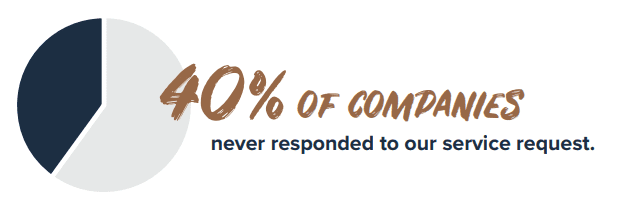
2 out of 5 companies never called us back at all.
That’s 40 percent of potential jobs abandoned.
Imagine telling your owner you neglected 40% of booked jobs because your team didn’t answer the phone. That’s unacceptable in this business.
Countless articles online promise quick tips for speeding up your dispatch process. But generic solutions don’t work for every business.
What we’re about to share can be set up immediately by any plumbing company and improve response speed in as little as a day. Real results. Real improvement.
Here are the three critical keys to improving your sales response process:
#1 – Track The Entire Flow of Your Sales Response Process
Let’s see if you can answer these questions about your own operation.
Who gets notified when a new inbound lead arrives from your website?
Does the lead go into a company-wide email inbox where it sits with everything else?
Does your office administrator receive it first, then have to forward to your dispatch team?
Can your CSRs immediately schedule appointments, or do they sit waiting for a response you don’t even know is there?
These gaps kill your conversion rate. Trace your lead flow from web form to phone call.
What Drags Down Your Sales Response Process?
An Outdated CRM?
Older CRM systems limit flexibility and customization. As you collect more demographic data about leads and build more personalized campaigns, outdated systems create bottlenecks and reduce speed.
Bad Phone Tracking and Recording Systems?
Phone tracking systems help your team understand which campaigns generate calls. Call recordings provide training opportunities and help you coach your CSRs to book more jobs. This visibility is essential.
Poor Marketing Automation Systems?
When inbound leads submit forms, send them an immediate autoresponder thanking them for their inquiry. Your automation system should also notify your dispatch team instantly that a new lead needs attention and focus on it immediately.
#2 – Set Up a Cross-Channel Approach to Your Sales Response Process
There’s a balance between asking too much information on a contact form and asking too little. Companies need more information from leads at submission, but asking for too much kills conversion rates.
More information means more ways to reach and follow up with leads. But keep it balanced.
The average home services web form asks for 6 fields. You could request home address, home type, service requested, and other helpful details. Knowing a homeowner’s address lets you send direct mail campaigns for additional services and special offers.
Use email addresses for lead nurturing campaigns and social media retargeting. Branch out beyond the phone. Don’t limit yourself to one contact method.
Branch out and diversify your follow-up channels.
#3 – Train Everyone on Your Team Your Sales Response Process
Every single person in your company is a salesperson, whether they realize it or not.
Your dispatchers, office managers, even your plumbers interact with customers. They’re all part of your sales process. If your team doesn’t understand how critical immediate response is, they won’t drop everything to call a lead back.
Even worse if someone outside of sales manages the process without understanding its importance.
Ensure everyone in your office knows that your response speed determines your success. If you’ve set up automated lead routing, your CSRs will get instant notifications. They’ll know responding immediately is their responsibility.
Make this real for your team. Share response time benchmarks. Show them how long it takes competitors to call back. Celebrate when your team beats those numbers. Make speed a core value that everyone understands and owns.
Make Improving Your Sales Response Process a Priority
People don’t like waiting. Stop making them.
Today’s customers expect instant responses. Plumbing emergencies especially can’t wait. Homeowners with burst pipes want a contractor they can reach right now.
By running a fast response process and investing in modern technology and tools that help your dispatch team win, you’ll convert more leads into booked jobs. You’ll increase your cost per lead and your overall revenue.
This isn’t complicated. It’s about fundamentals: tracking your process, providing multiple contact channels, and ensuring your entire team understands that speed wins jobs.
A faster response process means more trucks rolling, more jobs booked, and a healthier bottom line.