


As the world shifts toward renewable energy, solar energy businesses must navigate a changing policy landscape. Understanding how to research, plan, and launch data-driven marketing separates great solar panel companies from competitors.
What Are The Best Digital Marketing Strategies For Solar Energy?
Why do certain solar businesses rank higher in search engines, shine on social media, and stand out in the marketplace?
At Valve+Meter Performance Marketing, our solar marketing agency uses data and effective digital marketing techniques to transform how solar businesses go to market.
Innovation within solar energy has been made possible through research and planning. From niche energy source to mainstream industry, demand for solar panels continues to grow globally and across the United States.
Digital marketing uses market research into your target audience, competitors, and existing solar marketing to build innovative strategies. Unlike traditional advertising, performance marketing plans, measures, and improves the return on investment of every marketing dollar.
Your target audience is more sophisticated than ever, and the media landscape is more diverse. To win, you need a custom solar marketing plan that reaches prospects effectively and eliminates spending on ads that don’t generate leads.
Let’s explore insights about how data-driven solar energy marketing aids business growth.
In This Article
Performance marketing campaigns for solar installers, manufacturers, and suppliers raise your online presence through an array of techniques across multiple platforms and all phases of the buying process.
A successful marketing plan should have three characteristics:
- Customization: Your solar marketing must be designed for your unique value proposition, target audience, and competitive position.
- Measurable: When marketing efforts can be measured, you can predict outcomes, repeat successful tactics, and adapt as your business evolves.
- Versatile: Solar power is evolving across residential and commercial use to utility-scale solar. Proven marketing strategies can rapidly adapt to reach prospects at all phases of your sales process.
The solar industry is evolving and your solar marketing strategy must meet potential customers where they are. By building data-driven marketing strategies, you’ll make informed decisions as technology, customers, and your business grows.
What Are The Key Elements Of Solar Marketing Strategies?
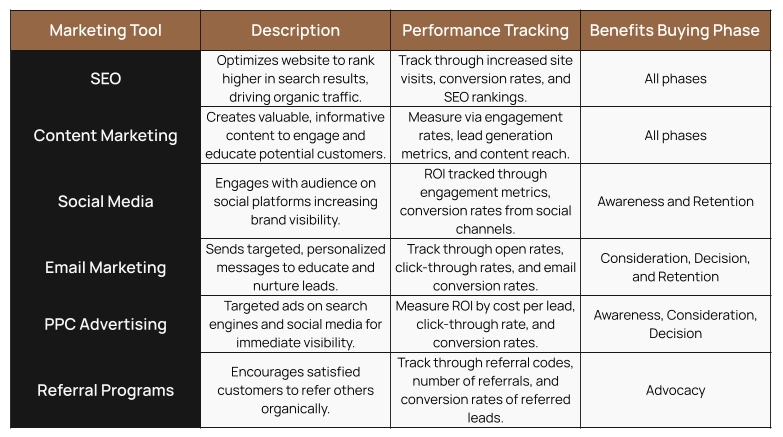
There are key building blocks for data-driven solar marketing. Before we explore how to incorporate each element, let’s define each, the buying phase it addresses, and how to track performance.
What Are The Five Stages Of The Solar Buying Process?
Solar can be a complex, prolonged buying process. Traditional marketing may only increase brand awareness among prospects already considering solar.
Solar marketing acknowledges that prospective buyers may consider a purchase for months or years.
- Awareness: This initial stage introduces prospects to solar energy solutions and your unique value proposition.
- Consideration: Customers research and compare solar options. They assess feasibility and benefits of installations, looking for content explaining advantages and installation processes.
- Decision: At the decision point, customers are ready to purchase. Marketing strategies help this step through clear calls to action, promotions, or financing options.
- Retention: Keeping customers satisfied and engaged opens opportunities for referrals, maintenance, repairs, and system expansion.
- Advocacy: Happy customers are your most powerful lead source. The best marketing strategies build customer relationships and turn them into brand advocates.
Effective Solar Digital Marketing Tools
Individual solar marketing ideas and singular campaigns capture quick wins, but dominating your target market requires thinking beyond short-term tactics.
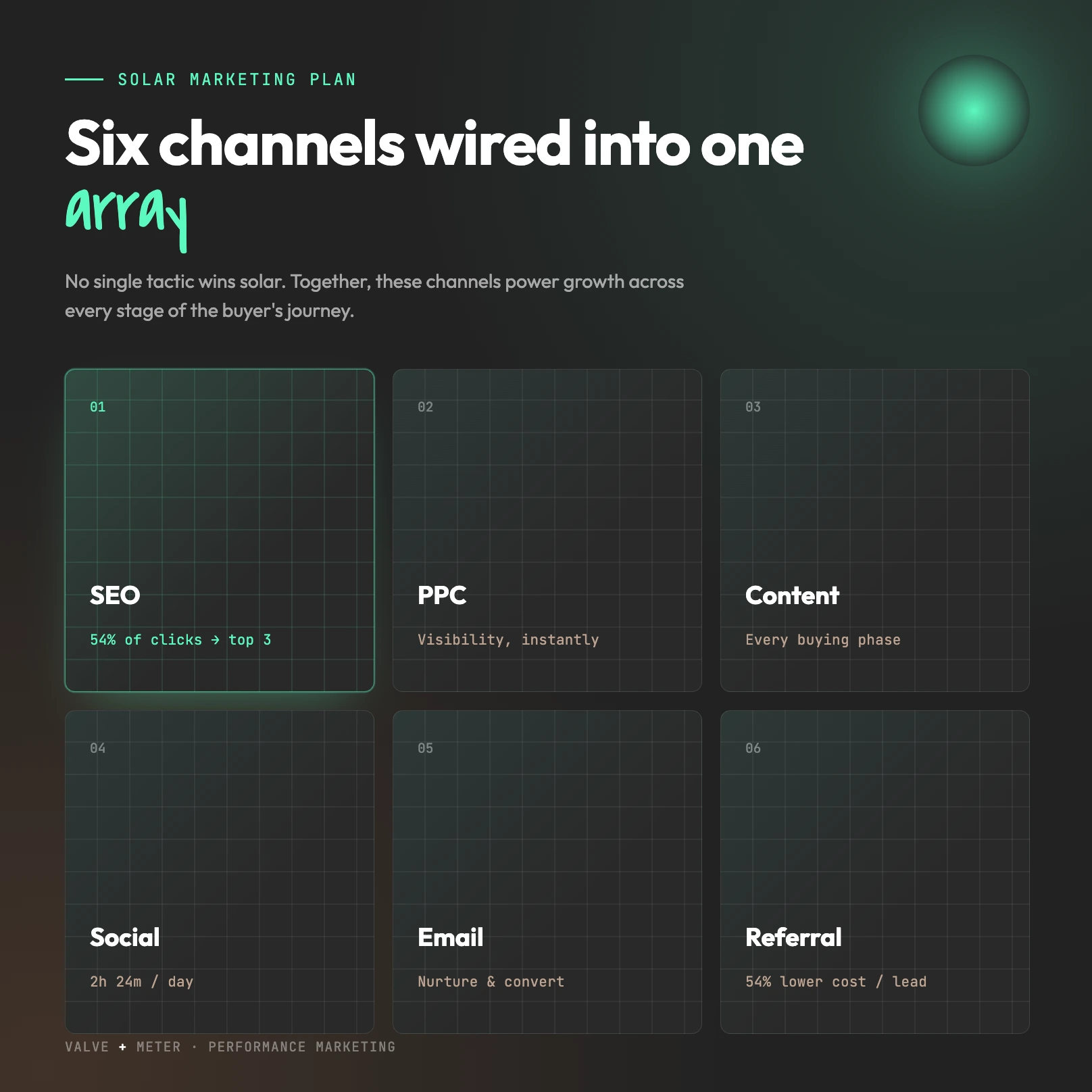
Like an array of solar panels, Valve+Meter understands the power of utilizing a wide range of marketing channels to power your solar marketing strategy.
A great solar marketing campaign focuses on winning search engine results and raising your solar brand’s online profile.
SEO: How Do Solar Businesses Rank In Google Searches?
When your solar business ranks at the top of search results, you gain brand awareness and greater traffic share around key terms.
Search engine optimization enhances your website’s structure and content to improve visibility in organic search results. As many as 94% of users skip past sponsored ads and click organic results.
SEO aims to increase website traffic by ensuring your site ranks highly for relevant queries. This is the most important factor in growing your digital marketing and earning solar leads.
Performance Tracking:
Track SEO performance using organic site visitors, conversion rates, and organic keyword performance in tools like Ahrefs, Semrush, Moz, and others.
Benefits Buying Phrase:
Search engine optimization is exceptional for solar marketing because it reaches prospects at all phases.
Consumers use search engines for research. SEO generates leads from awareness through consideration directly from search engine results pages.
In decision-making and retention phases, high-quality SEO content enriches user experience with clear calls to action, internal linking, and credible inbound links.
Daily Searches 3-4
The average internet user searches Google 3-4 times each day.
Organic Results 54%
The top-three Google search results get 54.4% of all clicks.
PPC Advertising: Gain Visibility Quickly
How do you showcase solar products and earn leads right now?
Target sponsored ads on Google, Bing, and social media.
Pay-per-click advertising is a model where advertisers pay a fee each time their ad is clicked. While SEO focuses on organic results, PPC reaches your target audience quickly through search engines and social platforms.
When your strategy targets all positions of search engine results pages (SERPs), you gain visibility and relevancy.
Performance Tracking:
PPC performance is tracked by analyzing cost per click (CPC), click-through rate (CTR), conversion rate, and overall ROI using Google Ads and Facebook Business Manager.
Benefits Buying Phrase:
PPC advertising provides solar companies with fast-track visibility in search results and social media, generating awareness and nurturing leads through consideration and decision phases. Display ads and retargeting are particularly effective.
Paid advertising and organic campaigns work best together. Measure and analyze results to identify the most profitable marketing strategies.
Lead Generation 7%
Continuous content marketing increases lead generation 7% YoY.
Linkbuilding 97%
Businesses with blogs obtain 97% more backlinks than those without.
Content Marketing: Connecting With All Phases Of Buying Process
The most successful solar businesses engage prospects continuously throughout the buying process.
SEO focuses on search engine algorithms, but what happens when someone visits your website?
Content marketing zeros in on user experience and converting visitors into prospects.
High-quality content educates consumers about new technologies, incentive programs, and your company’s value proposition.
Performance Tracking:
Track performance through engagement rates such as time on site and social shares, lead generation metrics like download counts for gated content, and content reach via Google Analytics.
Benefits Buying Phrase:
Content marketing surpasses SEO in importance because it’s fundamental to all buying phases. User-centric content, when optimized effectively, fuels success across SEO, social media, email, and paid campaigns.
Social Media Marketing: Customer Engagement Beyond Your Website
Growing your website takes time, so a versatile solar marketing plan should incorporate social media.
People spend hours daily on social media platforms. Social media marketing uses platforms like Facebook, Instagram, LinkedIn, and YouTube to engage your target audience.
Social media is a brand-building tool. Through paid ads and creating quality content, you encourage customers to learn more about solar panels and drive website traffic.
Performance Tracking:
Track engagement metrics such as likes, shares, comments, and messaging, and conversion rates from social channels using platform-specific analytics and UTM tracking for website visits.
Benefits Buying Phrase:
Social media provides a powerful platform for your solar company to connect with potential and existing customers.
It’s ideal for generating awareness through paid ads and organic growth. PPC ads offer immediate visibility to ideal prospects, while consistent organic social media activity builds long-term brand recognition and loyalty.
Email Marketing: Increasing Efficiency In Lead Nurture
Like door knocking or direct mail, email marketing delivers your message directly to your target audience.
It allows you to personalize communications with subscribers and automate tasks slowing down sales teams. For solar companies, educational content via email nurtures leads, drives faster conversions, and keeps existing customers engaged.
Performance Tracking:
Email campaign success is measured by open rates, click-through rates, and conversion rates from emails to sales or inquiries, using platforms like Mailchimp or HubSpot.
Benefits Buying Phrase:
While email can’t generate leads like cold calling or paid ads, it’s highly effective for solar marketing in maintaining communication with potential leads and existing customers during consideration through decision-making.
Referral Programs: Growth Through Existing Customers
Referral programs incentivize existing customers to refer new clients by offering rewards or discounts. This uses their personal networks to expand your customer base. Referred leads often have a higher close rate and convert faster.
Performance Tracking:
Measure referral program effectiveness by tracking referral codes, monitoring the number of referrals, and analyzing conversion rates of referred leads using CRM software.
Benefits Buying Phrase:
Referral programs use word-of-mouth marketing, substantially boosting trust and credibility. These programs encourage happy customers to act as brand advocates, generating valuable leads.
Summary
These are the building blocks of planning a solar energy marketing campaign. Market research and your company’s current position help determine how and when to invest in these programs.
Now let’s consider how to bring these solar marketing ideas into a complete strategy.
How To Build A Solar Marketing Campaign?
Digital marketing opens a world of opportunity for solar businesses aiming to connect with a specific audience.
These six essential solar marketing tools can be shaped into a custom strategy. The best strategies combine the strengths of each to form a stronger, more effective whole.
Search engine optimization and paid advertising work together. For high-value keywords, PPC can rank almost immediately. High-quality content and organic SEO take time to develop and rank. Once organic performance is strong, you can shift paid advertising to new targets and expand reach.
This dual approach increases site visitors and enhances the chances of converting them into leads and satisfied customers.
Through a well-crafted digital marketing strategy, your solar business establishes a strong online presence, attracts more prospects, and grows your customer base.
So how do you develop your digital marketing strategies?
How Do You Optimize Your Website for Solar Lead Generation?
Converting potential customers into leads requires the right website design and development.
To turn your website into a powerful lead generation tool, focus on design, development, and content.
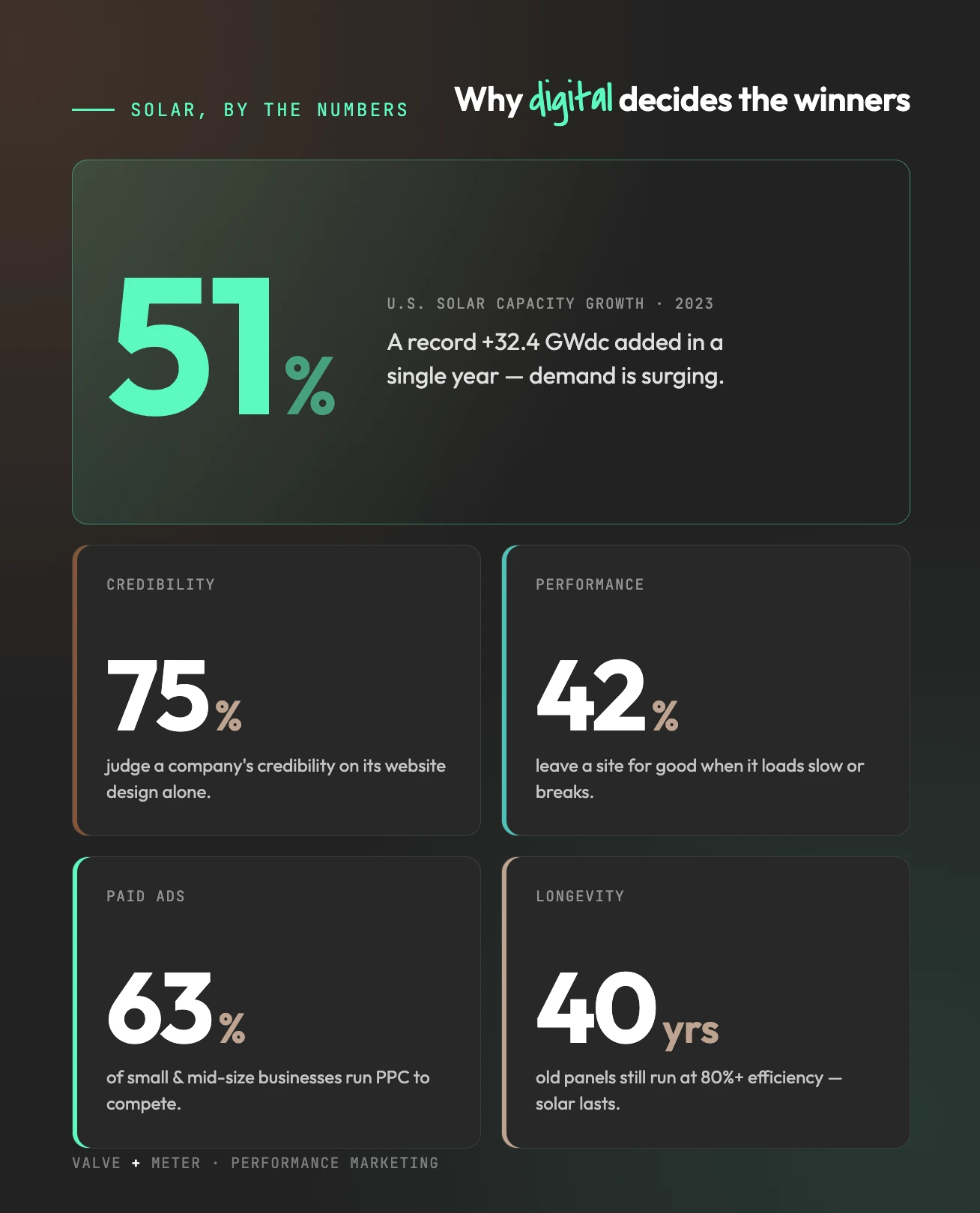
Solar marketing strategies drive all potential leads toward your website. As your online showroom, your website must immediately clarify why visitors should choose you over competitors. By contrast, 42% of people will leave a website due to poor functionality.
Incorporate these elements into your design:
- Dynamic images on every page
- Easy-to-use navigational menus
- Lead capture mechanisms such as contact forms and quote requests
- People-focused content building credibility and authority
- Exceptional site speed
- Responsive design for mobile devices
By running these strategies, you enhance user experience, making it more likely that visitors engage and act, thereby improving conversion rates and driving more business.
Organic Content 19x
The top organic result in search engines earns 19 times more clicks than the top paid result.
Local Search 97%
Consumers discover local businesses through the internet.
Navigating the Solar Industry with SEO and Online Reputation Management
Securing a prominent online presence and safeguarding your company’s reputation is essential in solar marketing. When the top organic search result earns an average of 19 times more clicks than the top paid result, there’s a clear reason to build an organic SEO strategy.
Search engine optimization (SEO) elevates your solar business in organic search results on Google, Bing, and other search engines.
Solar SEO incorporates:
- Long-tail keywords reaching your target audience
- High-quality content converting organic traffic into leads
- Well-structured website architecture
- Link building
- Online reputation management
- Local SEO and Google Business Profile management for installation contractors
Running SEO best practices and managing your online reputation meticulously enhances visibility with algorithms and positions your company as a trustworthy leader in the solar market.
Why Is Content Marketing Crucial for Solar Companies?
Content marketing is a powerhouse for solar companies educating and informing prospects about emerging technology and capabilities. Content includes written text, images, video, and other assets for your website, social platforms, email, and brand materials.
By crafting and disseminating high-quality, informative content, you’re engaging your target audience with unique selling points. In an era of AI, only 47% of businesses research their audience. Valve+Meter creates a brand vocabulary deeply resonating with new and existing customers.
Key content marketing efforts include:
- Blog posts
- Infographics
- Demonstration videos
- Customer testimonials
- Webinars and podcasts
- Ebooks and whitepapers
Paired with SEO best practices, content marketing serves a dual purpose. It educates new leads about solar energy, moving them closer to a decision, while simultaneously boosting your search engine rankings.
Market Research 47%
Only 47% of businesses research their audience.
Social Media 2 hrs 24 mins
Americans spend an average of 2 hours and 24 minutes on social media every day.
How Can Paid Media and Pay-Per-Click Advertising Balance SEO for Solar?
Paid media and PPC advertising serve as effective accelerators for solar companies amplifying visibility alongside ongoing SEO and content marketing. While SEO grows your online presence over time, PPC offers an immediate boost by placing ads directly in search engine results and on social platforms.
This immediacy is particularly beneficial when launching new websites, introducing new products, or initiating SEO campaigns, as it drives targeted traffic right from the start.
PPC and other rapid media include:
- Search ads on Google or Bing
- Display ads on relevant websites
- Social media ads (Facebook, Instagram, LinkedIn)
- Video ads on YouTube
Deploying PPC and SEO creates a balanced marketing strategy and deeper insights. PPC campaigns help refine strategies, making informed decisions to optimize both paid and organic efforts for maximum impact and ROI.
Leveraging Social Media to Connect with Potential Solar Clients
Social media platforms are powerful tools for solar businesses reaching and engaging prospects. Americans spend on average 2 hours and 24 minutes on social media daily.
By deploying targeted ads and crafting interactive content, you effectively communicate with your audience, showcasing industry trends and sharing stories from satisfied customers. This approach helps generate leads and builds a community passionate about renewable energy.
Use social media not just for promotion but as a platform for dialogue and education, creating a space where prospects learn, ask questions, and get excited about solar energy possibilities.
The Power of Referral Programs in Solar Marketing
A referral program may not seem like a cutting-edge internet marketing strategy. However, harnessing personal recommendations is vital, especially in emerging technology.
Referral programs have a lower cost-per-lead compared to other marketing efforts.
By incentivizing happy customers to spread the word, you’re expanding reach and tapping into the trust they’ve built with their peers. In emerging markets, word-of-mouth recommendations are more impactful than any other marketing method throughout the entire buying process.
This strategy can dramatically increase solar sales and referred customers are more likely to remain loyal to your brand. Through personal connections and the trust they carry, referral programs significantly streamline acquiring new solar leads.
Referral Programs 54%
54% of businesses report referral programs have a lower cost-per-lead compared to other channels.
Word-Of-Mouth Marketing 20-50%
Word-of-mouth marketing influences between 20-50% of all buying decisions.
Harnessing the Power of Email Marketing in Solar Industry Outreach
Email marketing emerges as a cornerstone in the solar industry’s marketing toolkit, offering a direct line to potential and existing customers. Email nurtures prospects with personalized information.
Because email is an outbound tool, automation and customer segmentation deliver highly personalized experiences. This is valuable for complex buying processes and engaging younger demographics.
Deliver targeted messages educating, informing, and inspiring action, engaging your target audience more effectively.
This digital strategy excels in nurturing leads through personalized communication, delivering targeted messages educating, informing, and inspiring action toward solar solutions. By segmenting lists based on customer interests, behaviors, and buyer’s journey stage, solar companies tailor messages to resonate more deeply with each recipient.
Effective email campaigns provide updates on latest solar technology, share success stories of installations, and detail environmental and financial benefits of switching to solar.
Beyond selling, these emails build relationships with your audience, positioning your solar company as a trusted advisor in renewable energy.
Incorporating email marketing into your solar company’s overall digital strategy enhances the ability to convert leads into customers and keep your brand top-of-mind among those considering solar. With its cost-effectiveness and high ROI potential, email marketing educates and engages a community interested in sustainable energy solutions.
How To Know What Digital Marketing Strategies Suit Your Solar Business?
Determining the right digital marketing strategies for your solar business can feel like navigating a labyrinth.
Partnering with a professional agency helps you identify the marketing programs to reach your target audience and drive traffic to your sales team.
Valve+Meter focuses on performance marketing which insists on a foundation of predictability and accountability in all marketing endeavors. We believe every marketing take action with a clear understanding of expected outcomes, leveraging data and analytics to accurately forecast results.
This principle ensures investments are made wisely, with strategies tailored to the unique aspects of your solar business. When you can measure the results of your marketing efforts, you can refine and optimize continuously. Versatile, adaptable, and measurable marketing ensures sustainable growth and the ability to scale success.
Interested In Learning More About Solar Marketing?
Through this methodical approach, Valve+Meter helps solar companies illuminate the most effective paths in their digital marketing journey, turning insights into action and investments into measurable returns.